
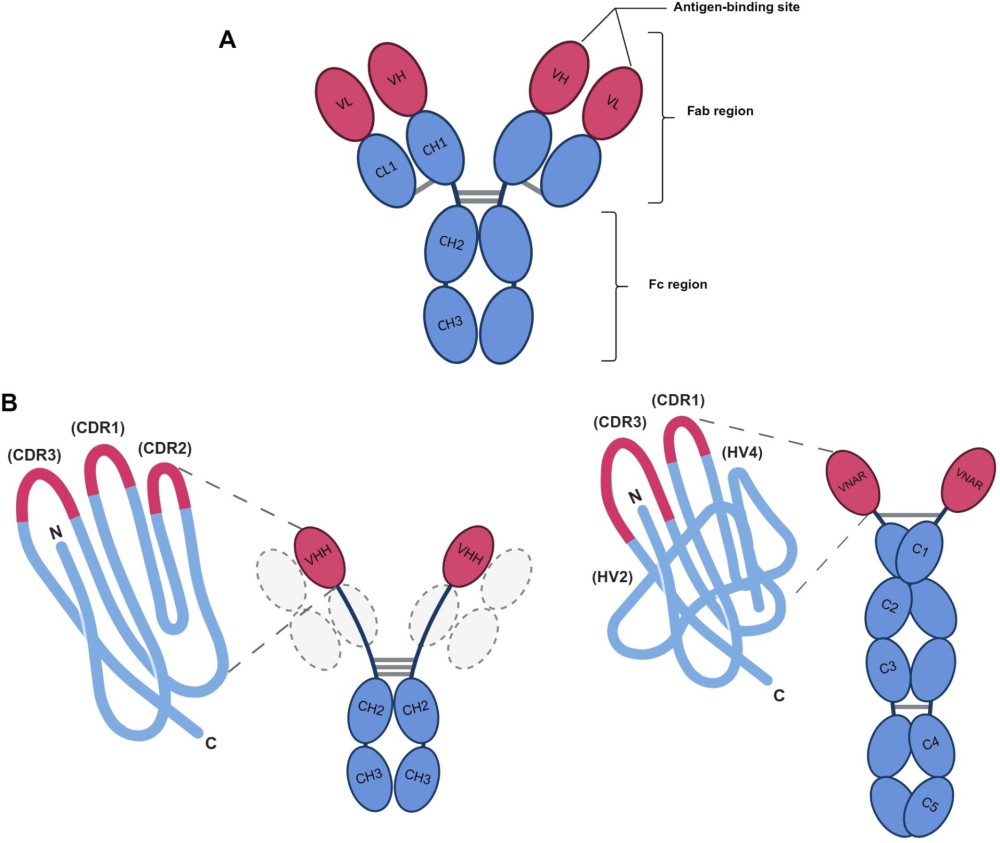


Bispecific antibodies (BsAbs) can bind two different antigens simultaneously, offering opportunities to combine complementary mechanisms against tumors. Selecting target pairs that deliver effective antitumor activity with an acceptable safety profile remains a major challenge for drug developers. Two binding arms, chain pairing, valency, geometry, and a narrow window between efficacy and toxicity all have to line up.
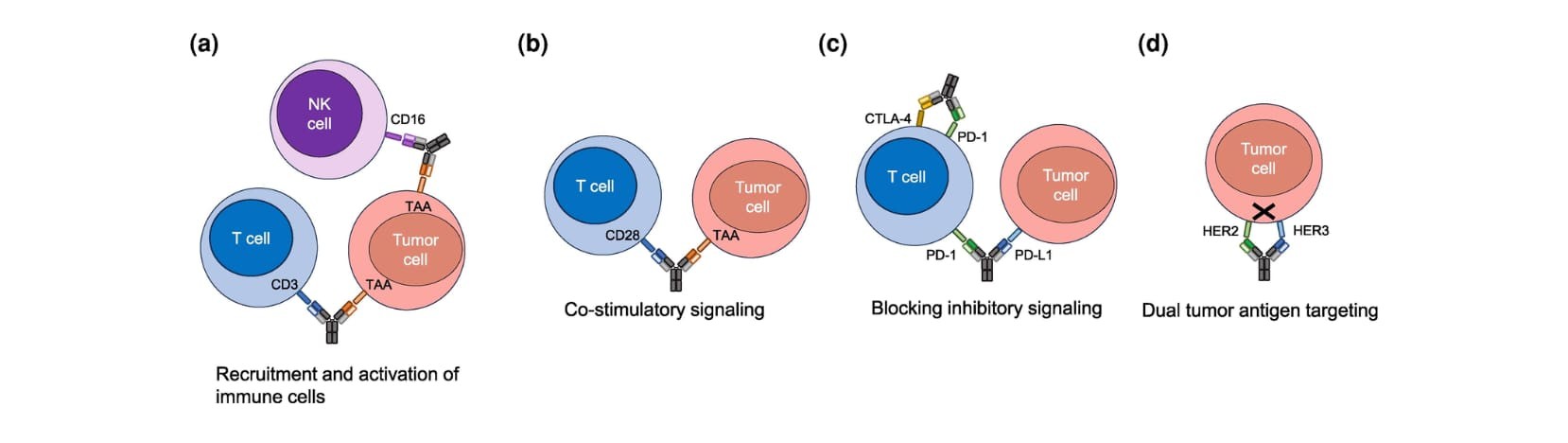
Choosing which two targets to combine is the first and most consequential bispecific decision. BiSpec Pairwise AI, from Sinocelltech and Nankai University, ranks target pairs using single-cell RNA-seq, safety, pathway, and gene-embedding features, reaching an AUC of about 89%. GPT-4 then generates readable reports on each predicted pair. PD-L1 + CTLA4 came out as a high-scoring combination.
Light-chain mispairing is a core manufacturing headache for bispecifics. A recent bioRxiv preprint describes a computational platform that combines structure prediction, molecular dynamics, and machine-learning design to engineer common light chains. The platform produced workable common light chains for 7 of 10 therapeutic targets, and structure-guided optimization succeeded for 67.2% of variants versus 38.8% at baseline. Three of the resulting bispecifics reached titers of about 1.6 to 1.8 g/L.
Why it matters: manufacturability is being designed in from the start, not fixed later.
Excalipoint Therapeutics Inc. and DP Technology are co-developing an AI agentic platform for T-cell engager and multi-specific discovery. A central AI agent coordinates affinity, specificity, and developability models, while human experts weigh in on CRS risk and therapeutic window. Lab results feed back into the models in a closed loop.
Across the industry, AI is being applied to predict cytokine release syndrome risk in T-cell engaging formats, flag expression and aggregation problems earlier, and integrate multi-omics data for dual-target strategies. Regulators' expectations around model explainability are also shaping how platforms are built.
Sanofi (Jan 2026): up to $2.56B, including $160M upfront and near-term payments, for AI-discovered bispecifics across multiple autoimmune programs.
Genentech (Sept 2026): $55M upfront and more than $1.5B in total potential value to discover and develop bispecifics in oncology, built on pre-agreed target combinations.
Earendil’s pitch is predictive protein modeling and generative protein design paired with high-throughput experimental validation. Its own pipeline already includes a CD19 x BCMA T-cell engager for B-cell cancers and an IL-13 x IL-31 bispecific for inflammatory skin disease.
Aug 20, 2026: Bristol Myers Squibb will apply Chai Discovery's molecular folding and de novo design models to antibody discovery across its portfolio as part of an AI-powered, continuously learning discovery system. The models generate antibody sequences and structures from scratch to meet set biological and biophysical requirements, aimed at hard targets such as multi-pass membrane proteins that conventional discovery struggles to reach. BMS's antibody research centers on ADCs and bispecifics, and Chai already works with Lilly, Pfizer, and Novartis.
Sept 22, 2026: Boehringer Ingelheim is paying up to about $1B to use Envisagenics' AI platform to find cancer-specific RNA splicing targets in aggressive solid tumors. Modalities on the table include multi-specific antibodies, T-cell engagers, and ADCs. Why splicing? A single gene can be spliced into several versions of a protein. Tumors often make abnormal versions that healthy cells don’t, which gives drug developers targets found mainly on cancer cells. Envisagenics’ AI platform finds these cancer-specific versions by learning which proteins control splicing at each site in the genome. In a 2024 study, the team used it to find an abnormal splicing event in about two-thirds of triple-negative breast cancer patients, then designed an RNA-based drug that corrected it in cancer cells.
LGTX-101 was designed for selectivity using machine learning and high-throughput experimentation. Preclinical data presented at AACR 2026 showed:
T-cell activation in bladder cancer co-cultures below 5 pM
No activation against healthy Nectin-4-expressing keratinocytes
Over 90% tumor growth inhibition at doses as low as 0.1 mg/kg
PK supporting dosing every two to four weeks
Galux paired a PD-1 antibody with an AI-designed IL-18 variant built to escape IL-18 binding protein and limit systemic toxicity. The candidate, presented at AACR 2026, was selected in June for Korea Drug Development Fund support to advance through preclinical validation. Target patients: those who respond poorly to, or become resistant to, current immunotherapies.
Every story above runs on the same loop: design, test, learn, repeat. The models are only as good as the wet-lab data behind them. RushDATA™ is Biointron's high-throughput antibody characterization service, built for AI and ML teams:
10,000+ antibodies per day
Sequence to data in 2 days (cell-free) or 3 days (CHO)
Expression, QC, and developability assays in one workflow
In-house Biacore SPR, Carterra LSA, nanoDSF and AC-SINS
mg-scale material when you need it
Packages and custom workflows to fit your pipeline
Biointron's Q3 2026 Antibody Industry Trends report aims to explore the events a……
When we think of antibodies, sharks and alpacas probably aren't the first an……
Antibody-based cancer therapies have expanded treatment options across multiple ……