


Here at the AACR (American Association for Cancer Research) Annual Meeting 2024 in San Diego, there are over 7000 abstracts, 300 poster presentations, and 50 symposia all about cancer research. A few topics that are currently trending in the conference include cancer vaccines, AI for diagnostics, novel immunotherapies, and antibody-drug conjugates (ADCs) as a new modality.
Cancer Vaccines: The importance of understanding and promoting immunogenicity was emphasized, including several therapeutic cancer vaccines in preclinical and clinical development. For instance, preliminary clinical results of PDC*lung01 in combination with anti-PD-1 in patients with stage IV non-small cell lung cancer (NSCLC) demonstrated a mild safety profile, immunological activity and promising tumor response. This response appeared to be enhanced by the combination with pembrolizumab, a monoclonal IgG4.
AI Diagnostics: At the AACR opening plenary session, Dr. J. Kather discussed artificial intelligence-based biomarkers in cancer histopathology. Cancer histopathology is the study of cancer at a microscopic level, focusing on the examination of tissue samples (biopsies) to analyze the structure, cellular composition, and organization of cancerous tissues. AI can now be used to extract prognostic and predictive data from routine pathology slides, in addition to more challenging biomarker prediction. Possible AI models include foundation models, multimodal models, and large language models.
Novel Immunotherapies: Dr. J. Allison explored historical perspectives, new opportunities, and prospects for cures with immune checkpoint blockade in cancer therapy. Immune checkpoint therapy works by targeting checkpoints and blocking the signals that cancer cells use to evade detection. A common type involves the use of checkpoint inhibitors, which are drugs that block proteins such as PD-1 (programmed cell death protein 1) or CTLA-4 (cytotoxic T-lymphocyte-associated protein 4). However, while thousands of patients have benefitted from immune checkpoint therapy, thousands more do not respond to the treatments. Thus, focused research on patient immune responses in the tumor microenvironment is needed to understand this problem.
ADCs: Several antibody-drug conjugates were discussed with highly promising results. From Japan, Daiichi presented, DS-3939a, a novel TA-MUC1-targeting ADC with a DNA topoisomerase I inhibitor DXd, exhibited potent antitumor activity in preclinical models. From Seattle, ProfoundBio’s novel EGFR x cMET bispecific ADC PRO1286 demonstrated broad antitumor activity and promising tolerability in preclinical models. Furthermore, from France, Innate Pharma revealed the preclinical characterizations for IPH45, a novel topoisomerase I inhibitor ADC targeting Nectin4 for the treatment of Nectin-4 expressing tumors.
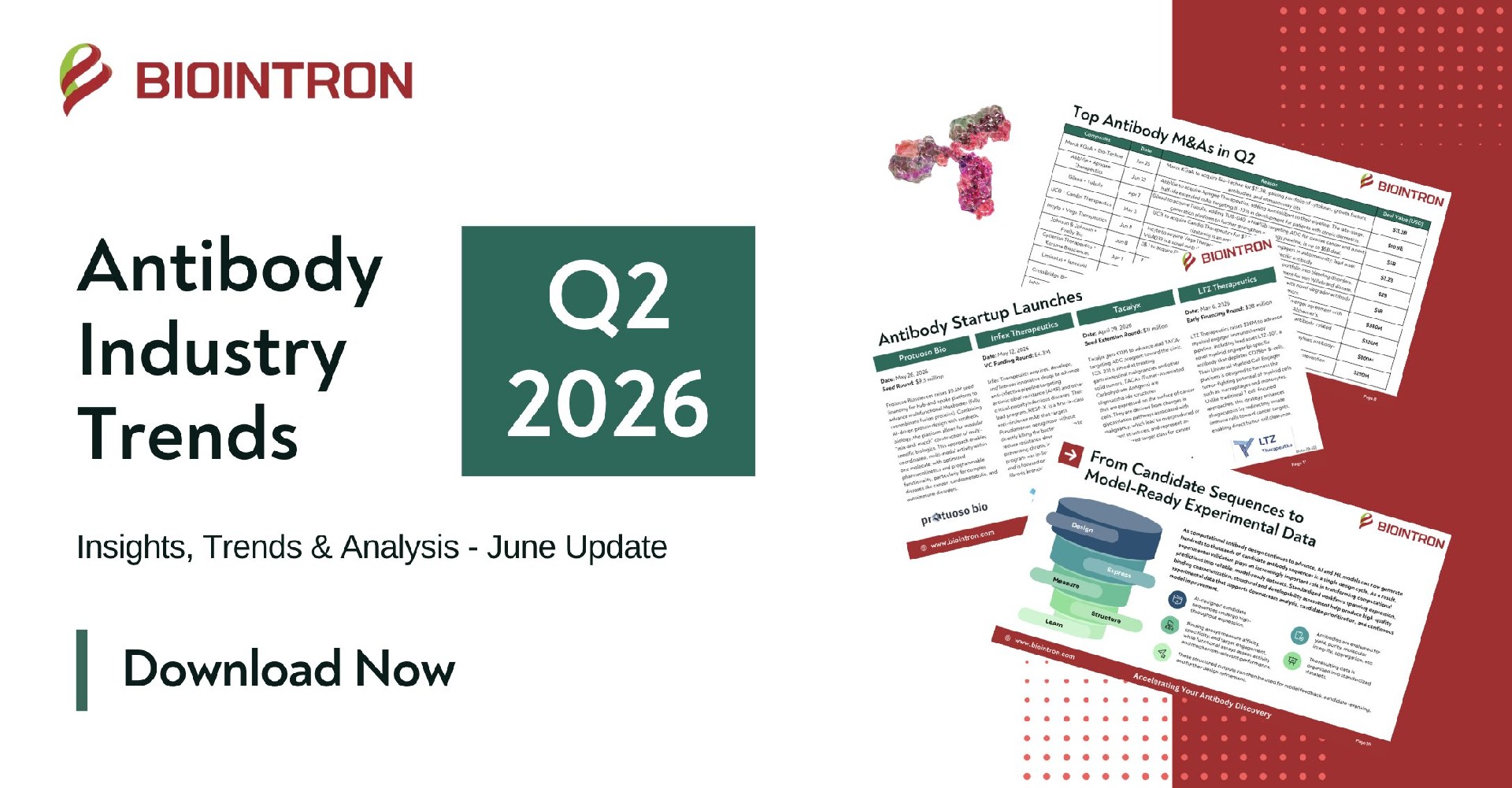
Biointron’s Q2 2026 Antibody Industry Trends report aims to explore the events a……
Artificial intelligence (AI) can be used throughout the drug development process……
Peptides and antibodies have different strengths as therapeutic molecules. Pepti……
Therapeutic antibodies are often used to block receptors or neutralize soluble m……