


A recent paper by Qian et al. (2026) in Nature Communications highlights a growing challenge in computational discovery. Researchers can generate new protein designs faster than conventional laboratory workflows can produce and characterize them. Closing that gap requires experimental testing that combines speed, scale, and consistent data collection.
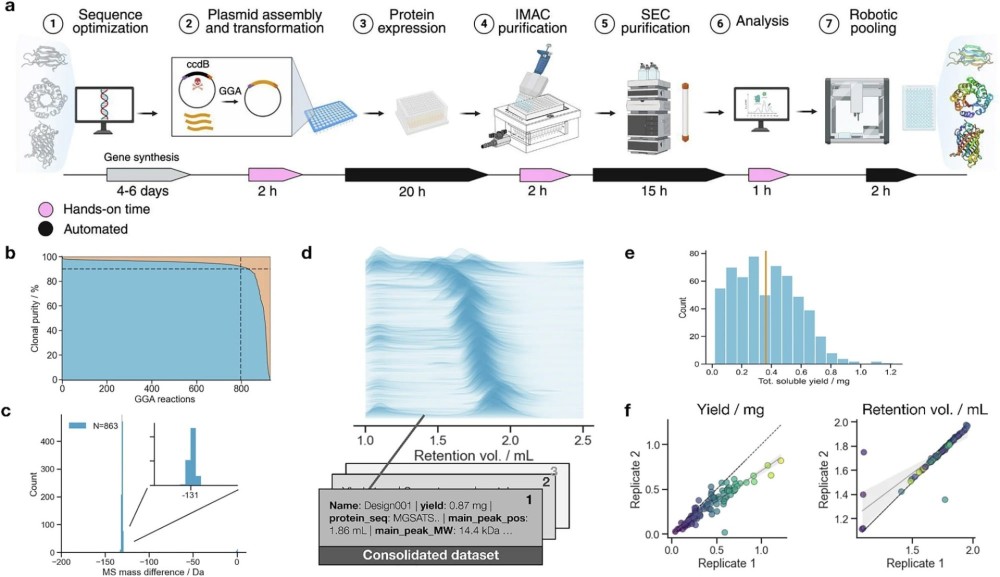
The researchers developed Semi-Automated Protein Production (SAPP), a workflow that produces and characterizes hundreds of protein designs per day. Starting from gene fragments, the process takes approximately 48 hours, excluding commercial DNA synthesis, with around six hours of hands-on work. It combines streamlined cloning, bacterial expression, purification, and automated analysis to measure yield, sample uniformity, and assembly state.
The study also shows why testing different designs matters. When researchers evaluated engineered protein binders against respiratory syncytial virus, changing how the binding domains were arranged substantially affected neutralization. Two dimeric constructs with identical binding domains differed approximately 25-fold in potency, demonstrating how molecular architecture can influence performance.
For antibody discovery teams, scaling experimental characterization creates more opportunities to compare sequence variants and molecular formats before selecting candidates for further development. Combining expression, binding, and developability measurements helps researchers identify promising designs, investigate weaknesses, and decide what to change in the next round.
Consistent data collection also makes those comparisons more informative. Recording results across both successful and unsuccessful designs can help researchers understand which sequence changes improve performance and provide experimental feedback for future computational design cycles.
Biointron’s RushDATA™ platform brings this emphasis on scalable characterization to antibody discovery, with capacity to evaluate 10,000+ antibodies per day. Our new case study presents projects spanning rapid CHO expression, binding characterization, and developability assessment, including 4,000+ antibodies expressed and characterized for binding within two weeks across two customer orders and a panel of 120 AI-designed antibody candidates.
Download the case study for free to explore the workflows, assay results, and data behind large-scale antibody validation.
Biointron's Q3 2026 Antibody Industry Trends report aims to explore the events a……
Bispecific antibodies (BsAbs) can bind two different antigens simultaneously, of……
When we think of antibodies, sharks and alpacas probably aren't the first an……