


Antibodies are important raw materials for many in vitro diagnostic (IVD) applications, including enzyme-linked immunosorbent assays, chemiluminescent immunoassays, lateral flow assays, and particle-based immunoassays. The IVD raw materials market is on a strong growth trajectory, projected to expand from $27.47 billion in 2025 to $30.16 billion in 2026, at a compound annual growth rate (CAGR) of 9.8%.
While identifying an antibody that binds the target antigen is an important early step in assay development, diagnostic developers must also produce and test antibody candidates, identify suitable antibody pairs, confirm performance in the intended assay format, and establish a production process capable of supplying the required quantity with consistent quality. Antigens and antibodies are part of the upstream IVD supply chain, and their performance can affect the performance of the final diagnostic system.
For sandwich immunoassays, this process begins with identifying two antibodies that can function together as a capture-and-detection pair. A sandwich immunoassay generally uses one antibody to capture the target antigen and a second antibody to detect the captured antigen. The two antibodies must bind to sites that remain accessible when the antigen is present in the sample and when one antibody is attached to a solid surface or detection label. An antibody with strong binding activity may still perform poorly when combined with another antibody, so individual antibody testing cannot replace antibody pair screening. The selected pair must produce sufficient signal at the required antigen concentrations while maintaining low background in negative samples.
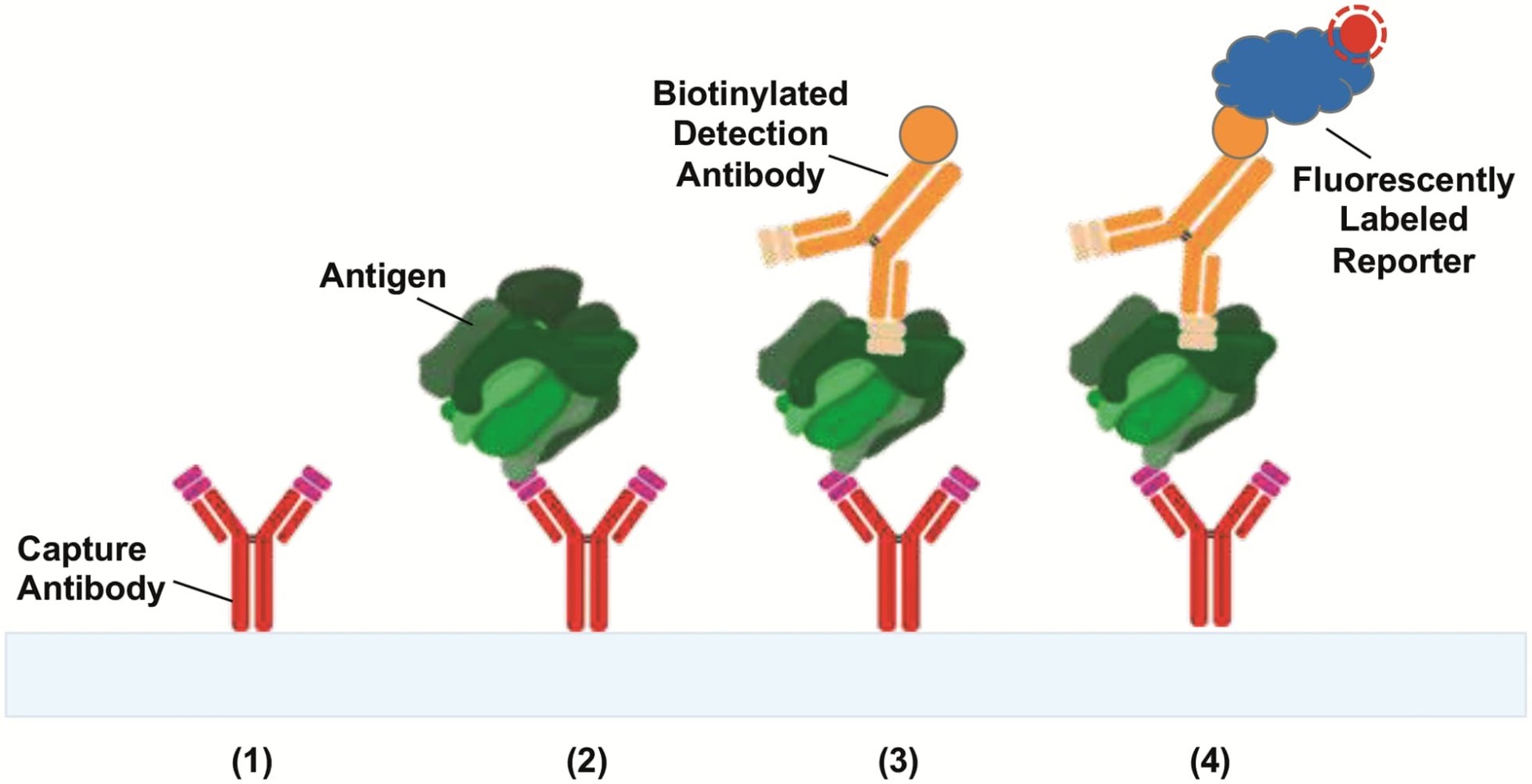
To establish pair performance, each antibody combination must be tested against different assays. Important factors include:
Epitope compatibility: The two antibodies must bind without preventing each other from accessing the antigen.
Binding activity: Both antibodies must maintain sufficient antigen binding after coating, labeling, or conjugation.
Specificity: The pair should distinguish the target from related proteins and other components in the sample.
Detection range: The assay should measure the required antigen concentrations with suitable linearity.
Signal and background: Each pair should be compared based on positive signal, negative background, and signal-to-background ratio.
Sample matrix: Performance should be tested in the intended sample type, such as serum, plasma, urine, saliva, or swab extract.
Diagnostic antibody selection may require more than finding one pair that produces a sandwich signal. A recent review notes that antibodies with different affinity ranges may be needed to support measurements across high and low antigen concentrations and to extend the linear detection range.
Modern antibody discovery methods can generate hundreds or thousands of antibody sequences, but candidate sequences need to be expressed as antibodies and tested experimentally before suitable antibodies or antibody combinations can be selected. Small-scale, parallel antibody production can provide material for initial binding studies, pair screening, and assay testing without requiring a separate large production run for every candidate.
After initial candidates have been produced, their performance can be confirmed under conditions that reflect the intended IVD kit. Antibody performance can change with the assay format because immobilization, conjugation, incubation time, flow conditions, buffers, sample composition, and detection chemistry can affect antigen binding and background. The same antibody may be used as a capture antibody in one experiment and as a labeled detection antibody in another, but these roles place different requirements on the antibody. The constant regions outside the antigen-binding variable region can also affect downstream assay behavior and should not always be treated as inactive structural components. Antibody pairs that perform well in the selected format can then proceed to further assay optimization and analytical testing.
After an antibody pair has been selected, additional material is required for assay optimization and analytical studies. Developers may need to adjust antibody concentration, coating density, conjugation ratio, incubation time, buffer composition, and detection conditions. They must also evaluate characteristics such as analytical sensitivity, specificity, linearity, precision, and interference. As the assay advances through optimization and validation, the amount of raw material required generally increases.
Moving from candidate screening to larger-scale production introduces additional requirements:
Material quantity: More antibody may be needed for assay optimization, validation studies, pilot lots, stability studies, and kit production.
Production process: Expression and purification conditions must produce antibody with acceptable yield and quality.
Purity and aggregation: Product-related impurities and aggregates must be measured and controlled according to the intended use.
Binding activity: Antigen-binding performance should be confirmed after production and purification.
Batch comparison: New batches should be compared with previous or reference material using defined tests.
Storage and handling: Formulation, storage temperature, freeze–thaw exposure, and shipping conditions must be considered.
Documentation: Specifications, analytical results, production records, and change controls become increasingly important as the assay advances.
Once the heavy- and light-chain sequences are known, recombinant expression provides a sequence-defined route for producing the antibody. The sequence can be stored and used for future production without relying on repeated animal immunization or continued ascites production. Wang et al. identifies recombinant expression as a method for long-term digital preservation and stable supply of target antibodies. Recombinant systems can also produce full-length antibodies and antibody fragments such as Fab and single-chain variable fragments, although the appropriate format must be selected based on the assay.
Biointron supports recombinant antibody production at different stages of IVD immunoassay development. RushMab can provide small quantities of multiple antibody candidates for experimental evaluation and antibody pair screening. After a sequence and antibody pair have been selected, the project can move to larger-scale production for assay optimization, validation studies, pilot manufacturing, or continued supply. Biointron has provided tens of thousands of recombinant antibodies for more than 3,000 biotech and pharma companies worldwide.
Biointron’s Q2 2026 Antibody Industry Trends report aims to explore the events a……
Artificial intelligence (AI) can be used throughout the drug development process……
Peptides and antibodies have different strengths as therapeutic molecules. Pepti……
Therapeutic antibodies are often used to block receptors or neutralize soluble m……