



Antibody selection is a weight-of-evidence decision. No single measurement identifies the best candidate, because a candidate has to bind its target tightly enough, bind little else, do something useful once bound, and survive expression, purification and storage. Those are four independent questions, answered by four different experiments.
The tightest binder is frequently not the best candidate. High affinity routinely arrives packaged with poor expression, self-association, binding to unrelated proteins, or a kinetic profile that works against the intended mechanism. Ranking a panel on affinity alone selects for whichever of those problems travelled with the strongest binder.
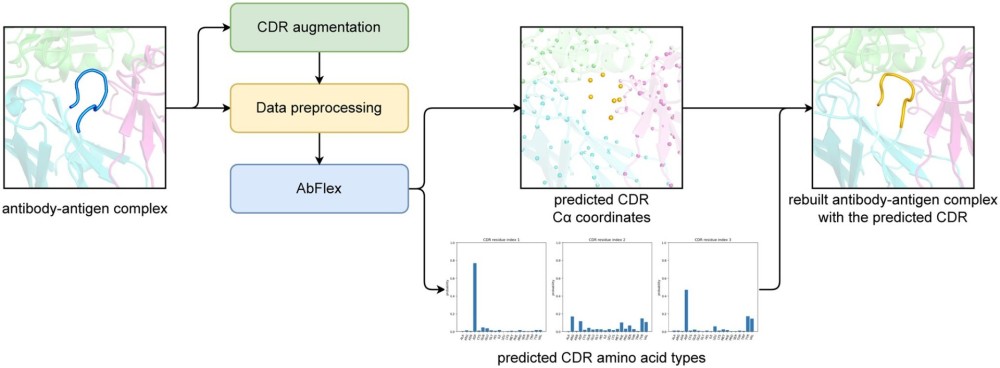
The same logic applies with more force to computationally designed candidates, where a model has already produced a ranking. A predicted ranking is a hypothesis, not a result, and the experiments below are what turn it into one.
Define the application before looking at any data. Target, format, intended activity and development stage decide what matters. A receptor blocker, an agonist and an ADC-targeting antibody are selected on different evidence: the blocker needs sustained occupancy at the relevant epitope, the agonist the right geometry and often a specific valency, the ADC antibody efficient internalization more than maximal affinity. Writing the requirements down first prevents ranking candidates on whatever assay ran earliest.
Separate requirements from goals. Some criteria are pass or fail: a minimum expression titer, no detectable binding to a defined off-target panel, activity in the intended assay. Others can be improved later through affinity maturation or engineering. Each candidate then resolves into one of four decisions, which is more useful than a rank order: advance, redesign, retest or discontinue. Universal cutoffs for affinity or stability are best avoided, since the number that matters depends on mechanism and format.
Affinity: Binding Strength and Kinetics
KD describes equilibrium; the rate constants describe behavior. KD is the ratio of off-rate to on-rate, so two candidates with the same KD can behave differently: one associates and dissociates quickly, the other slowly on both counts. For a blocking antibody, a slow off-rate usually matters more than the KD value itself. Kinetic constants also depend on assay conditions, immobilization orientation and analyte format, so values are comparable only when generated the same way.
Affinity, avidity and potency are not interchangeable. Multivalent binding and high antigen density raise apparent binding strength without changing the intrinsic affinity of a single site, which is why an IgG and its Fab give different numbers against the same antigen. Potency reflects affinity plus expression level, epitope accessibility and the biology downstream of binding.
Higher is not always the goal. Very high affinity can limit tissue penetration in solid tumors, promote target-mediated clearance, or hold a receptor in a state that works against the intended effect. Affinity is interpreted alongside biological activity, not ahead of it.
Specificity: What Else Does It Bind?
Counterscreens define the answer. Candidates are screened against closely related family members, unrelated proteins and negative controls. Related-protein binding is sometimes intended, as when a program needs cross-reactivity with the mouse orthologue, so the panel has to separate wanted cross-reactivity from unwanted binding.
Context matters as much as the panel. Binding purified antigen and recognizing it on a cell surface are different results. Conformation, glycosylation, expression level and accessibility all differ, and candidates that look equivalent on purified protein often separate on cells.
Specificity and polyreactivity are distinct problems. Binding a related antigen is a specificity question. Sticking to many unrelated molecules is a biophysical liability, usually driven by surface charge or hydrophobic patches, and it is caught by polyreactivity ELISA rather than by a target counterscreen. One clean counterscreen does not establish general specificity.
Functional Activity: Does Binding Do Anything?
The assay follows the mechanism: ligand blocking or neutralization, receptor activation, internalization, or effector function such as ADCC and CDC. Record both potency and maximal response, since a candidate can be potent and still produce only a partial effect, and include controls, ideally a benchmark antibody. Antigen binding does not demonstrate function, and panels regularly contain tight binders with no measurable activity.
Developability: Can the Candidate Be Advanced?
Expression and sample quality come first, because they determine whether any later comparison is valid. Yield and recovery are compared in one consistent expression system, then purity, fragmentation and aggregation. A candidate that expresses poorly or arrives partly aggregated underperforms in a binding assay for reasons unrelated to its binding site.
Stability, solubility and self-association come next: thermal unfolding by DSF, stress and freeze-thaw testing, and self-interaction measurements such as AC-SINS. These screens flag liabilities, but they are not formulation or shelf-life studies, and one favorable measurement, a high melting temperature in particular, does not establish developability.
Sequence liabilities round it out. Unpaired cysteines, N-glycosylation sites in CDRs, deamidation and isomerization motifs and hydrophobic patches are flagged computationally, then confirmed or ruled out experimentally. A flag is a reason to run an assay. Early developability screening says nothing about clinical safety.
Build a Practical Selection Matrix
Selection criterion
Apply the requirements before ranking anything. Remove candidates that fail a predefined requirement, but distinguish a confirmed failure from an inconclusive measurement: a candidate that expressed badly in one run has not failed, it has not been measured. Retest before deciding.
Keep trade-offs visible. Collapsing six criteria into one weighted score hides exactly the information a selection meeting needs. Keep the measurements and the reasoning next to the ranking, and carry backups with different property profiles rather than six variants of one design.
Selecting AI-Designed Candidates
Label predicted and measured properties separately and never let them share a column. Model confidence is not affinity, and a predicted developability score is not a measured one. Keeping them apart also enables the useful comparison: where predictions and measurements diverge for a given model and target class is the most informative output of the round.
Results then feed back two ways. Candidates sort into advancement or targeted optimization, and the full dataset, failures and inconclusive results included with their quality annotations, becomes the basis for the next design cycle. Our article on AI-ready antibody data covers what that dataset needs.
Adapting Criteria to the Format
VHHs are selected with size and valency in mind, and bispecifics add chain-pairing accuracy and the behavior of each arm. ADCs change the picture most. Conjugation chemistry and site alter isoelectric point, hydrophobicity and thermal stability, and conjugation in the CH2 region has been shown to destabilize antibodies and promote aggregation. Binding, stability and aggregation therefore have to be re-measured on the conjugate rather than inferred from the naked antibody. Internalization and antigen density also outweigh affinity, since early ADC programs failed partly because too few antigen copies per cell limited intracellular drug accumulation.
How Biointron Supports Candidate Selection
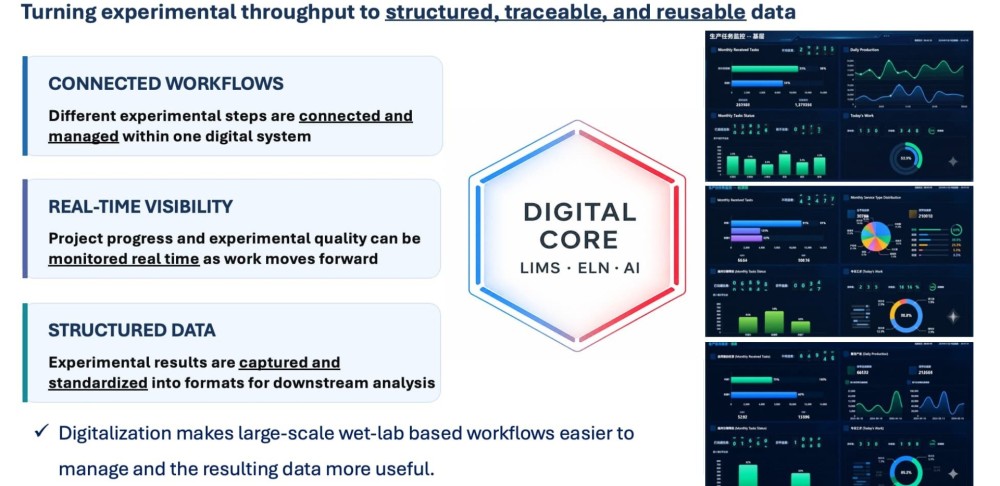
Selection is only as good as the data behind it, and the bottleneck is usually generating comparable data across a whole panel rather than a triaged subset.
Biointron expresses candidate panels recombinantly at mg scale and characterizes them on the instrumentation these decisions require: SPR on Biacore and Carterra for affinity and kinetics, nanoDSF for thermal stability and AC-SINS for self-association, with purity and aggregation assessed first. Affinity maturation is available for candidates that meet every requirement except binding strength.
For panels large enough that throughput sets the timeline, RushDATA™ expresses and characterizes more than 10,000 antibodies per day, with sequence-to-data turnaround of two days for cell-free expression and three days for CHO. Running a whole panel under identical conditions is what makes a selection matrix trustworthy, since candidates measured in separate runs are not strictly comparable.
Contact Biointron to plan antibody expression and characterization around your candidate-selection criteria.
FAQs About Antibody Selection Criteria
What are the main criteria for selecting an antibody candidate?
Affinity and kinetics, specificity, functional activity in a mechanism-appropriate assay, and developability, judged against requirements defined for that program.
No. Very high affinity can limit tissue penetration or work against the intended mechanism, and often travels with expression or self-association problems.
Specificity concerns binding to related antigens. Polyreactivity is nonspecific stickiness toward unrelated molecules, usually biophysical in origin, and needs its own assays.
At candidate selection, not after. Early screens are cheap relative to carrying a liability forward, though they do not replace later formulation studies.
They narrow the panel worth testing. They do not substitute for measurements, and predicted scores should never sit alongside experimental values as though equivalent.
McCombs, J.R., Owen, S.C. Antibody Drug Conjugates: Design and Selection of Linker, Payload and Conjugation Chemistry. AAPS J 17, 339–351 (2015). https://doi.org/10.1208/s12248-014-9710-8
Learn how antibody CDR design connects loop structure, heavy and light chain pai……
Learn how generative AI antibody design creates new sequences using target const……
Artificial intelligence (AI) is transforming antibody discovery by enabling rese……