


Generative AI antibody design means using computational models to propose new antibody sequences under specified conditions: a target, often a particular surface patch on it, an antibody format, and the project's constraints.
Proposing a sequence and showing that it binds are different achievements. A model can produce thousands of sequences that look like real antibodies, and most will not bind the intended site. The work runs in four stages: define the constraints, generate candidates, rank them computationally, then express and test what survives.

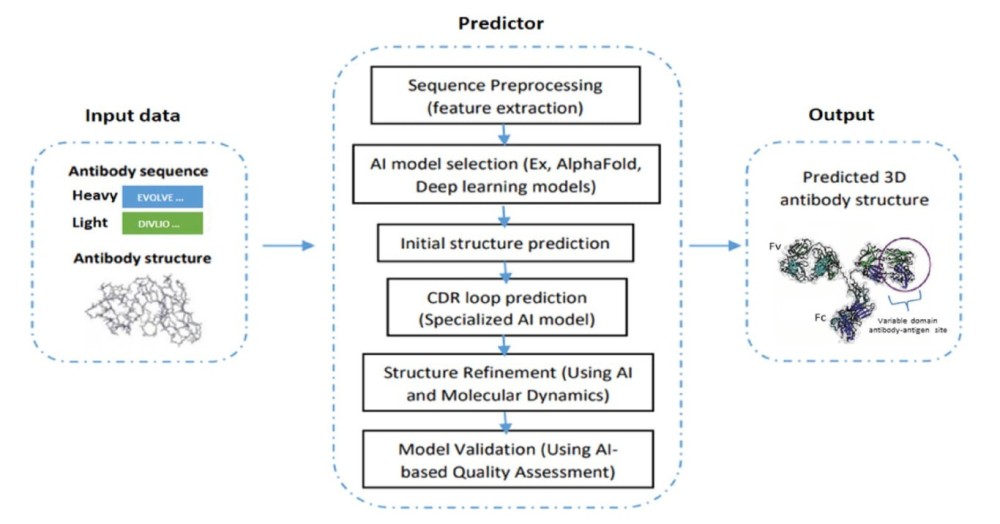
Two kinds of model do different jobs. Generative models propose sequences; predictive models estimate what a sequence will do, from folding into a structure to scoring a developability risk. They work in series: generation produces candidates, prediction filters them. Neither establishes function, since a sequence plausible by every computational measure can still fail to bind.
De novo design starts without an antibody known to engage the target, while optimization starts from a binder and improves it. The distinction is narrower than it sounds: de novo design still relies on patterns learned from known antibodies and complexes, and most therapeutic campaigns keep a clinically validated framework fixed and redesign only the CDRs, since approved frameworks bring known stability, expression and developability behavior.
Inputs vary by model, but target information is the main lever. Some models take only the antigen sequence, others require a structure, and epitope-conditioned models take a specified set of surface residues and design against that patch. That control is the practical appeal of computational design: traditional discovery gives little say over which epitope a campaign lands on. The epitope does have to be accessible and well modeled in the conformation the antibody will meet, which our article on antigen and epitope selection covers.
The second set of inputs describes the antibody. Format is chosen first, typically a paired-chain IgG or a single-domain VHH. If a framework is fixed, the design space narrows to the CDR loops, which are treated unequally: some lengths are held at germline values while longer, more variable loops such as HCDR3 vary. Permitted substitutions and liability filters are set at the same time.
Sequence models learn statistical patterns from large antibody and protein datasets, then sample new sequences from them. Conditioning narrows the sampling, so a model can be asked for a sequence fitting a given framework, CDR length and chain pairing. Most antibody language models are trained on repertoires rather than target-specific binding data, so fluency in antibody sequence space does not amount to target specificity.
The alternative works through structure. A model first generates a proposed antibody-antigen complex conditioned on the antigen and chosen epitope, then designs CDR sequences predicted to fold into that geometry. Backbone geometry constrains which amino acids fit, so sequence design becomes a compatibility problem. Generating a structure and designing a sequence for one are separate tasks, usually handled by separate models, and the second depends on the first.
The binding site is formed by loops from both chains, so CDRs cannot sensibly be designed one at a time. Many widely used inverse folding models treat the two chains independently, a known limitation when they contact each other and the antigen together. Paired-chain models design both jointly; our article on heavy and light chain pairing covers why that matters.
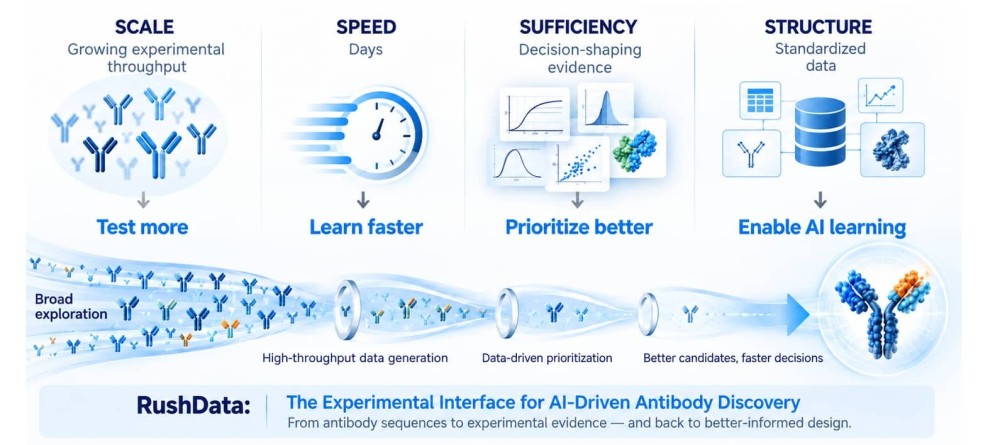
Generation is cheap and testing is not, so filtering decides what a campaign costs. The standard approach, sometimes called design and score, uses structure prediction and confidence metrics to rank designs and advance a small, high-confidence set to the lab.
One caution is specific and important. Confidence scores from co-folding models indicate reasonably well whether a sequence will adopt a given geometry, but published work shows they perform notably worse on antibody-antigen complexes, where models can fail to recover the correct pose even for a real complex. A high score narrows the field; it does not establish binding.
Ranking on a single score also returns near-identical sequences. A panel that samples different CDR solutions and carries proper controls yields more per experiment than the top twenty variants of one design.
| Design Consideration | Computational Question | Experimental Follow-up |
|---|---|---|
| Sequence and structure compatibility | Is the sequence compatible with the intended fold? | Expression and sample quality assessment |
| Target interaction | Does the predicted interface support the intended interaction? | Binding and specificity assays |
| Developability | Are sequence or biophysical liabilities present? | Analytical and biophysical testing |
| Biological function | Could the binding mode support the intended mechanism? | Mechanism-appropriate functional assays |
Expression comes first, and not as a formality. Designs are expressed recombinantly, then checked for concentration, purity and aggregation before anything is compared. A poorly expressed or partly aggregated design underperforms in a binding assay for reasons unrelated to its interface, so candidates cannot be ranked until sample quality is comparable.
Binding is then measured by the method that suits the question, with ELISA for throughput and biolayer interferometry or SPR for kinetics. Specificity needs its own experiments: designs screened against unrelated proteins to detect polyreactivity, and antigens screened against designs they were not made for. Where a mechanism is claimed, only a cell-based assay tests it, since binding and producing the intended effect are separate results.
Early developability testing runs alongside. Thermal stability by nanoDSF, self-association by AC-SINS, hydrophobicity and polyreactivity screening catch liabilities that affinity data hide, and strong binders with poor biophysical profiles are common. Predicted and measured developability often diverge, as our companion article discusses.
The value of a round lies in comparing predictions against measurements. Those comparisons support three actions: reranking candidates in hand, revising constraints for the next generation, and retraining the model itself. The first two are routine and fast; the third is a far larger undertaking.
Failed designs are the most informative part of the dataset and the most often discarded: non-binders, poor expressers and polyreactive candidates, kept with their assay conditions, are what make the next round's scoring meaningful.
Performance drops on unfamiliar targets, epitopes and formats, since these models generalize from what they have seen. Uncertainty about antigen conformation propagates into every design made against it. Novelty is not activity. And affinity, specificity, expression and developability trade off against one another, so optimizing one often costs another.
Reported hit rates should be read with the design problem in mind. On targets with no structural precedent for the chosen epitope, a campaign of roughly a hundred designs may yield a handful of validated binders, and some targets yield none. Hit rates also depend on how a hit is defined, which is why independent evaluation and criteria set before the experiment matter more than headline numbers.
Computational design programs are usually limited not by their models but by how quickly designs can be expressed, measured and fed back.
Biointron works at that step. Designed sequences are expressed recombinantly at mg scale, then characterized for binding by SPR on Biacore and Carterra instruments, thermal stability by nanoDSF and self-association by AC-SINS.
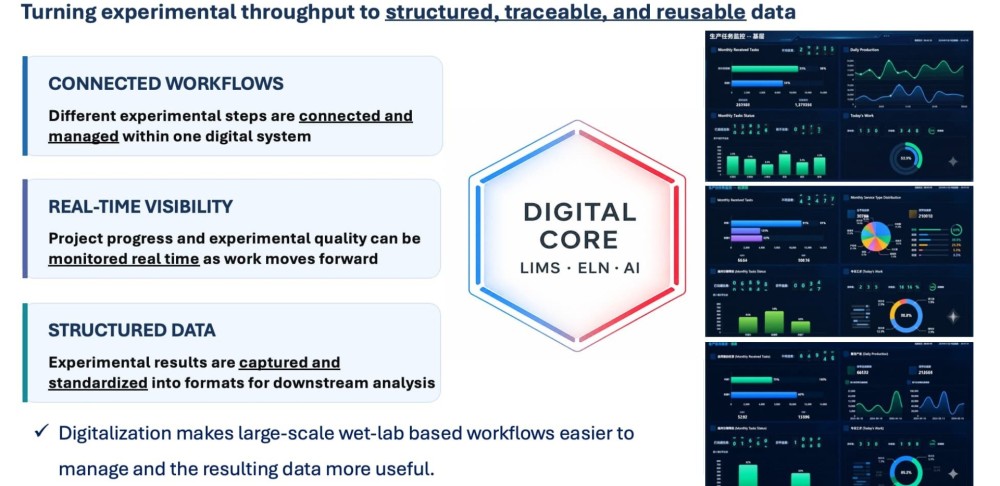
RushDATA™ is the high-throughput option for programs that need that data at design-cycle scale. It expresses and characterizes more than 10,000 antibodies per day, with sequence-to-data turnaround of two days for cell-free expression and three days for CHO. Running a full panel under consistent conditions, rather than a triaged subset, gives a cleaner basis for the next round, since results generated the same way can be compared.
Models trained on antibody and protein data propose sequences meeting specified conditions, either by sampling sequence space or by fitting sequences to a proposed structure.
No, but it is not built from nothing: most campaigns keep a validated framework fixed and redesign only the CDRs, and every model draws on patterns learned from known antibodies.
Epitope-conditioned models accept a defined set of surface residues and design against that patch. Success depends on the epitope being accessible and well modeled, and needs experimental confirmation.
Computationally, by predicted structure and confidence scores. Experimentally, through expression, binding and specificity assays, developability testing and, where relevant, functional assays.
No. Computational scores narrow a panel but do not establish binding, and binding alone does not establish therapeutic activity or good developability.
Artificial intelligence (AI) is transforming antibody discovery by enabling rese……
AI-driven antibody discovery has made it possible to generate thousands of candi……
Learn how predicted antibody structures help screen AI-designed candidates, asse……