



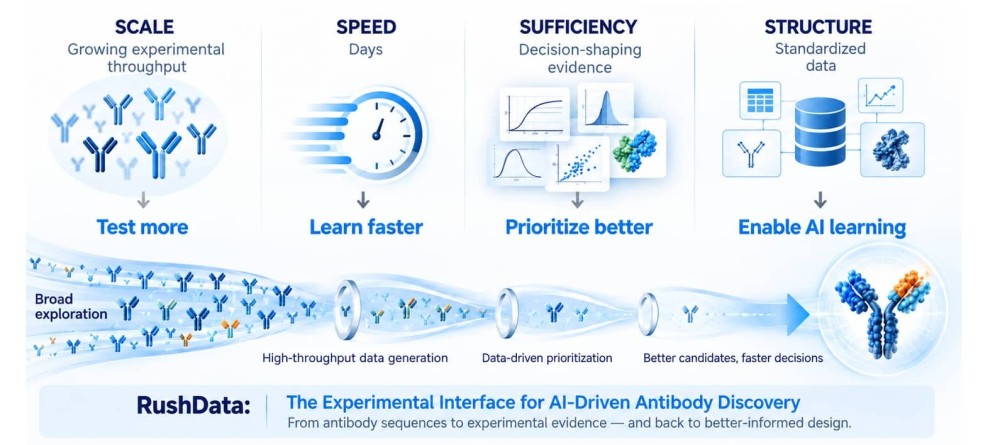
AI-driven antibody discovery has made it possible to generate thousands of candidate sequences in a single design cycle. However, computational predictions alone cannot confirm whether an antibody will express efficiently, bind its intended target, or demonstrate properties suitable for further development. Experimental validation remains essential.
Biointron's RushDATA™ bridges this gap by transforming antibody sequences into structured, AI-ready experimental data. With the capacity to process 10,000+ antibodies per day, RushDATA™ delivers sequence-to-data results in as little as 2 days using cell-free expression or 3 days using CHO expression.
To accommodate different research needs, RushDATA™ offers three levels of experimental characterization.
Designed for early-stage screening of large antibody libraries, the Basic package combines high-throughput expression, titer measurement, and two-point affinity assessment using biolayer interferometry (BLI).
This approach helps researchers rapidly identify promising candidates and prioritize sequences for further characterization.
For researchers seeking deeper insights into antibody-target interactions, the Standard package adds antibody purification, quality control, and multi-point binding analysis using BLI or surface plasmon resonance (SPR).
Measurements include binding affinity (KD) and kinetic parameters (kon and koff), supporting more informed candidate ranking and selection.
Beyond binding performance, therapeutic antibody candidates must demonstrate suitable physicochemical properties.
The Premium package builds on Standard characterization by incorporating developability assessments, including differential scanning fluorimetry (DSF), polyspecificity testing (PSR-BVP), and self-interaction analysis (AC-SINS).
These measurements help identify potential stability, polyspecificity, and self-association liabilities early in antibody development.
From rapid screening to comprehensive developability profiling, all three RushDATA™ packages support the generation of high-quality experimental datasets tailored to different stages of antibody discovery.
By combining automated high-throughput workflows, standardized characterization, and API-enabled data integration, RushDATA™ helps AI-driven research teams accelerate experimental validation, refine computational models, and make more informed antibody development decisions.
Learn how predicted antibody structures help screen AI-designed candidates, asse……
Compare RushDATA Basic, Standard and Premium: BLI affinity, SPR kinetics, DSF, P……
The 17th Annual World ADC San Diego Summit highlighted novel payload mechanisms,……