




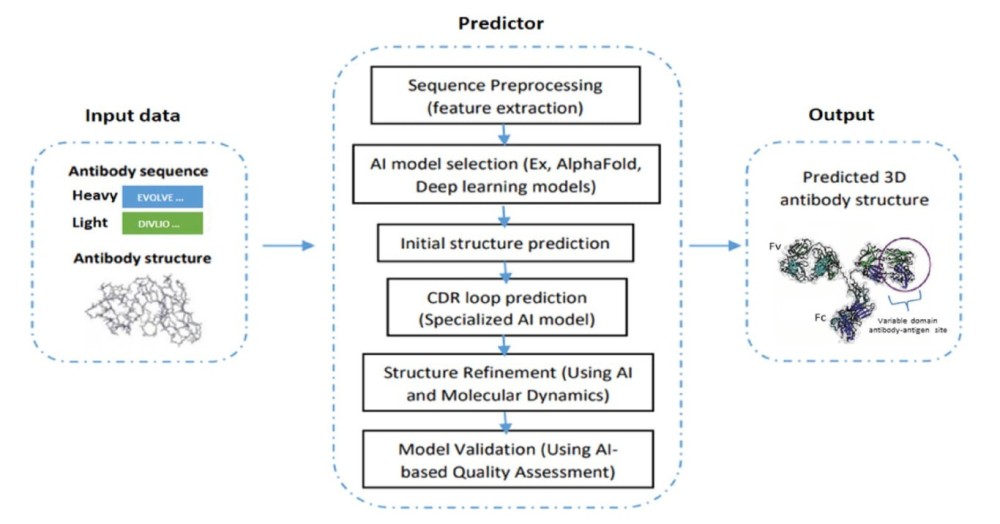
Antibody structure prediction is the computational modeling of an antibody's three-dimensional structure from its amino acid sequence. As AI models generate antibody sequences in growing numbers, predicted structures give design teams a fast first check: is a sequence likely to fold into a well-formed antibody, and what might its binding site look like?
A predicted structure can help filter out implausible designs and decide which candidates to make. It cannot show that an antibody binds its target, how strongly, or whether it will behave well in development. Those answers come from the lab. This article covers what structure prediction can and cannot tell antibody designers, and where experimental data fits in.
Each antibody variable domain has a conserved framework that holds three hypervariable loops, the complementarity-determining regions (CDRs), in place. The CDRs carry most of the sequence diversity and make most antigen contacts. In a conventional antibody, three heavy-chain and three light-chain CDRs together form the binding site, or paratope. Its shape depends on loop length, sequence, and how the framework positions each loop.
The heavy-chain (VH) and light-chain (VL) variable domains pack against each other, and the angle between them varies between antibodies. Small differences in that angle can shift the CDRs and reshape the binding surface. Single-domain antibodies, such as VHHs, bind through one domain and often rely on a longer CDR3, which gives them a distinct structural profile.
A sequence predicted to fold well has passed a useful filter, but it has not shown affinity, specificity, or biological activity. Binding depends on interface details that current models capture only partially. Structural plausibility is a necessary condition, not a predictor of performance.
Predictions are only as good as the input. Sequences should cover the full variable domains and, for conventional antibodies, be correctly paired. Applying a standard numbering scheme assigns consistent positions to framework residues and CDRs, which makes candidates directly comparable and mutations easy to track.
Template-based methods build models from solved antibody structures with similar sequences. Deep learning methods learn sequence-structure relationships from large datasets and predict coordinates directly. Both produce backbone geometry, which sets the fold and loop shapes, and side-chain positions, which define the surface chemistry.
Frameworks and most CDRs are now generally predicted well. CDR-H3 is the main exception: it is the most variable loop in length and sequence, often lacks close templates, and can be flexible. It also sits at the center of the binding site, so it remains the least reliable part of most models.
Most methods report per-residue confidence, which helps locate uncertain regions. A high overall score can still hide an uncertain binding site, because the well-predicted framework dominates the average. Confidence in the CDRs, especially CDR-H3, should be reviewed separately, along with checks for clashes and strained geometry.
Structure prediction offers a scalable way to screen large sets of AI-generated sequences for plausible folds. Warning signs include disrupted framework packing, unusual loop conformations, misaligned VH-VL interfaces, and clashes. These checks work best combined with sequence-based screens for liabilities such as deamidation, oxidation, or unpaired cysteines.
Models can highlight residues likely to contact the antigen and positions where substitutions may be tolerated, helping narrow the set of variants worth making. Predicted contacts remain hypotheses. Improved affinity is established only by measurement.
During humanization, some framework residues, including Vernier zone positions, help support CDR conformation, and changing them can reduce binding. Structural models help identify which residues to retain. Humanized variants still need to be tested against the parental antibody to confirm that binding and function are preserved.
Models can flag exposed hydrophobic patches, uneven surface charge and potentially unstable regions, all linked to aggregation, polyreactivity or poor stability. Computational developability predictors have limited accuracy, so these flags are best used for ranking and then confirmed with expression, stability and self-association data.
A model of the antibody alone shows its fold and paratope shape, but not whether or where it binds the antigen. Predicting the antibody-antigen complex, whether by co-folding or docking, is a separate and harder task. It can suggest contact residues and binding orientation, but accuracy is lower and less consistent, and confidence scores do not reliably indicate whether a predicted pose is correct. Antigen flexibility and glycosylation add further uncertainty. Complex models are most useful for generating hypotheses and comparing candidates, not as evidence of binding.
Define the target and design objective: Specify the antigen, antibody format, desired function, and any existing data, such as known epitopes or reference binders.
Generate or select candidate sequences: Include AI-generated designs, experimentally discovered antibodies or engineered variants, and confirm sequences are complete and correctly paired.
Predict structures and review uncertainty: Check framework geometry, CDR conformations, and VH-VL orientation, with particular attention to CDR-H3. Compare models from more than one method when uncertainty could change a decision.
Prioritize using multiple criteria: Combine structural plausibility, sequence liabilities, and any available assay data rather than ranking on a single prediction score.
Express, test, and refine: Produce the selected antibodies, measure binding, specificity, and developability, and feed the results into the next design round.
The first question is whether a candidate binds its intended target. Binding screens can test many candidates quickly, while counter-screens and polyreactivity assays confirm that binding is selective. Benchmark antibodies with known properties make results easier to interpret.
Surface plasmon resonance (SPR) and biolayer interferometry (BLI) measure binding kinetics, reporting association and dissociation rates (kon, koff) and the equilibrium dissociation constant (KD). Functional assays matched to the intended mechanism of action are then needed to show that binding produces the desired biological effect.
A strong binder that expresses poorly or aggregates is unlikely to progress. Measurements of expression yield, purity, thermal stability (for example by DSF), self-association, and polyreactivity identify which candidates are suitable for development, and provide a direct check on computational developability flags.
Structure prediction helps decide which antibodies to make. It does not replace making them. The speed and consistency of experimental feedback largely determine how many design rounds a team can complete and how much each round learns from the last. For AI models, well-structured experimental data also becomes training data for future designs.
RushDATA™ is Biointron's high-throughput wet-lab validation service for AI-designed antibodies, with capacity for more than 10,000 antibodies per day. It takes candidate sequences through expression, purification, and QC, binding characterization by BLI or SPR, and developability profiling including DSF, PSR-BVP, and AC-SINS. Results are delivered as structured, model-ready datasets by report or API, ready for the next round of computational design. Three packages cover rapid screening, binding characterization, and full developability profiling, and each workflow can be tailored to a program's needs.
Biointron's antibody discovery services, including single B cell screening, provide experimentally derived antibodies that can serve as design starting points or as benchmarks for AI-generated candidates. High-throughput antibody expression supports production of large candidate panels for testing.
For candidates moving forward, Biointron's humanization and affinity maturation services refine sequences while retaining binding and function, with every engineered variant evaluated experimentally.
Speak to an Expert: Planning an antibody discovery, expression, humanization or affinity maturation project, or looking to validate AI-designed candidates at scale? Speak to an Expert to discuss your requirements with Biointron's scientific team.
It is the computational modeling of an antibody's three-dimensional structure from its amino acid sequence, using template-based methods, deep learning or both.
It helps screen AI-generated sequences for plausible folds, identify residues that may shape the binding site and flag potential developability risks, so teams can prioritize which candidates to test.
CDR-H3 is the most variable loop in length and sequence, often lacks close templates and can be flexible. Because it sits at the center of the binding site, its uncertainty strongly affects model reliability.
Antibody modeling predicts the antibody alone. Complex prediction models how the antibody and antigen interact, which is harder and generally less accurate.
No. Models can suggest whether a binding site is plausible, but affinity must be measured experimentally, for example by SPR or BLI.
They help identify framework residues that support CDR conformation, guiding which residues to retain. Humanized variants are then tested against the parental antibody.
Models cannot confirm that an antibody binds its target, functions as intended, or can be developed. Only laboratory measurements of binding, function, expression, and stability can establish that.
AI can now design thousands of antibody candidates in an afternoon. Knowing whi……
The 17th Annual World ADC San Diego Summit highlighted novel payload mechanisms,……
Recombinant antibody production involves introducing the genetic sequence encodi……