




Antibody discovery has traditionally relied on screening large libraries of molecules to identify candidates that recognize a specific target. Although established techniques such as hybridoma technology and phage display have been successful, identifying and optimizing promising antibodies can require extensive experimental work.
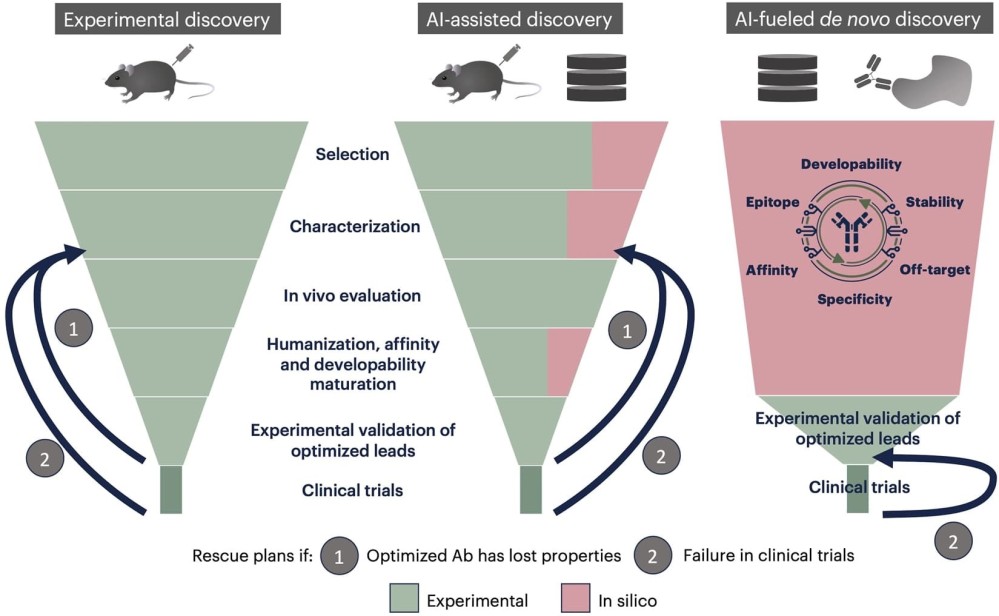
AI is beginning to change how researchers approach this challenge. Machine learning models can analyze protein sequences, predict structural features, and suggest modifications that may improve antibody properties. These tools can help researchers narrow down candidates and make more informed decisions about which molecules to investigate. A 2024 review explores several of these applications, highlighting how AI is being incorporated into different stages of antibody discovery.1
An antibody's amino acid sequence determines how it folds into a three-dimensional structure. This structure influences how the antibody interacts with its target, particularly through its complementarity-determining regions (CDRs), which play a central role in antigen recognition.
AI-based structure prediction tools can estimate protein structures from sequence information. Tools such as AlphaFold have advanced this field, giving researchers new ways to investigate protein folding and structural relationships.
For antibody research, structural predictions can help scientists examine variable regions, investigate potential binding configurations, and identify structural features that may influence antibody function. However, predicted structures are not equivalent to experimentally determined structures. Antibody flexibility and interactions with the target can introduce uncertainties that computational models may not fully capture.
Understanding where an antibody binds its target is another important part of discovery. AI approaches can help predict the paratope, the antibody region involved in binding, and the corresponding epitope on the target antigen. By analyzing sequence and structural information, computational models can suggest potential binding sites and interactions.
Molecular docking approaches can also help researchers investigate how an antibody might interact with an antigen.
These predictions can guide candidate selection and help prioritize antibodies for experimental testing. However, computational predictions alone cannot confirm that a binding interaction actually occurs. Laboratory validation remains necessary.
Traditional antibody discovery methods generate and screen large collections of candidates. AI can complement these approaches by helping researchers analyze sequence information and prioritize molecules for further investigation.
Machine learning models can identify sequence patterns associated with desirable antibody characteristics. Researchers can use these predictions to compare candidates and focus experimental resources on sequences with potentially favorable properties.
For example, computational screening may help identify candidates with promising sequence characteristics before they enter expression and binding assays. However, AI cannot replace experimental screening. Rather, it provides another layer of analysis to help researchers decide which candidates are worth testing.
Identifying an antibody that binds its target is the start, as researchers often need to improve binding affinity through a process known as affinity maturation. Traditionally, this involves introducing mutations into antibody sequences, generating variants and experimentally screening them for improved binding.
AI offers additional ways to explore potential sequence modifications. Machine learning models and protein language models can analyze antibody sequences and suggest mutations that may improve binding properties. Researchers can then express and test these variants to determine whether the predicted improvements translate into measurable changes.
Importantly, besides binding, sequence modifications can also affect expression, stability, and specificity. Optimization therefore requires evaluating multiple properties rather than focusing on affinity alone.
An effective antibody should recognize its intended target without interacting with unrelated molecules. AI can help investigate potential cross-reactivity by analyzing sequence similarities, structural features, and predicted molecular interactions. These approaches may highlight candidates that warrant additional specificity testing.
For example, computational analysis could identify similarities between the predicted binding regions of an intended target and another protein. Researchers can then investigate whether the antibody interacts with both.
This can help inform experimental design, although computational predictions cannot establish that an antibody is free from off-target interactions.
A promising antibody must also be suitable for production and further development. Developability refers to the collection of molecular properties that influence whether an antibody can be expressed, purified, stored, and manufactured reliably. These include expression levels, stability, solubility, and aggregation tendency.
AI models can analyze antibody sequences and structures to identify characteristics associated with potential developability challenges.
For instance, computational models may flag sequence features associated with aggregation or poor solubility. Researchers can use this information to compare candidates and identify potential problems earlier in discovery.
These predictions still need to be checked experimentally. An antibody's actual expression and stability can vary depending on its sequence and the production conditions used.
Beyond analyzing existing antibodies, generative AI is being explored as a way to design entirely new sequences.
Protein language models and other generative approaches learn patterns from existing protein sequences and use these patterns to propose new candidates. Some approaches incorporate structural information or specific design objectives to guide sequence generation.
This allows researchers to explore antibody sequences beyond those available in conventional screening libraries.
However, generating a plausible sequence does not guarantee that it will fold correctly, express efficiently, or bind its intended target. Each candidate still requires experimental evaluation.
Across these applications, one requirement remains consistent. Computational predictions need experimental evidence.
AI can help researchers identify promising sequences, investigate molecular interactions and prioritize design modifications. Laboratory testing determines whether those candidates actually express, bind their intended targets, and demonstrate the predicted properties.
As computational approaches generate larger numbers of antibody candidates, the capacity to evaluate them experimentally becomes increasingly important.
Biointron's RushDATA™ supports AI-driven antibody research through high-throughput expression and characterization, with a processing capacity of 10,000+ antibodies per day. Depending on the selected expression workflow, sequence-to-data turnaround can be as fast as 2 days with cell-free expression or 3 days with CHO expression.
By connecting computationally designed sequences with experimental measurements, researchers can assess their predictions and generate evidence to guide subsequent optimization.
Musnier, A., Dumet, C., Mitra, S., Verdier, A., Keskes, R., Chassine, A., Jullian, Y., Cortes, M., Corde, Y., Omahdi, Z., Puard, V., Bourquard, T., & Poupon, A. (2024). Applying artificial intelligence to accelerate and de-risk antibody discovery. Frontiers in Drug Discovery, 4, 1339697. https://doi.org/10.3389/fddsv.2024.1339697
Recombinant antibody production involves introducing the genetic sequence encodi……
Explore September 2026 antibody biotech deals, including major licensing agreeme……
As AI models become more involved in antibody discovery and design, the need for……