



August 2026 brought another mix of acquisitions, licensing agreements, strategic collaborations, and private financings across the antibody biotech sector. Antibody-drug conjugate technologies, such as bispecific ADCs and new payload technologies, were mentioned, while autoimmune and inflammatory diseases attracted both large acquisitions and venture funding. AI-driven antibody discovery also remained active through new pharma collaborations and investment in biological foundation models.
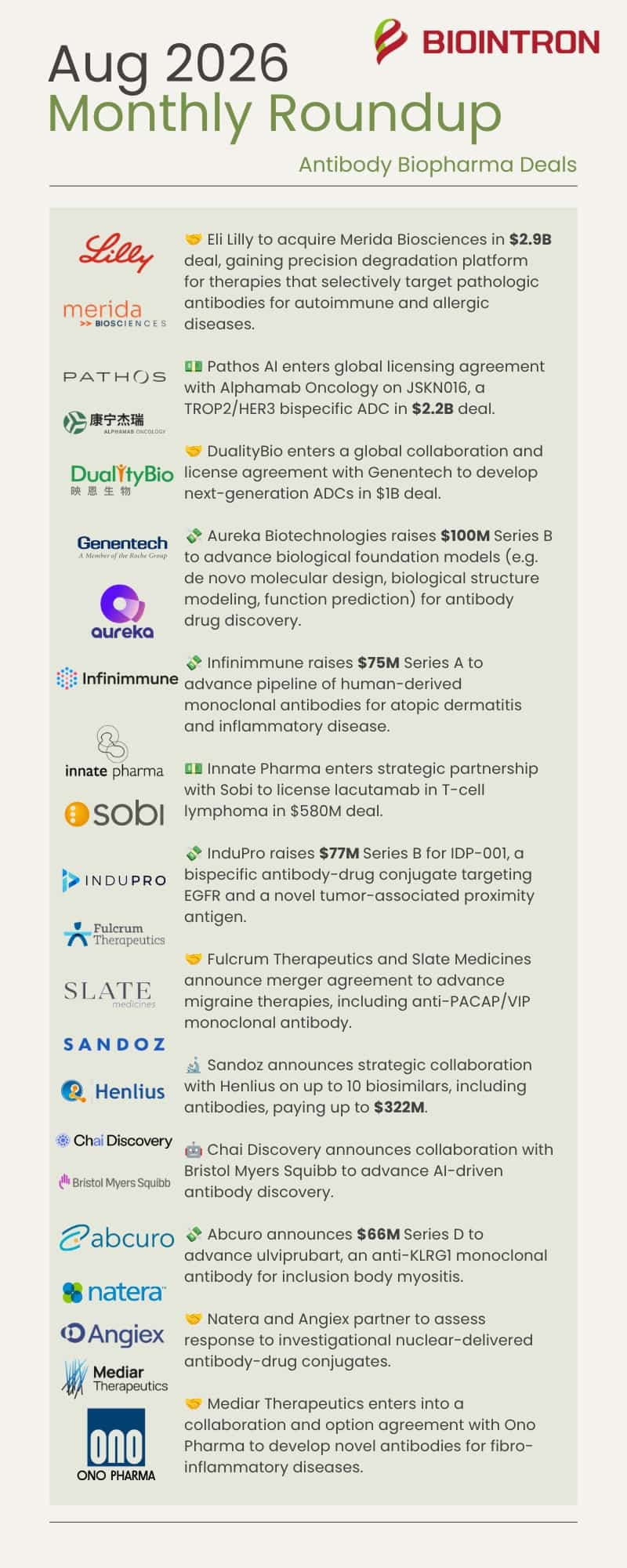
ADCs continued to attract large partnerships and financing. Pathos AI entered a $2.2B licensing agreement with Alphamab Oncology for a TROP2/HER3 bispecific ADC, while DualityBio signed a $1B collaboration with Genentech around next-generation ADCs. InduPro also raised $77M to advance its bispecific ADC program.
Autoimmune and inflammatory diseases were another active area. Eli Lilly agreed to acquire Merida Biosciences in a $2.9B deal focused on selective degradation of pathogenic antibodies. Infinimmune and Abcuro also raised new financing to advance antibody programs in inflammatory and autoimmune disease.
AI remained part of antibody discovery and development strategies. Chai Discovery announced a collaboration with Bristol Myers Squibb in AI-driven antibody discovery, while Aureka Biotechnologies raised $100M to further develop biological foundation models and experimental discovery workflows.
Eli Lilly × Merida Biosciences – Eli Lilly agreed to acquire Merida Biosciences in a $2.9B deal. Merida is developing a precision degradation platform designed to selectively remove pathogenic antibodies associated with autoimmune and allergic diseases while preserving broader immune function.
Fulcrum Therapeutics × Slate Medicines – Fulcrum Therapeutics and Slate Medicines announced a merger agreement focused on developing new migraine therapies. Slate’s pipeline includes monoclonal and bispecific antibody programs targeting neuropeptide pathways involved in migraine.
Pathos AI × Alphamab Oncology – Pathos AI entered a $2.2B global licensing agreement with Alphamab Oncology for JSKN016, a TROP2/HER3 bispecific antibody-drug conjugate. The program combines dual-target recognition with an ADC format for solid tumor treatment.
DualityBio × Genentech – DualityBio entered a $1B global collaboration and license agreement with Genentech to develop next-generation ADCs.
Sobi × Innate Pharma – Sobi entered a $580M strategic partnership with Innate Pharma for lacutamab, an anti-KIR3DL2 monoclonal antibody being developed for T-cell lymphoma.
Sandoz × Henlius – Sandoz announced a strategic collaboration with Henlius covering up to 10 biosimilars, including antibody-based products, in a deal worth up to $322M. The agreement expands Sandoz’s biosimilar pipeline across several therapeutic areas.
Mediar Therapeutics × Ono Pharmaceutical – Mediar Therapeutics entered a collaboration and option agreement with Ono Pharmaceutical to discover and develop novel antibodies for fibro-inflammatory diseases. The companies will focus on antibody candidates against targets involved in fibrosis and inflammation.
ADCs remained one of the more active areas of antibody dealmaking in August, with activity spanning bispecific ADCs, new payload technologies, and clinical development.
Pathos AI × Alphamab Oncology – JSKN016 is a bispecific ADC targeting TROP2 and HER3, two receptors associated with several solid tumors. The program combines dual-target binding with delivery of a cytotoxic payload.
InduPro – InduPro raised $77M Series B financing to support development of IDP-001, a bispecific ADC targeting EGFR and a novel tumor-associated proximity antigen. The company also announced dosing of the first patient in a Phase 1 study of the program.
DualityBio × Genentech – The $1B collaboration will focus on ADCs with the aim of developing candidates with different mechanisms from commonly used ADC payload classes.
Natera × Angiex – Natera and Angiex partnered to evaluate treatment response to Angiex’s investigational nuclear-delivered antibody-drug conjugates using circulating tumor DNA testing. The collaboration will assess whether molecular response measurements can support clinical evaluation of the program.
Chai Discovery × Bristol Myers Squibb – Chai Discovery announced a collaboration with Bristol Myers Squibb to apply AI models to therapeutic antibody discovery. The collaboration will use computational approaches to support antibody design and candidate identification.
Aureka Biotechnologies – Aureka raised $100M Series B financing to expand its biological foundation models and experimental discovery infrastructure. Its work includes de novo molecular design, structural modeling, function prediction, and antibody drug discovery.
Pathos AI × Alphamab Oncology – The JSKN016 licensing agreement also reflects the use of AI in portfolio evaluation and drug development. Pathos uses computational models and biological data to identify and prioritize therapeutic programs for further development.
Aureka Biotechnologies – Aureka raised $100M Series B to advance biological foundation models and related experimental capabilities for drug discovery, including antibody programs.
InduPro – InduPro raised $77M Series B to advance IDP-001 and additional programs from its proximity-based discovery platform.
Infinimmune – Infinimmune raised $75M Series A to advance a pipeline of human-derived mAbs for atopic dermatitis and other inflammatory diseases.
Abcuro – Abcuro raised $66M Series D to advance ulviprubart, an anti-KLRG1 monoclonal antibody being developed for inclusion body myositis.
August 2026 deal activity covered several areas of antibody R&D. ADCs continued to generate licensing agreements and financing, including multiple bispecific programs. Autoimmune and inflammatory diseases also received significant investment, while AI-based approaches remained present in both antibody discovery and asset selection. Biosimilars and clinical-stage monoclonal antibodies added further activity across the sector.
Biointron’s Antibodies After Hours: From Algorithms to Antibodies was held at Th……
Discover how high-throughput wet-lab validation connects AI-designed antibody se……
Understand the hybridoma generation process for monoclonal antibody production, ……
Learn how AI antibody discovery connects computational design with antibody expr……