
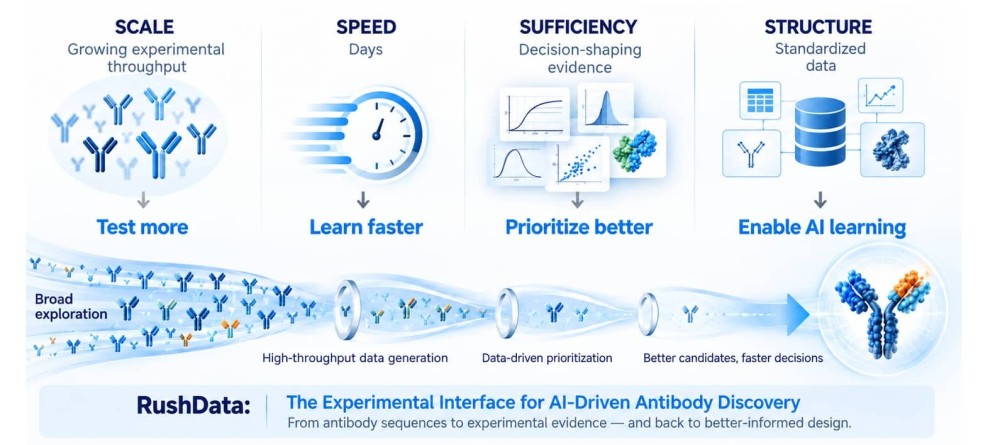
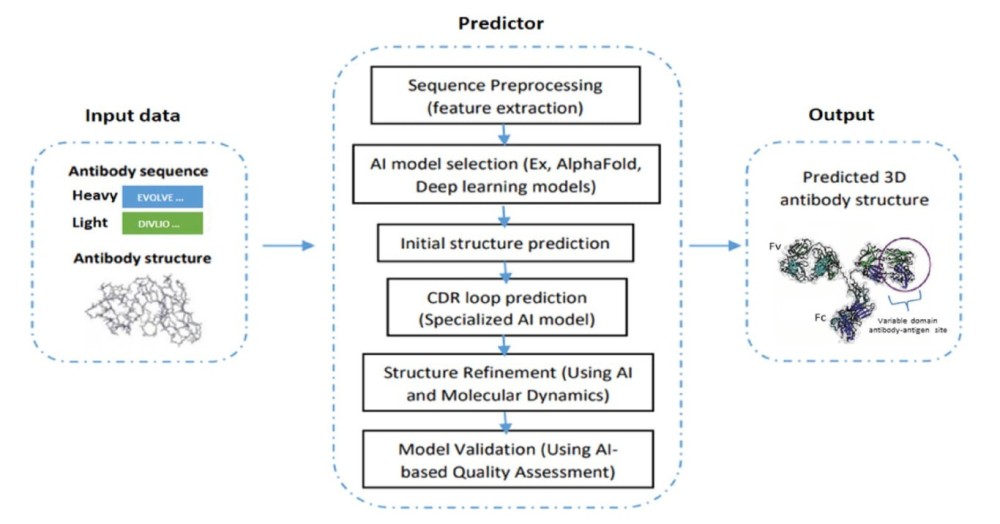


Artificial intelligence (AI) is transforming antibody discovery by enabling researchers to design and optimize thousands of antibody sequences in a fraction of the time required by traditional approaches. However, while computational design has become increasingly efficient, experimental validation has struggled to keep pace.
Before an AI-designed antibody can advance toward therapeutic development, researchers must determine whether it can be successfully expressed, bind its intended target, and exhibit suitable developability properties. These laboratory processes can create significant delays, particularly when evaluating thousands of candidates.
High-throughput antibody production offers a way to overcome these limitations by connecting rapid molecular design with scalable experimental testing.
Traditional antibody discovery workflows often involve multiple stages, including gene synthesis, antibody expression, purification, binding analysis, and developability assessment.
When these steps are performed sequentially or across different laboratories, testing large candidate libraries can take weeks. This creates several challenges:
Limited experimental capacity: AI models can generate more sequences than conventional laboratory workflows can efficiently evaluate.
Lengthy turnaround times: Sequential expression and characterization slow candidate selection and optimization.
Fragmented experimental data: Results generated across different workflows may be difficult to standardize and integrate into AI models.
As a result, the speed of antibody discovery increasingly depends not only on computational capabilities but also on how efficiently experimental data can be generated.
High-throughput antibody production addresses these challenges by enabling large numbers of antibody candidates to be expressed and characterized in parallel.
Automated workflows reduce repetitive manual handling, while standardized experimental conditions help improve consistency across large datasets.
Importantly, high-throughput production is not simply about producing more antibodies. Its value comes from connecting expression with downstream analytical testing, allowing researchers to identify candidates with desirable properties earlier in the discovery process.
For AI-driven antibody discovery, this enables faster design-build-test-learn cycles, in which experimental results guide subsequent rounds of computational optimization.
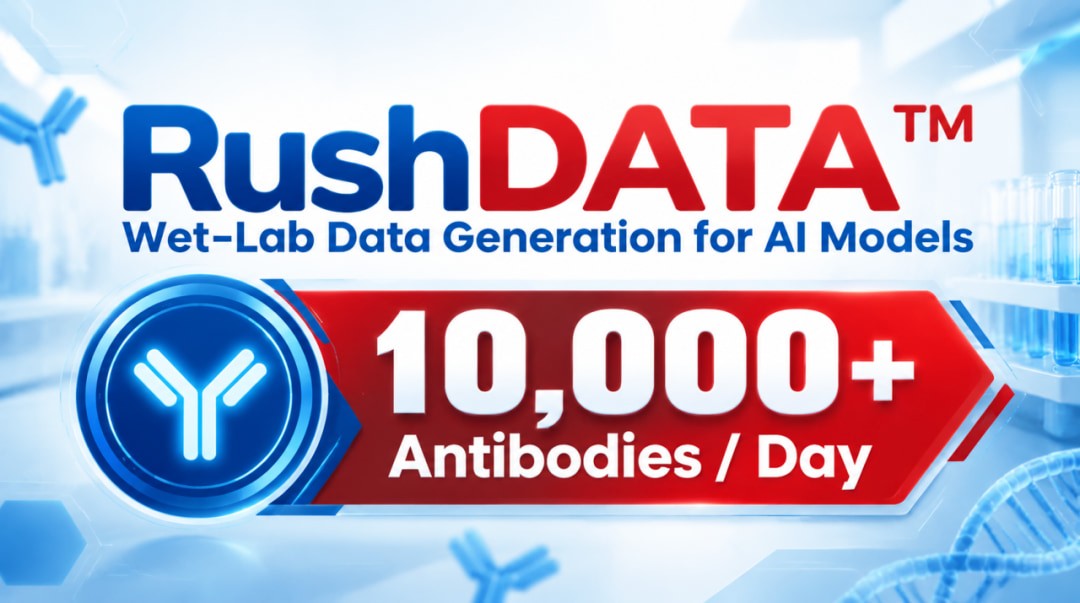
Biointron's RushDATA™ platform was developed to support the growing demand for scalable wet-lab validation in AI-driven antibody discovery.
With the capacity to process 10,000+ antibody molecules per day, RushDATA™ integrates high-throughput expression, binding characterization, and developability profiling into streamlined experimental workflows.
The platform offers two expression approaches to support different research objectives:
Cell-free expression: From sequence to experimental data in as little as 2 days, supporting rapid early-stage screening.
CHO expression: From sequence to experimental data in as little as 3 days, providing mammalian-cell-derived antibodies for characterization.
Beyond expression, RushDATA™ supports binding analysis using biolayer interferometry (BLI) or surface plasmon resonance (SPR), as well as developability assessments covering thermal stability, polyspecificity, and self-interaction.
These measurements help researchers move beyond predicted binding performance to evaluate experimentally measured properties relevant to antibody development.
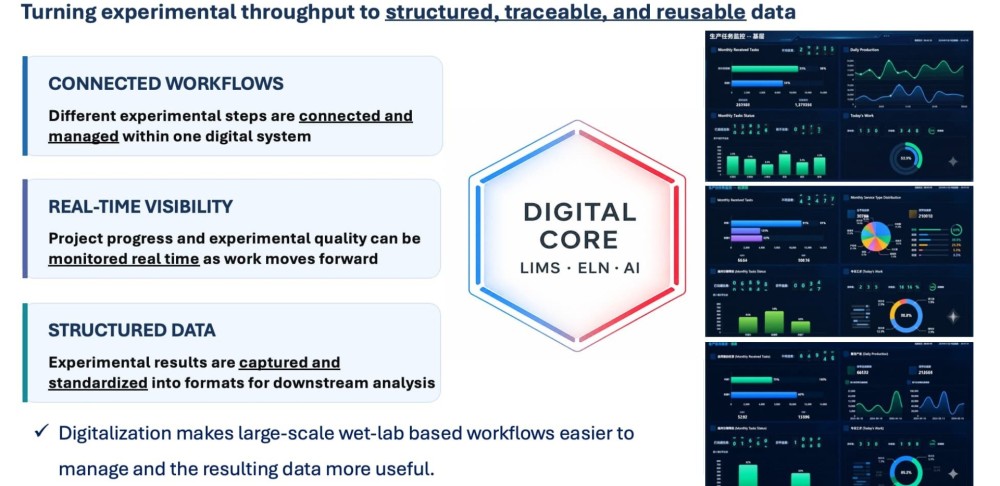
High-throughput testing generates substantial amounts of experimental information, but its value depends on whether researchers can efficiently interpret and reuse it.
For AI-driven discovery, standardized datasets are particularly important. Measurements of expression, affinity, binding kinetics, and developability can be used to evaluate model predictions, prioritize candidates, and inform subsequent design cycles.
RushDATA™ supports this process through structured experimental datasets and API-enabled data delivery, allowing results to be integrated into computational workflows.
By connecting AI-generated sequences with experimental feedback, researchers can continuously improve their understanding of which antibody designs are most likely to demonstrate desirable laboratory properties.
As AI continues to expand the scale of antibody design, high-throughput experimental validation will become increasingly important.
The ability to produce and characterize thousands of antibodies efficiently can help reduce delays, support earlier identification of developability risks, and enable more data-driven candidate selection.
Ultimately, accelerating antibody discovery requires more than generating sequences faster. It requires an integrated approach that connects computational predictions with reliable experimental evidence.
With platforms such as RushDATA™, Biointron is helping bridge this gap by delivering high-throughput wet-lab data at the speed and scale needed for the next generation of AI-driven antibody discovery.
Learn more about RushDATA™ and how Biointron supports high-throughput antibody validation.
AI-driven antibody discovery has made it possible to generate thousands of candi……
Learn how predicted antibody structures help screen AI-designed candidates, asse……
Compare RushDATA Basic, Standard and Premium: BLI affinity, SPR kinetics, DSF, P……