



Antibody AI models are trained on five broad data types: antibody sequences, paired heavy and light chain sequences, experimentally determined structures, antigen and complex information, and measured properties such as binding affinity, expression, and developability.
A generative sequence model can be trained on sequences alone. A model that predicts whether a sequence will express well, or bind a given antigen, needs sequences paired with measurements of that property. Sequence data are abundant, and property data are not. A sequence alone says nothing about what it binds, how tightly, or whether it can be manufactured.
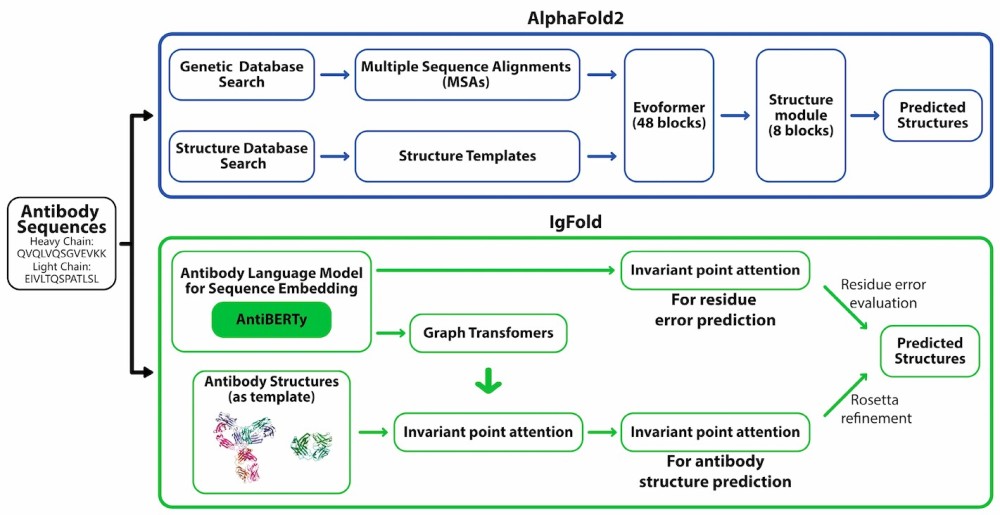
Self-supervised pretraining needs no property labels. The model receives sequences with residues masked out and learns to predict what belongs in the gaps, so nothing has to be measured and the corpora can be enormous: AntiBERTy, the sequence encoder in several antibody structure tools, was pretrained on 558 million natural sequences. What emerges is a representation of what antibody sequences look like, not a model of what they bind.
Task-specific training needs measured outcomes. Supervised models need labels: binder or nonbinder, an expression titer, a melting temperature. Categorical labels are cheaper at scale; continuous measurements are more informative and harder to produce. A pretrained representation is often fine-tuned on a small labeled set.
Immune repertoire sequences come from B-cell receptor sequencing, with metadata on species, donor, tissue and sampling context. Public collections such as the Observed Antibody Space run to billions of sequences. Two cautions: the data are redundant and unevenly distributed, since clonal expansion and study design skew representation, and a sequence from an exposed donor is not a confirmed binder.
Paired heavy and light chain sequences are a smaller, more valuable subset. Native VH-VL pairs recovered from single cells support models that reason about the complete binding site, which unpaired chains cannot, and randomly recombined chains should never be labeled as biological pairs. Our article on heavy and light chain pairing covers why.
Engineered libraries and designed variants are the third source, informative about local sequence changes and therefore useful for optimization models. A thousand variants of one parent antibody is still one antibody.
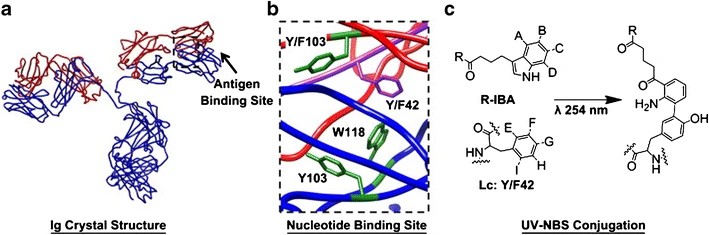
Experimentally determined structures from crystallography and cryo-EM give variable-domain geometry, CDR conformations and chain orientation; SAbDab curates them from the Protein Data Bank with consistent antibody-specific annotation. Coverage is the limitation: structures are scarce relative to sequences, unevenly spread across formats and families, and weighted toward Fab fragments, with very few intact IgG structures.
Antibody-antigen complex structures are scarcer still, and only a complex shows which residues contact each other, so interface modeling depends on them. Antigen construct, missing residues and experimental conditions all affect what one means. The consequence shows up in benchmarks: published evaluations put high-accuracy docking success for antibody-antigen complexes far below general protein complexes, in some cases in single digits.
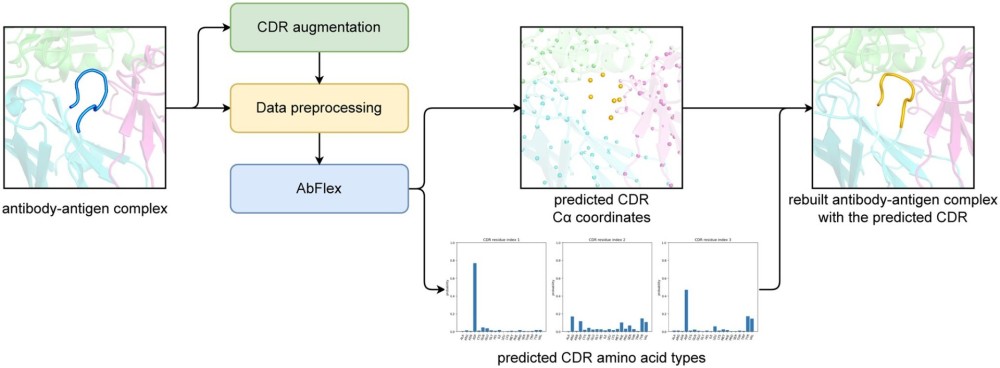
Predicted structures now enter training workflows in bulk, since prediction tools have released millions of models. They are useful and not equivalent to experimental coordinates: they carry the generating model's errors forward, so training on them can teach a model to agree with another model rather than with reality.
Not all binding labels are the same measurement. A display enrichment score, an ELISA signal, a screening hit call and a measured KD on purified protein differ in precision and in what they support, and treating them interchangeably is the most common way an antibody dataset goes wrong. Each record needs the antigen identity, the format on both sides and the assay conditions.
Specificity data mean counterscreens: related antigens, unrelated controls and, where relevant, cell-based measurements. The subtlety is in the negatives. A confirmed nonbinder under stated conditions is a valuable label; an untested pair is a missing observation, and turning it into a negative teaches the model something nobody measured.
Functional labels are mechanism-specific. Neutralization, receptor blocking, activation and internalization are different readouts, each needing its assay context recorded. Antigen binding is not biological activity, and conflating them trains a model on the wrong endpoint.
Expression data need the host, format, conditions, yield, and recovery, since the same sequence expresses differently across systems and the label partly records the workflow that produced it.
Developability is several properties, not one. Thermal stability, aggregation, self-association and polyreactivity are distinct endpoints with distinct assays, and a high melting temperature says nothing about self-association. Property prediction models largely tackle one parameter at a time, which published reviews attribute to the absence of large, integrated biophysical datasets. One published immunogenicity predictor was trained on 199 antibodies. Our article on predicted versus experimental developability covers the gap.
Deep mutational scanning links systematic substitutions to assay outcomes across thousands of variants, supporting accurate modeling within a defined sequence neighborhood. The best-known antibody example screened large libraries of trastuzumab variants and trained a model that predicted high-affinity HER2-specific variants, with tested designs retaining specificity. Strong evidence for the approach, bounded by its system: one parent antibody and one target will not transfer to unrelated antibodies.
Display-based screening on phage, yeast or mammalian cells generates labels at far greater scale, but selection pressure, expression bias and amplification shape what survives a round. Enrichment reflects fitness in the display format as much as affinity, so those labels and purified-antibody data belong in separate columns.
| Training-data Type | Example Information | Tasks It Can Support | Main Limitation |
|---|---|---|---|
| Repertoire sequences | Variable-region sequences, annotations | Sequence representation, generation | Usually no target-binding labels |
| Paired-chain sequences | Linked VH-VL identities | Pair-aware sequence modeling | Pairing does not establish binding |
| Experimental structures | Coordinates, CDR geometry | Structure prediction and design | Uneven structural coverage |
| Complex structures | Antibody-antigen contacts | Interface modeling and design | Limited target and interface diversity |
| Binding and functional data | Affinity, counterscreens, assay responses | Property prediction and ranking | Assay-dependent labels |
| Developability data | Expression, stability, self-association | Liability prediction and optimization | Incomplete and heterogeneous |
| Mutational screens | Variant sequences, screening outcomes | Local sequence-property modeling | Restricted sequence context |
Keep identity and context attached to every result. Each measurement should link to the exact sequence, chain pair and format tested, with units, controls, replicates and assay conditions retained. Our article on AI-ready antibody data covers the implementation.
Handle negatives, missing values and failures separately. A confirmed nonbinder, a failed expression, an assay that did not run and a value below the detection limit are four different facts. Collapsing them loses information, and dropping failures biases the dataset toward whatever worked.
Size is not suitability. Coverage across targets, species, formats, germlines and families is what matters. Antibody datasets inherit publication bias and the habit of re-measuring the same well-studied antibodies, and underrepresentation of rare targets is a recognized limit on generalization.
Leakage inflates performance more than any modeling choice. Duplicate sequences, close variants and overlapping structures spread across training and test sets produce benchmarks that do not survive new data, so splits go by sequence cluster, lineage, target or date depending on the claim being tested. That claim matters: predicting new variants of a well-characterized antibody is a different problem from predicting for an unfamiliar antibody or target, and a model good at the first may be useless at the second. Prospective testing on held-out candidates is the strongest evidence available.
Nearly every limitation above is a measurement problem. Sequences are plentiful; sequence-linked measurements, generated consistently enough to train or evaluate on, are not.
Biointron produces that kind of data. Candidate panels are expressed recombinantly and characterized with the readouts these models need: binding and kinetics by SPR on Biacore and Carterra, thermal stability by nanoDSF and self-association by AC-SINS, with expression yield, purity and aggregation recorded alongside, each result linked to its sequence.
For dataset-scale work, RushDATA™ expresses and characterizes more than 10,000 antibodies per day, with sequence-to-data turnaround of two days for cell-free expression and three days for CHO. Identical conditions matter more here than in candidate selection, since a model trained on measurements pooled across conditions learns the conditions along with the biology.
One caveat: generating data does not improve a model by itself. Curation, labeling, split design and validation remain your side of the work.
Speak to an Expert about generating antibody expression and characterization data for your machine learning project.
Antibody sequences, paired heavy and light chains, experimental structures including antibody-antigen complexes, and measured properties such as affinity, expression, and stability.
Yes. Pretraining on unlabeled sequences produces useful representations, but it cannot teach a model what a sequence binds; that requires measured labels.
The binding site is formed by both chains, so models of antigen recognition need pairs that genuinely occurred together, not chains combined computationally.
No. They are useful and far more plentiful, but they inherit the errors of the model that produced them and should be labeled separately.
Split by sequence cluster, clonal lineage, target or date rather than by individual sequence, and confirm performance prospectively where possible.
Zheng, J., Wang, Y., Liang, Q., Cui, L., & Wang, L. (2024). The Application of Machine Learning on Antibody Discovery and Optimization. Molecules, 29(24), 5923. https://doi.org/10.3390/molecules29245923
Learn how antibody selection criteria balance affinity, specificity, functional ……
Learn how antibody CDR design connects loop structure, heavy and light chain pai……
Learn how generative AI antibody design creates new sequences using target const……