



AI and machine-learning approaches are being applied across antibody discovery, including sequence generation, structure prediction, affinity optimization, and candidate ranking. These methods can produce large numbers of antibody sequences for experimental testing, increasing the need for wet-lab workflows that can evaluate candidates at comparable scale.
For antibody production in AI drug discovery, the speed of expression is one consideration, but experimental capacity is also important. Candidate antibodies must be produced and tested before computational predictions can be compared with measured properties such as expression, binding, and developability.
Recent developments in high-throughput antibody discovery illustrate this challenge. Although technologies such as next-generation sequencing can accelerate candidate identification, subsequent gene synthesis, cloning, antibody expression, and functional validation can still require substantial time and resources.
As larger candidate panels move from computational design into the laboratory, antibody production and characterization workflows need to accommodate hundreds or thousands of molecules in parallel.
An antibody sequence must first be expressed before many of its experimentally measurable properties can be assessed.
Transient mammalian expression systems, including Chinese hamster ovary (CHO) cells, are commonly used to produce recombinant antibodies. Besides expression data, researchers may also need measurements of:
Antibody titer or concentration
Antigen binding
Binding affinity
Analytical quality
Thermal stability
Polyreactivity
Self-interaction
Biointron provides a high-throughput antibody production workflow integrated with the assays required for candidate evaluation.
Many AI antibody discovery programs are designed to evaluate large sequence sets. Experimental testing at this scale requires production workflows that can process many constructs under consistent conditions.
Biointron's RushData platform combines gene-to-data antibody production with high-throughput experimental characterization. The workflow uses transient CHO expression and can process more than 20,000 molecules per week.
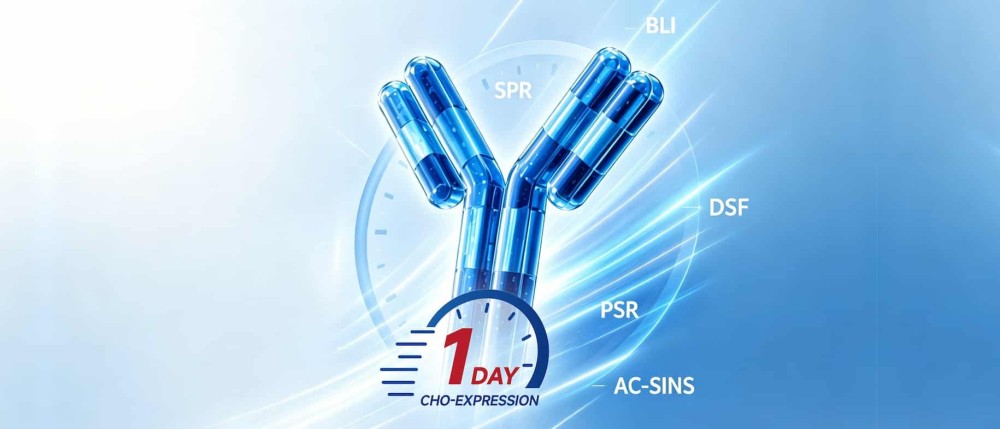
RushData uses a 1-day CHO expression workflow, followed by assay-specific characterization depending on the selected service package. Antibodies can be analyzed directly from supernatant for rapid screening or purified before more detailed analytical and binding measurements.
This approach allows large candidate sets to move from sequence input to experimental data within a single coordinated workflow.
Binding measurements are frequently used to compare antibody candidates during discovery and optimization.
Bio-layer interferometry (BLI) and surface plasmon resonance (SPR) are label-free methods used to study biomolecular interactions. Depending on the assay format, these methods can provide information on antibody-antigen binding and affinity.
RushData incorporates binding measurements at different levels of characterization. The "Basic" workflow includes titer measurement and two-point affinity assessment by BLI using antibody-containing supernatant. The "Standard" workflow includes purified antibody and multi-point affinity analysis by BLI or SPR.
Combining antibody production and binding analysis within the same high-throughput workflow reduces the number of separate experimental steps required between sequence design and experimental characterization.
For computational antibody discovery, these measurements can also provide experimental data associated with individual antibody sequences. Predicted properties can then be compared with laboratory measurements, and experimentally characterized candidates can be incorporated into subsequent computational analyses.
Affinity is an important property of an antibody candidate, but early developability assessment can provide additional information on properties such as thermal stability, nonspecific interactions, and antibody self-association. These measurements can be incorporated alongside expression and binding data to provide a more complete experimental profile of each candidate.
RushData's "Premium" package includes several developability assays in addition to purified-antibody expression and affinity characterization:
Differential scanning fluorimetry (DSF) measures parameters including melting temperature (Tm) and onset temperature (Tonset), which are used to assess thermal stability.
PSR-BVP evaluates polyreactivity.
AC-SINS evaluates antibody self-interaction.
These assays allow candidate sets to be compared across several experimentally measured properties. For AI and machine-learning applications, multidimensional datasets may also be useful when models are being developed or evaluated against several antibody characteristics simultaneously.
The increasing use of computational methods in antibody discovery has also increased interest in the structure and consistency of experimental datasets.
Large experimental campaigns can generate measurements from several assays across hundreds or thousands of molecules. Maintaining the association between each sequence and its experimental results is important for downstream analysis.
RushData produces structured datasets linking antibody candidates with their corresponding assay measurements. Depending on the selected workflow, these data can include expression, concentration, analytical characterization, binding, thermal stability, polyreactivity, and self-interaction measurements.
Structured output can support statistical analysis, candidate comparison, and integration with computational workflows. RushData also supports API-based order submission and retrieval of experimental data in JSON format for groups developing automated or programmatic workflows.
For AI drug discovery antibody production, this integration between physical antibody production and structured experimental data is particularly relevant. Computational systems operate on data, while experimental assays provide the measurements needed to evaluate the behavior of designed molecules.
AI-based antibody design can increase the number of sequences available for experimental testing. Wet-lab capacity must scale accordingly if large computational candidate sets are to be evaluated experimentally.
Faster expression can shorten one stage of this process, but overall validation also depends on assay throughput. Expression, binding characterization, and developability profiling all contribute different information about candidate antibodies.
RushData was developed to combine these steps in a high-throughput workflow, with 1-day CHO expression, capacity for 20,000 molecules per week, binding characterization, developability profiling, and structured data delivery.
As antibody discovery becomes more computationally intensive, scalable experimental validation provides the data needed to test predictions, compare candidates, and support subsequent design cycles.
Biointron’s Antibodies After Hours: From Algorithms to Antibodies was held at Th……
Discover how high-throughput wet-lab validation connects AI-designed antibody se……
Understand the hybridoma generation process for monoclonal antibody production, ……
Learn how AI antibody discovery connects computational design with antibody expr……