




Biointron, a leading contract research organization specializing in antibody discovery, expression, and optimization for global biotechnology and pharmaceutical companies, has released RushData, a new service for antibody discovery uniquely suited for AI/ML driven workflows.
AI-driven antibody discovery is rapidly reshaping how therapeutic antibodies are generated and optimized. Computational and machine learning models can now generate hundreds to thousands of designed antibody sequences per cycle, all of which require high-quality experimental data for validation. However, the current experimental workflows have not scaled at the same pace. Expression, binding characterization, and developability assessment are still commonly executed as separate steps, taking at least 3-4 weeks to complete. This creates a fragmented experimental workflow, which becomes the bottleneck for rapid and continuous improvement in modeling and machine learning.
In most antibody discovery pipelines, candidates move through different stages:
Expression is performed in one workflow or by one provider
Antibody-antigen interaction analysis is conducted in another workflow
Developability assessments are often delayed until later-stage selection
Data formats and experimental conditions vary across steps
To address this gap, Biointron has launched RushData, an integrated high-throughput platform designed to connect antibody sequence generation directly to standardized experimental data. Serving over 3,000 biopharma companies worldwide with 14+ years of experience in the field, Biointron is trusted for speed, reliability, and deep expertise in antibody production and characterization.
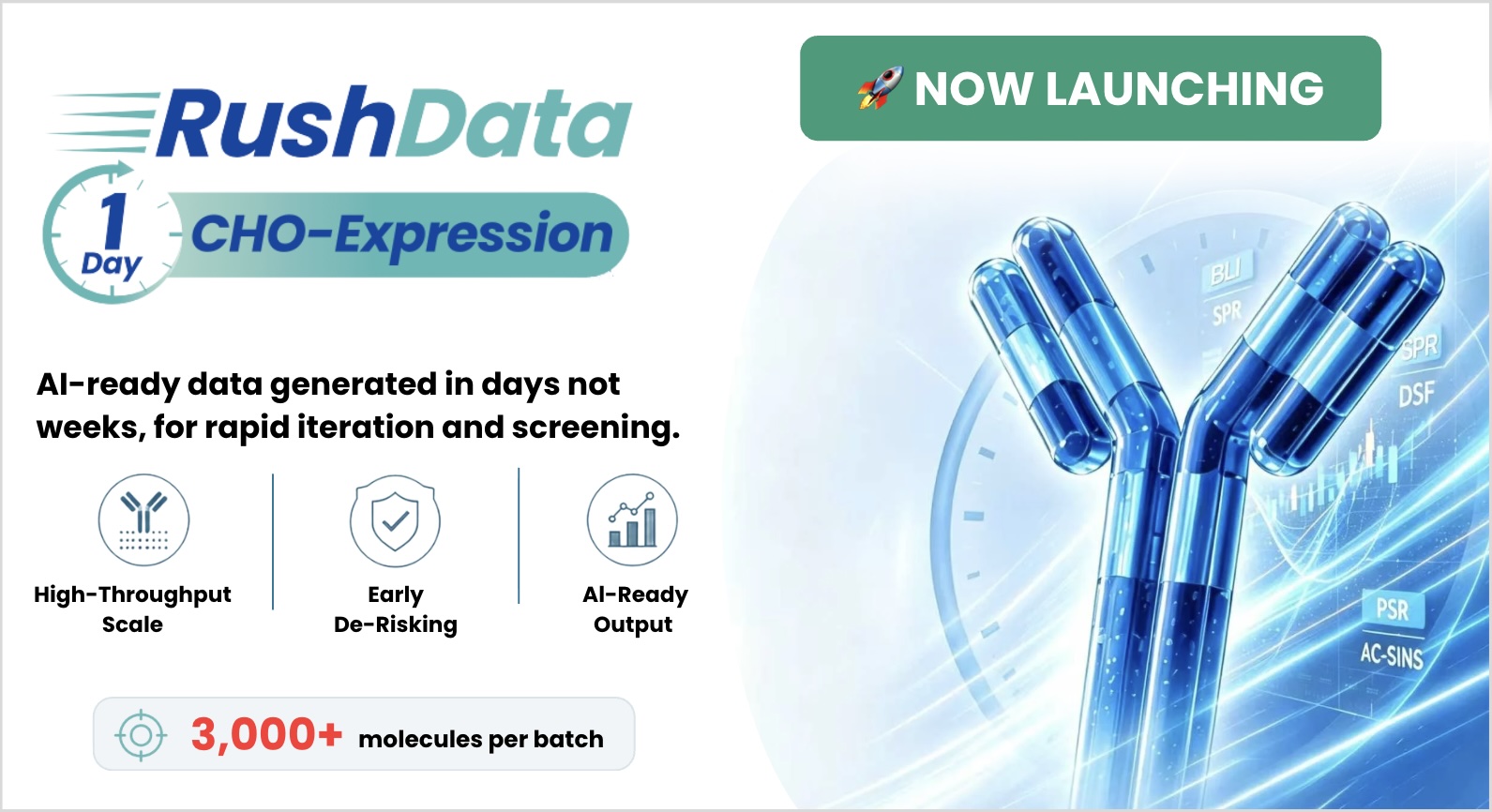
RushData is built around a 1-day transient CHO expression system, enabling rapid production of large antibody panels using mammalian expression. CHO cells are the most widely used host for therapeutic antibody expression across biopharmaceutical industry due to their ability to produce human-like post-translational modifications, proper protein folding, and clinically relevant developability profiles.
With 1-day CHO expression, Biointron enables researchers to generate data that is not only rapid, but directly predictive of downstream performance. This means scientists can move from sequence to functional, developability-relevant insights in a fraction of the traditional timeline.
1-day expression with CHO cells, the gold standard host system used by the biopharma industry, for rapid iteration and screening with custom workflows for targets and modalities
Standardized, structured AI/ML-ready data from processing 3,000+ molecules per batch in parallel
Binding characterization using BLI and/or SPR, integrated directly with expression and purity data
Early developability profiling in selected packages, including:
Differential scanning fluorimetry (DSF) for thermal stability
AC-SINS for self-interaction behavior
Polyspecificity reagent binding (PSR-BVP) for polyreactivity
By combining expression and characterization into a unified workflow, RushData shortens the time between sequence to decision-ready data. This allows for:
Faster elimination of low-priority candidates
Earlier detection of expression and developability liabilities
Reduced reliance on sequential outsourcing steps
More frequent and better-informed design cycles
For AI-driven antibody discovery teams, the goal is to generate high-quality experimental data that validates whether model-designed sequences behave as predicted. RushData is designed around this need, enabling teams to rapidly express large panels of AI-generated candidates and generate structured, multi-parameter datasets across expression, binding, and early developability attributes. This allows computational groups to quickly determine which designs work, where models fail, and how to refine subsequent iterations, thus turning experimental validation into a scalable data-generation engine for continuous model improvement.
RushData is designed to address this transition by integrating rapid expression with binding and developability characterization in a single system. The result is a more continuous link between computational design and experimental validation.
To learn more, contact Biointron at www.biointron.com or +1(732)790-8340.
Biointron announces limited-time RushData launch pricing for high-throughput ant……
August 2026 brought another mix of acquisitions, licensing agreements, strategic……
Antibody discovery often begins with a highly diverse population of B cells, onl……
As larger candidate panels move from computational design into the laboratory, a……