



Antibody discovery often begins with a highly diverse population of B cells, only a fraction of which may produce antibodies with the desired specificity or functional properties. Single-cell screening provides a way to examine these cells individually while maintaining a connection between an antibody phenotype and the cell that produced it.
Droplet microfluidics extends this concept by placing individual cells and assay reagents into very small, physically separated reaction compartments. In antibody screening, these droplets can be used to detect antibody secretion, antigen binding, and other assay-compatible signals before selected cells are recovered for sequence analysis and recombinant antibody validation.
Recent high-throughput antibody screening workflows increasingly combine microfluidics with single-cell sequencing and downstream expression. These approaches complement established antibody library display and other single B cell technologies rather than replacing them; each addresses different parts of the antibody discovery process.
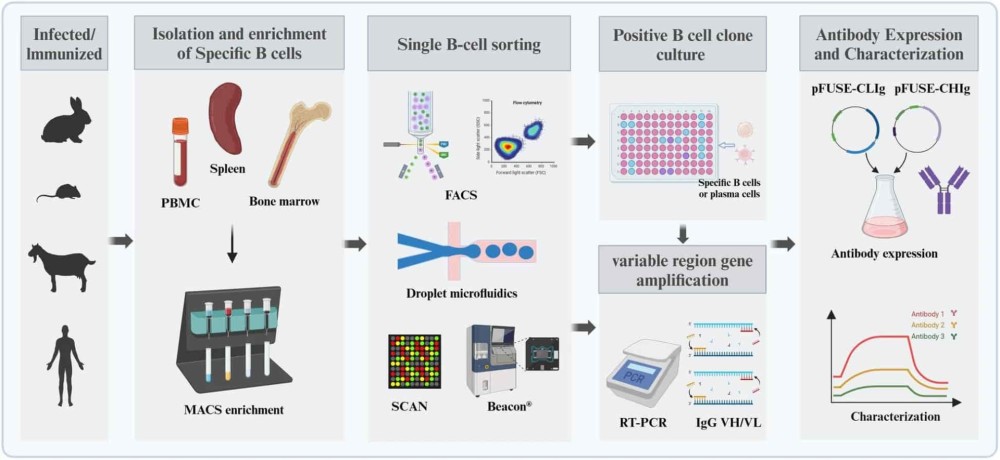
Antibody-secreting cells within an immune repertoire can differ substantially in antibody sequence, secretion level, antigen specificity, and affinity. Measurements made across mixed cell populations do not inherently preserve the relationship between a secreted antibody and the individual cell that produced it.
Droplet-based screening addresses this problem through physical separation. Individual cells are encapsulated in discrete reaction compartments, allowing secreted products to remain associated with their cell of origin during the assay. This is particularly useful when screening large and heterogeneous cell populations in which potentially useful antibody-producing cells may occur at low frequency.
Microfluidic single-cell technologies are one of several approaches used for high-throughput antibody discovery. Single B cell workflows can directly isolate antigen-specific cells and recover naturally paired antibody variable regions, while display technologies screen antibody libraries through iterative selection. The choice of method depends on the biological source, desired readout, and downstream workflow.
Biointron's AbDrop platform applies droplet microfluidics to plasma B cell screening. The current workflow screens up to approximately 1-2 million plasma B cells from immunized animals and links droplet screening with sequence recovery, recombinant expression, and validation.
In droplet microfluidics, an aqueous phase containing cells and assay reagents is dispersed within an immiscible oil phase to form individual droplets. Each droplet functions as a small reaction compartment, commonly at picoliter scale. The droplets can subsequently be analyzed and sorted according to a detectable signal.
For antibody screening, the aim is generally to load individual antibody-producing cells together with the reagents required to measure a relevant phenotype. Depending on the assay design, this may include measurements of antibody secretion, antigen binding, specificity, or affinity.
The small volume of a droplet changes the physical environment of a single-cell assay. Secreted molecules remain close to the producing cell rather than dispersing throughout a larger shared volume, while physical separation reduces mixing between independent screening events.
Small volume is not universally advantageous, however. The same picoliter-scale environment limits the amount of reagent available within each compartment. The review identifies limited reagent availability, encapsulation efficiency, and dilution-related effects as factors that can reduce assay sensitivity or contribute to false-negative results.
Droplet assays therefore require careful optimization of cell loading, capture reagents, detection chemistry, and incubation conditions. The appropriate conditions depend on the cell type and the biological property being measured.
Droplet generation converts a cell suspension into a large number of independent assay compartments. In an antibody screening experiment, the objective is typically to obtain droplets containing individual cells together with the necessary nutrients and detection reagents.
Single-cell isolation makes it possible to associate a measured phenotype with an individual antibody-producing cell. Maintaining appropriate loading conditions is important because droplets containing more than one relevant cell can complicate interpretation, while empty droplets contribute no antibody-producing cell to the screen.
Cell viability must also be maintained if selected cells are to be recovered for subsequent molecular analysis. The performance of this step depends on the particular platform, cell population, and sample preparation method.
Once encapsulated, an antibody-secreting cell releases antibody into its local droplet environment. Detection reagents can then convert antibody production or antigen recognition into a measurable signal.
Several assay principles have been demonstrated. FRET-based systems, for example, use appropriately positioned fluorescent donor and acceptor molecules to detect complexes formed by secreted antibodies. The review describes commercial systems in which antibody secretion can be detected within droplets and antigen-specific cells subsequently selected for further analysis.
Biointron's AbDrop workflow similarly uses fluorescence-based detection. Individual plasma cells are encapsulated with detection reagents, incubated for approximately one to two hours, and sorted according to an antigen-associated fluorescence signal. Negative and empty droplets are used to establish the detection threshold.
A positive signal should still be interpreted within the context of the assay. Droplet screening identifies cells that satisfy a defined screening criterion; subsequent experiments are required to confirm the antibody's sequence, antigen specificity, affinity, and other properties of interest.
A major advantage of droplet microfluidics is the number of independent reactions that can be generated and analyzed.
A recent review describes microdroplet systems capable of producing very large droplet populations and processing droplets at high rates.1 Individual implementations vary substantially: one cited commercial system analyzed up to one million antibody-secreting cells at 250 droplets per second, while another reported sorting at up to 600 droplets per second.
Selected droplets can be physically separated from the larger population, enriching cells associated with the desired signal. This enrichment is especially relevant when the target cell population represents only a small fraction of the starting repertoire.
Because each experiment occurs within a very small volume, large numbers of assay events can also be performed using small quantities of reagent per compartment, although total reagent requirements depend strongly on the specific microfluidic and assay configuration.
A droplet-based antibody screening experiment can be viewed as a sequence of connected steps:
Prepare → Encapsulate → Measure → Sort → Recover → Validate
The starting population depends on the discovery strategy. In single B cell antibody discovery, cells may be isolated from peripheral blood or lymphoid tissues after immunization or infection. Antibody-secreting cells, including plasma cells, are commonly used for secretion-based droplet assays.
Cell concentration and viability affect the subsequent encapsulation step. Sample preparation may also include enrichment of the relevant B cell population before droplet generation.
Cells are introduced into the microfluidic system together with the reagents required for the assay. The aqueous material is divided into individual droplets within an oil phase.
Encapsulation conditions are adjusted to obtain an appropriate distribution of cells across droplets while maintaining conditions compatible with secretion and detection. Droplet stability is also required throughout incubation and analysis.
After a suitable incubation period, droplets are interrogated for the assay signal. Depending on the system, fluorescence measurements may indicate antibody secretion, target recognition, or another antibody-associated phenotype.
Droplets satisfying the predefined selection criteria are separated from the remaining population. This provides an enriched pool of cells for downstream molecular analysis.
Droplet selection is followed by recovery of the biological information required to identify the antibody.
Selected cells can be processed for antibody sequence recovery, and the corresponding variable regions can subsequently be cloned and expressed recombinantly. The recombinant antibodies are then tested using independent assays to confirm the phenotype observed during primary screening.
This confirmation step is important because the initial droplet signal is a screening measurement rather than a complete characterization of the antibody.
An antibody's binding site is formed by its paired heavy- and light-chain variable regions. Preserving the original VH/VL pairing of an individual B cell is therefore important when reconstructing antibodies identified through single-cell screening.
Droplet-based methods have been developed specifically to retain this relationship. Emulsion-based approaches are capable of preserving natural heavy- and light-chain pairing and generating paired VH–VL amplicons for next-generation sequencing.
High-throughput single-cell sequencing workflows similarly use cell-associated molecular identifiers or barcodes to recover paired IgG heavy- and light-chain variable-region genes from individual cells.
Sequencing becomes particularly useful when the sequence information can be associated with information generated during screening.
LIBRA-seq provides one example of this principle. In this approach, antigen-associated barcodes are linked with B-cell receptor transcripts, allowing BCR sequences to be associated with corresponding antigen specificity.
Similar cell-level barcoding approaches can be incorporated into droplet antibody screening workflows to maintain traceability between a selected cell and its antibody sequence.
Sequence analysis can also identify clonally related antibodies and reduce redundancy before recombinant follow-up. Biointron's AbDrop workflow, for example, includes sequence quality control and clonotype clustering after NGS to help distinguish unique antibody sequences from repeated clonotypes.
Once VH and VL sequences have been identified, selected pairs can be cloned into expression constructs and produced as recombinant antibodies.
Recombinant expression allows antibodies derived from different single cells to be produced under standardized conditions. Subsequent assays can then evaluate properties such as antigen binding, affinity, cell-surface recognition, biological activity, or other project-specific characteristics.
Experimental confirmation remains necessary even when screening and sequencing data are available. Sequence identity establishes which antibody was recovered; recombinant characterization determines whether the reconstructed molecule reproduces the desired phenotype.
Droplet screening is particularly applicable when the experimental question requires a phenotype to remain associated with an individual antibody-producing cell.
Typical considerations include:
| Screening requirement | Relevance of droplet screening |
|---|---|
| Large, heterogeneous B cell population | High-throughput single-cell analysis can interrogate many cells individually |
| Rare antibody-producing cells | Large screening populations can improve opportunities to identify low-frequency positives |
| Secretion-based readout | Secreted antibody can be measured within the cell's droplet |
| Need to retain cell-to-antibody linkage | Selected cells can be recovered for sequence analysis |
| Antibody phenotype incompatible with available droplet chemistry | A different screening format may be more appropriate |
| Assay requiring extensive reagent exchange or prolonged manipulation | Picoliter droplet volume may impose practical constraints |
Antibody-secreting B cells are a major application, particularly plasma cells and other antibody-secreting cells. The appropriate population depends on the assay and screening platform. Biointron's AbDrop workflow currently focuses on plasma B cells obtained from immunized animals, with mouse, rat, rabbit, and humanized mouse systems among the supported sources.
There is no universal minimum. The number required depends on the expected frequency of antigen-specific cells, sample composition, assay sensitivity, and screening platform. High-throughput droplet systems are useful because they can interrogate very large populations; published implementations described in the review range to hundreds of thousands or millions of cells. Biointron's AbDrop workflow can screen approximately 1–2 million plasma B cells.
Yes. Droplet screening can be linked to single-cell sequencing, and several methods have been developed to preserve paired heavy- and light-chain sequence information. Selected sequences can then be reconstructed and expressed as recombinant antibodies for confirmation.
Turnaround depends on the starting material and the number of steps included after screening, such as sequence recovery, bioinformatic analysis, recombinant antibody expression, purification, and validation. Reported timelines therefore vary considerably between platforms and should not be generalized from the droplet-sorting step alone.
Useful outputs include the screening conditions and controls, selected-cell or droplet information, paired antibody sequences, sequence-quality information, clonotype assignments, and results from recombinant validation. These data help maintain traceability from the primary screen to the final antibody candidate.
Biointron's AbDrop Single B Cell Screening Platform integrates droplet-based plasma cell screening with sequence recovery and downstream antibody characterization.
Individual plasma cells are encapsulated in picoliter droplets and screened for antigen-associated signals. Positive cells are subsequently processed through single-cell library construction, NGS sequencing, and bioinformatic analysis to recover naturally paired VH/VL sequences. Selected antibodies can then move into high-throughput recombinant expression and experimental validation. Biointron currently reports screening capacity of up to approximately 2 million plasma B cells, with screening completed within one day and paired antibody sequences obtainable within approximately one week.
The workflow illustrates the broader role of droplet technology in antibody discovery: the value of single-cell screening lies not only in the number of cells that can be processed, but in maintaining a connection between cellular phenotype, antibody sequence, and subsequent recombinant validation.
Droplet microfluidics provides a way to analyze antibody-producing cells individually while maintaining high screening throughput. Picoliter compartments isolate cells and their secreted products, allowing antibody-related signals such as secretion, specificity, and affinity to be measured at single-cell resolution.
The approach also has limitations. Encapsulation efficiency, restricted droplet volume, assay chemistry, cell viability, and signal detection can all influence screening performance. Positive droplets therefore represent candidates for further analysis rather than fully characterized antibodies.
When droplet screening is combined with paired heavy/light-chain sequencing and recombinant antibody expression, the workflow can connect a single-cell phenotype to a defined antibody sequence and subsequently test that antibody under standardized conditions. This combination of screening, sequence recovery, and experimental confirmation is central to the use of droplet microfluidics in high-throughput antibody discovery.
Wang, X.-D., Ma, B.-Y., Lai, S.-Y., Cai, X.-J., Cong, Y.-G., Xu, J.-F., & Zhang, P.-F. (2025). High-throughput strategies for monoclonal antibody screening: advances and challenges. Journal of Biological Engineering, 19(1). https://doi.org/10.1186/s13036-025-00513-z
Biointron’s Antibodies After Hours: From Algorithms to Antibodies was held at Th……
Discover how high-throughput wet-lab validation connects AI-designed antibody se……
Understand the hybridoma generation process for monoclonal antibody production, ……
Learn how AI antibody discovery connects computational design with antibody expr……