





VHHs antibodies, or nanobodies, are camelid single-domain antibody fragments derived from the variable region of camelid heavy-chain only antibodies. Their small size (~15 kDa), high solubility, and superior thermal and chemical stability make them effective biorecognition elements for biosensing applications. These VHH antibody constructs maintain affinity and specificity comparable to full-sized immunoglobulins, while offering distinct advantages in sensor fabrication and operation. The small VHH domain size and engineered complementarity-determining regions contribute to their strong target recognition and adaptability across biosensor platforms.
Unlike full-length antibodies (~150 kDa), VHHs retain functionality under harsh environmental conditions. Compared to conventional IgG antibodies, classical antibodies, and traditional monoclonal antibodies, VHHs exhibit reduced steric hindrance, facilitating access to cryptic epitopes and allowing higher packing densities on sensor surfaces. These properties enhance sensor performance in terms of sensitivity, response time, and long-term stability. The small size of VHH fragments also improves tissue penetration and compatibility with miniaturized sensor systems.
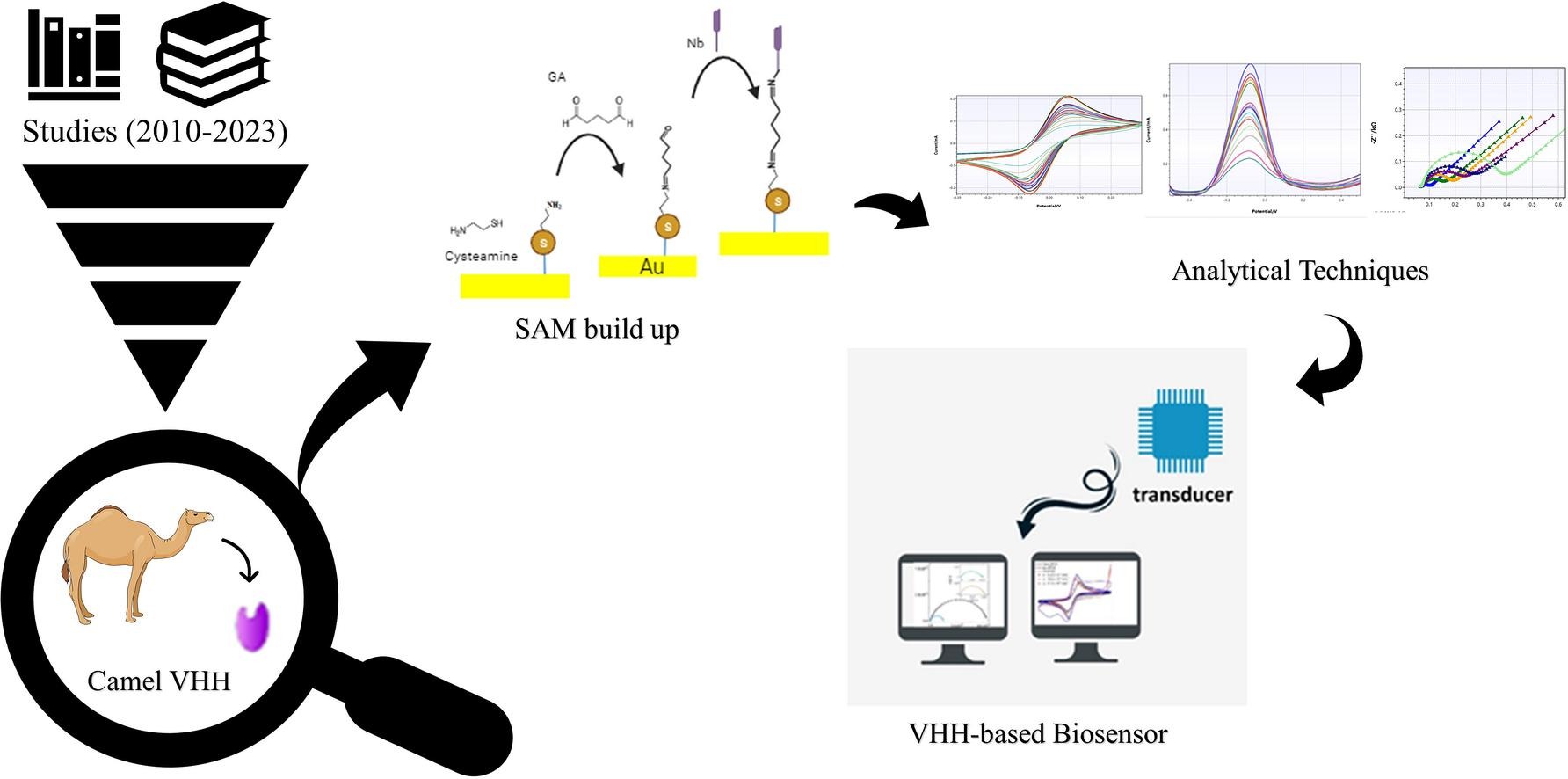
Engineered C-terminal cysteine residues enable covalent anchoring of VHHs onto gold surfaces through thiol-gold interactions. This strategy, validated by surface plasmon resonance (SPR), circular dichroism (CD), and secondary ion mass spectrometry, produces oriented, dense, and stable nanobody monolayers.
These monolayers showed high responsiveness in antigen-binding assays, confirming the retention of native conformations and exposure of the antigen-binding site. Thermal stability was confirmed up to 70 °C, ensuring compatibility with real-world diagnostic settings. Molecular dynamics simulations further supported the preferred orientation of VHHs, driven by the proximity of the engineered thiol group to the gold interface. The exposed CDR3 regions and optimized complementarity determining regions further improved accessibility to target analytes.
In a systematic review of nanobody-based diagnostics, Ahmad et al. emphasized that among various immobilization strategies, the use of modified cysteine residues at the C-terminal of VHHs is particularly effective in constructing well-oriented and dense self-assembled monolayers (SAMs) on sensor surfaces.1 This orientation control directly enhances sensor performance by preserving the accessibility of the antigen-binding site and maximizing surface coverage. These findings support broader development of advanced VHH biosensors for clinical and environmental monitoring.
Alternative immobilization strategies utilize pre-formed nanobody complexes in solution prior to application on sensor substrates. For example, “in tube” and “in drop” protocols combine VHHs with nanomaterials (e.g., AuNPs, Fe₃O₄, or polymeric nanofibers) and linkers (e.g., OVA or BSA) to form bioactive assemblies. These are then deposited onto screen-printed carbon electrodes (SPCEs) or glassy carbon electrodes (GCEs).2
Site-specific tags, such as lysine or histidine, have also been exploited for one-step immobilization. HaloTag and SpyTag/SpyCatcher systems facilitate oriented and stable attachment while enabling surface regeneration.
VHH-based electrochemical sensors employ cyclic voltammetry (CV), differential pulse voltammetry (DPV), square wave voltammetry (SWV), and electrochemical impedance spectroscopy (EIS). VHHs are immobilized on SPCEs or GCEs, often in conjunction with nanomaterial-enhanced films (e.g., gold nanoparticles, chitosan, mesoporous carbon). These platforms provide low detection limits, short assay times, and resilience to temperature fluctuations. The small heavy-chain-only variable domain structure contributes to efficient signal transduction and improved sensor stability.
Electrochemical systems are increasingly being applied in point-of-care diagnostic tests, rapid biomarker screening workflows, and disease diagnosis applications.
Gold surfaces functionalized with VHHs engineered to contain terminal cysteine residues allow real-time detection using surface plasmon resonance (SPR).
CD spectroscopy and contact angle measurements indicated that the immobilized nanobodies retained their secondary structure and hydrophilic surface characteristics, contributing to the consistency and reproducibility of sensor responses.
Organic electrochemical transistors (OECTs) integrated with VHHs via the SpyTag/SpyCatcher system demonstrated detection of viral proteins in under two minutes using low-power operation (<100 nW). Gate electrodes functionalized with Au and peptide interfaces enabled stable nanobody binding and high signal fidelity in real-time assays. These systems support next-generation VHH technology platforms for wearable biosensors and portable health monitoring devices.
VHHs can be rapidly and cost-effectively expressed in microbial hosts such as E. coli, unlike full-length antibodies which require mammalian cell expression. Production pipelines incorporate:
Immune libraries (10⁶–10⁸ CFU/mL) from immunized camelids belonging to the camelidae family.
Naïve libraries (10⁹–10¹¹ CFU/mL) for broad antigen coverage.
Synthetic libraries (up to 10¹⁵ CFU/mL) enabling high-affinity selection against non-immunogenic or hazardous targets using phage display and other advanced screening technologies.
Thermal stability: Active at 50-90 °C with long-term shelf life.
Size and flexibility: Low steric hindrance and access to buried epitopes.
Production efficiency: High yield and low cost in bacterial systems.
Functional robustness: Resistance to denaturation, aggregation, and enzymatic degradation.
Sensor compatibility: Suitable for electrochemical, optical, and transistor-based platforms.
For example, the unique convex paratope and extended CDR3 loop of VHHs, as noted by Ahmad et al., further enable binding to recessed or conformational epitopes not accessible to conventional antibodies.1
Immobilization control: Random orientation can reduce sensitivity. C-terminal engineering or bioconjugation systems (e.g., SpyTag) can address this.
Signal consistency: In complex media (e.g., urine, saliva, cell lysates), nonspecific binding or matrix effects can impact performance.
Analyte availability: Limited VHHs are available for some targets, necessitating de novo discovery from synthetic or immune libraries.
Surface regeneration: Some platforms support reuse via chemical stripping or mild regeneration buffers, but not all configurations are amenable.
Construct optimization: Review findings also highlighted the importance of framework modifications, fusion tags, and immobilization strategies such as cysteine tagging to overcome orientation and stability issues. Proper construct engineering accelerates biosensor development while ensuring functional reproducibility.
Gold-thiolate binding chemistry: Provides oriented, high-density VHH monolayers with preserved bioactivity.3
Nanomaterial enhancement: Incorporation of graphene oxide, mesoporous carbon, and metallic nanoparticles boosts sensitivity.
Wearable sensor integration: VHH-based immunotransistors and OECTs are being adapted for field use and personal health monitoring.
Multiplexing: VHH libraries allow development of multi-analyte biosensor arrays, increasing throughput and diagnostic value.
What are VHH-based biosensors?
They are analytical platforms that utilize camelid single-domain antibodies (VHHs or nanobodies) to selectively detect target molecules through transduction methods such as electrochemical or optical readouts.
How are VHHs immobilized on sensor surfaces?
Common strategies include covalent attachment via engineered cysteine residues to gold (forming thiol-gold bonds) or bioconjugation using SpyTag/SpyCatcher systems.
What detection methods are compatible with VHH-based sensors?
They can be used in CV, DPV, EIS, SPR, and transistor-based platforms (e.g., OECTs) and can be integrated with analytical methods such as flow cytometry for advanced research applications.
Ahmad, M., Amorim, C. G., Abu Qatouseh, L. F., & Montenegro, M. C. (2024). “Nanobody-based immunodiagnostics: A systematic review of nanobody integration in diagnostics and deep insight into electrochemical immunoassays”. Microchemical Journal, 196, 109628. https://doi.org/10.1016/j.microc.2023.109628
Ionescu, R. E., & Ionescu, R. E. (2023). Ultrasensitive Electrochemical Immunosensors Using Nanobodies as Biocompatible Sniffer Tools of Agricultural Contaminants and Human Disease Biomarkers. Micromachines, 14(8). https://doi.org/10.3390/mi14081486
Bárbara Simões, Guedens, W. J., Keene, C., Kubiak-Ossowska, K., Mulheran, P., Kotowska, A. M., Scurr, D. J., Alexander, M. R., Broisat, A., Johnson, S., Serge Muyldermans, Devoogdt, N., Adriaensens, P., & Mendes, P. M. (2021). Direct Immobilization of Engineered Nanobodies on Gold Sensors. ACS Applied Materials & Interfaces, 13(15), 17353–17360. https://doi.org/10.1021/acsami.1c02280
Biointron’s Antibodies After Hours: From Algorithms to Antibodies was held at Th……
Discover how high-throughput wet-lab validation connects AI-designed antibody se……
Understand the hybridoma generation process for monoclonal antibody production, ……
Artificial intelligence (AI) is changing how therapeutic antibodies are discover……