
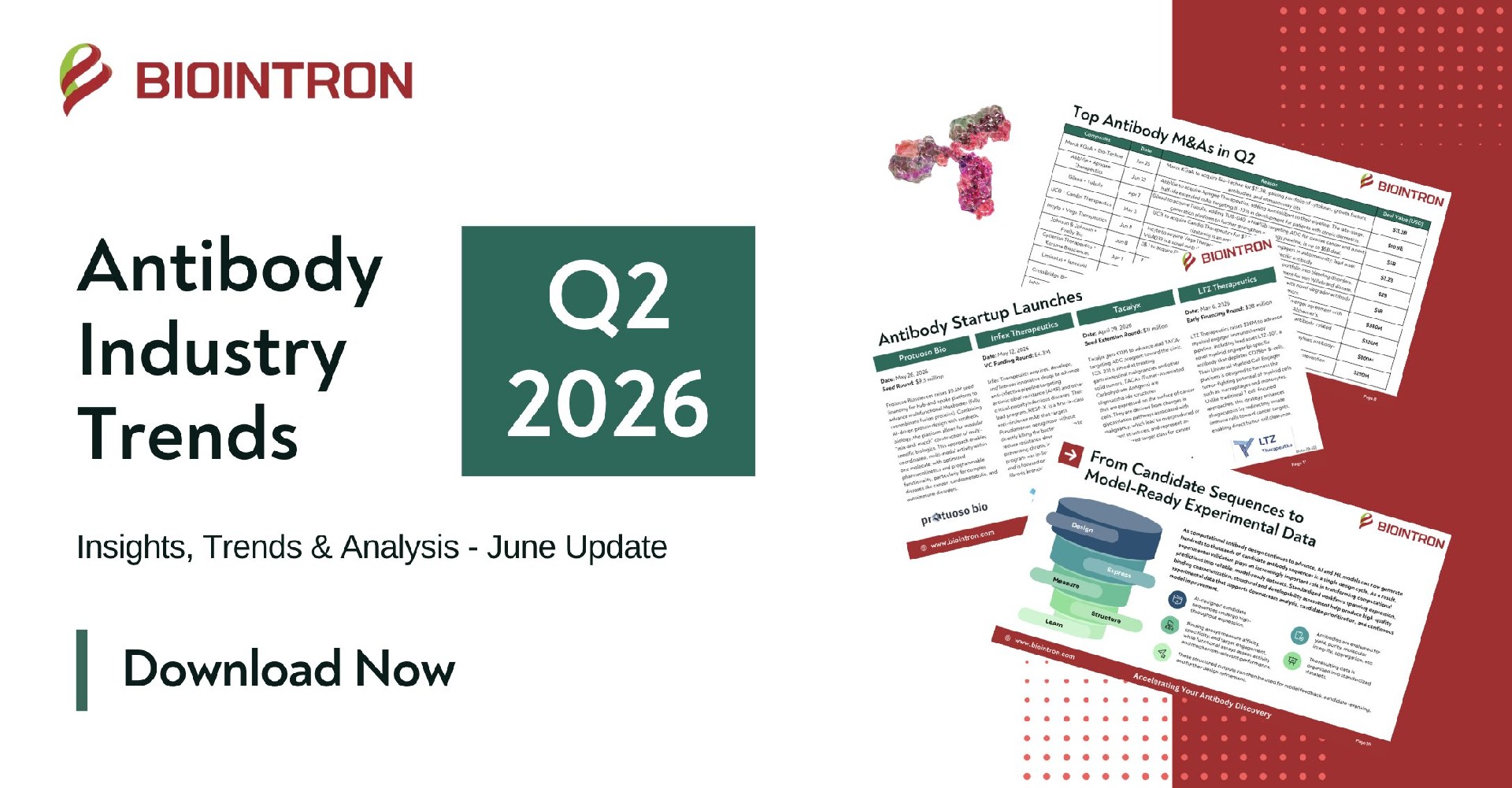


Over the past few months, the biotech landscape saw venture funding of antibody companies with significant seed-to-Series D rounds across a wide range of disease areas. A key trend emerging is the diversification of antibody modalities, spanning bispecifics, antibody-drug conjugates (ADCs), radioisotope conjugates, and de novo proteins, paired with a rapid acceleration in AI-powered discovery platforms. Therapeutic focus is broadening from oncology and autoimmune disease to cardiovascular, metabolic, ophthalmic, and allergic conditions, reflecting the growing clinical ambition and technological sophistication in the antibody startup ecosystem.
A substantial amount of funding was directed toward companies integrating artificial intelligence to reshape antibody discovery and engineering. Chai Discovery ($70M Series A) introduced a fully open-source, de novo antibody design platform powered by foundational AI models that analyze diverse biomolecular structures. Similarly, Ridge Biotechnologies ($25M seed) is developing next-generation antibody conjugates using proprietary machine learning trained on cell-free datasets. Their NativeLink™ and ProTrigger™ technologies enhance site-specific conjugation and payload activation.

Immuto Scientific ($8M Seed 2) leverages structural surfaceomics to identify targetable surface protein conformations (SPCs), forging a discovery partnership with Daiichi Sankyo for antibody development. Alchemab, with a cumulative $114M Series A raise, uses AI to identify protective auto-antibodies from resilient patient populations, advancing clinical candidates across immunology, oncology, and neurology.
Bispecific antibodies featured prominently in both early- and late-stage pipelines. Ollin Biosciences ($100M Series A) is progressing OLN324, a VEGF/Ang2 bispecific for ophthalmic indications, and OLN102, a TSHR/IGF-1R bispecific for autoimmune eye diseases. Minghui Pharmaceutical secured $131M in pre-IPO funding to advance bispecific antibodies and ADCs, including a PD-1/VEGF BsAb in Phase 2 and a B7-H3 ADC in Phase 3 for small-cell lung cancer.
Dualitas Therapeutics ($65M Series A) is targeting autoimmune and allergic diseases through its DualScreen platform for co-targeting novel surface combinations, with lead bispecifics DTX-102 and DTX-103. Avenzo Therapeutics ($60M Series B) is advancing two bispecific ADCs: AVZO-1418 targeting EGFR/HER3 and AVZO-103 targeting Nectin4/TROP2 for solid tumors. Mabylon ($37M Series B) is expanding its portfolio of multispecific antibodies, including a trispecific peanut allergen-neutralizing agent in clinical development.

Startups are pioneering novel antibody formats to address unmet clinical needs. IsoBio ($5M seed) is developing antibody-isotope conjugates (AICs™) for oncology, using proprietary linkers to attach isotopes such as Lutetium-177, Actinium-225, and Terbium-161 to monoclonal antibodies. They are targeting both derisked and novel tumor antigens for patients in need of new cancer therapies. Odyssey Therapeutics is developing medicines that target autoimmune and inflammatory diseases. Their $213M Series D will fuel development of V-body and bispecific candidates, including OD-00910, a tetravalent TNFR2 agonist for Tregs, and a TSLP/IL-33 bispecific cytokine antagonist designed to address upstream cytokine redundancy and improve suppression of inflammation.

EvlaBio raised €21 million seed funding to complete preclinical development and progress towards IND-enabling studies for a monoclonal antibody for the treatment of left ventricular hypertrophy in the setting of chronic kidney disease. Their lead asset is designed to inhibit the pathological FGF23/ FGFR4 cardiac signaling axis — a critical driver of cardiac remodeling in patients with CKD.
Several stealth-mode companies entered the public sphere with substantial backing. Neok BIO, a spinout from ABL Bio, launched with a $75M Series A to develop bispecific ADCs for solid tumors. Their novel Topo-1-based platform uses a proprietary, validated linker-payload technology (SYNtecan E™) that enables ADC generation with strong linker stability and superior biophysical properties. With regards to payload, exatecan has potential advantages over other approved Topoisomerase-1 (Topo-1) inhibitors including increased permeability and greater bystander effect, and lower risk of resistance (as exatecan is not an MDR1 substrate).
Accipiter Biosciences raised $12.7M in seed funding to develop de novo protein therapeutics for complex diseases using novel computational methods. They create customizable, multifunctional proteins for any therapeutic application. Meanwhile, AI Proteins secured $41.5M to develop miniprotein therapeutics as a novel modality. They would have control over function, stability, solution behavior, and pharmacology, and can be tailored for sophisticated and diverse mechanisms of action, including targeted delivery or multispecific agents.

Biointron’s Q2 2026 Antibody Industry Trends report aims to explore the events a……
Artificial intelligence (AI) can be used throughout the drug development process……
Peptides and antibodies have different strengths as therapeutic molecules. Pepti……
Therapeutic antibodies are often used to block receptors or neutralize soluble m……