


Degrader-antibody conjugates, or DACs, combine the targeting ability of antibodies with the intracellular activity of targeted protein degraders. Instead of delivering a conventional cytotoxic payload, they are designed to deliver a molecule that eliminates a specific disease-driving protein inside selected cells.
Interest in DACs is growing quickly. New partnerships, early clinical programmes and a $1 billion acquisition all suggest rising confidence in the format. But the field is still early. Clinical evidence is limited, and toxicity signals and terminated collaborations show that commercial momentum is ahead of proof.
The idea is simple: use an antibody to direct a degrader into antigen-expressing cells, then degrade a defined intracellular target rather than kill cells through broad cytotoxic damage. In practice, though, DACs depend on the whole construct working together, including the antibody, antigen, linker, payload, and E3 ligase.
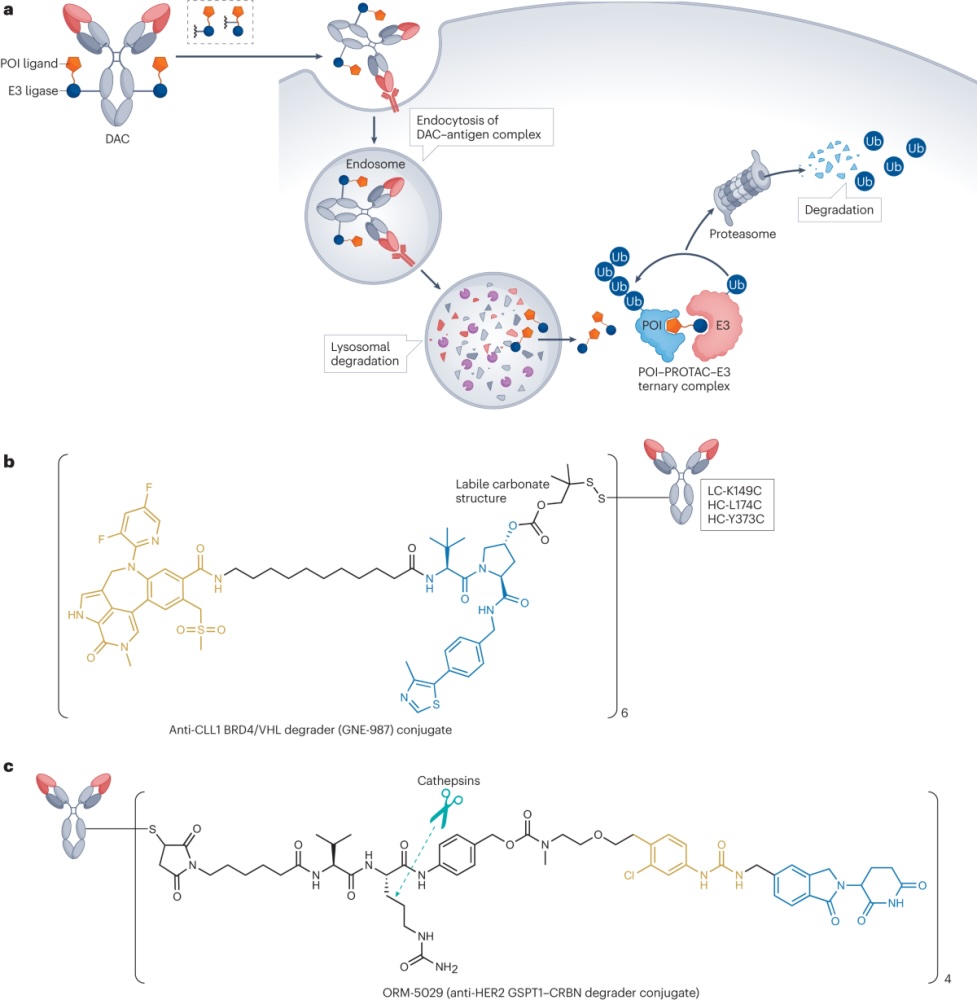
ADCs link an antibody to a payload through a chemical linker. The antibody binds a surface antigen, is internalized, and releases the payload inside the cell. In most approved ADCs, that payload is a potent cytotoxic agent.
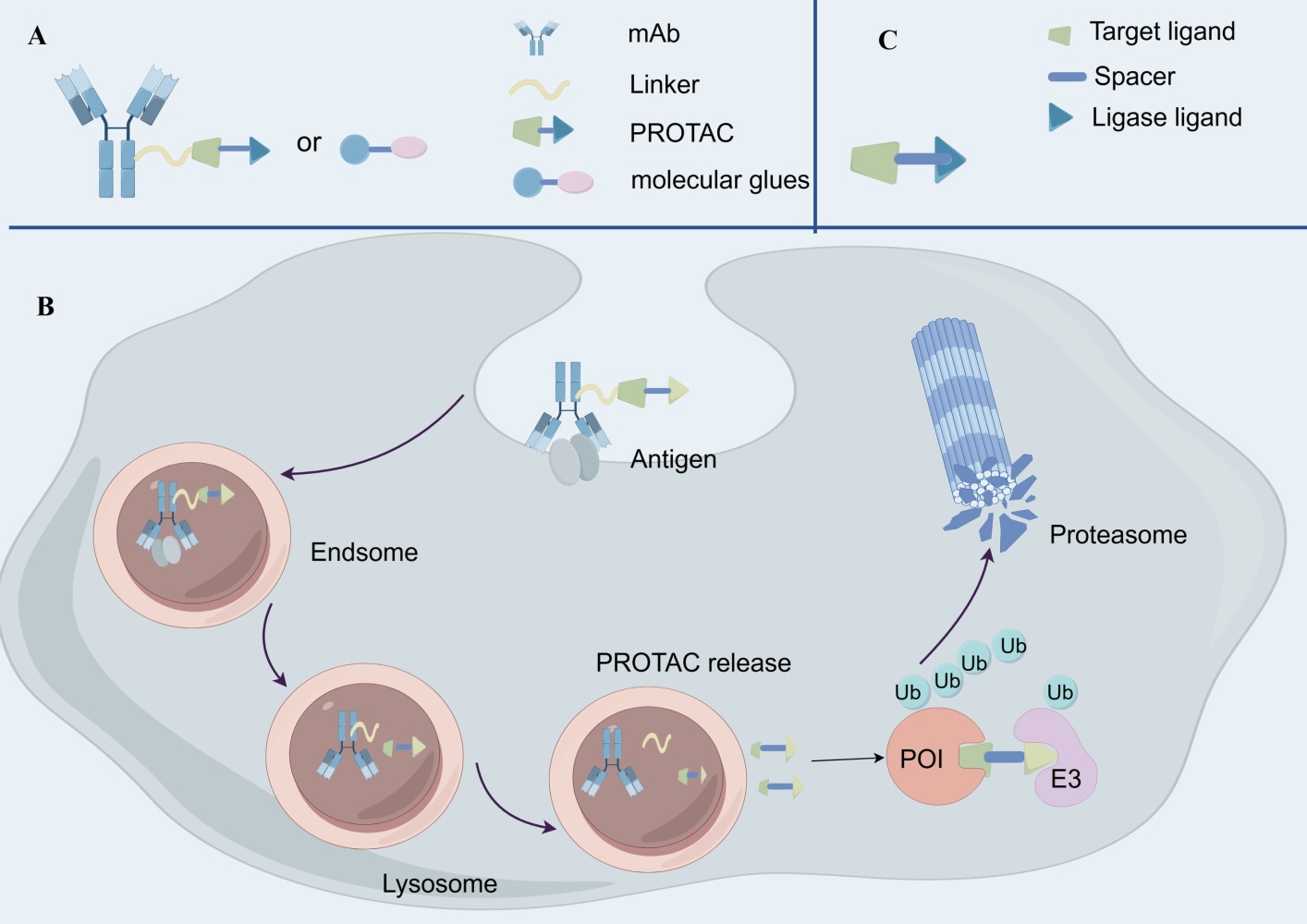
Targeted protein degradation works differently. Rather than inhibiting a protein, it removes it. Most advanced degraders recruit an E3 ubiquitin ligase to the protein of interest, leading to ubiquitination and proteasomal degradation. PROTACs do this with two ligands connected by a linker; molecular glues instead stabilize a target–ligase interaction.
A DAC applies that degrader mechanism to an antibody-conjugate format. The antibody delivers the degrader into an antigen-positive cell, where linker cleavage releases the payload. The degrader then binds its target, recruits an E3 ligase and drives degradation.
That makes DACs mechanistically distinct from conventional ADCs. Standard ADCs usually rely on broad cytotoxicity. DACs aim to remove a specific intracellular protein.
DACs bring together two maturing fields.
ADCs showed that antibodies can selectively deliver potent small molecules into target cells, but their efficacy can be limited by tumour heterogeneity, resistance, poor internalization and toxicity. These limits have driven interest in alternative payload classes and next-generation conjugate formats.
At the same time, targeted protein degradation has shown that removing a protein can offer advantages over simple inhibition, especially for non-enzymatic or scaffolding proteins. Degradation may also produce more durable effects.
Unconjugated degraders, however, often have poor drug-like properties and can cause systemic toxicity when the target is important in healthy tissues. DACs are meant to improve that by adding a targeting layer. In principle, selectivity comes from several filters: antigen expression, antibody binding, internalization, linker cleavage, target accessibility and ligase availability.
That layered selectivity is the main appeal of DACs. It could make it possible to target proteins that are too broadly expressed or too difficult to drug with free degraders.
The field remains early. Most DAC programmes are still preclinical, and oncology dominates because the ADC field already provides validated antigens, internalizing antibodies and manufacturing know-how. Other areas, such as autoimmune and inflammatory disease, may follow if pathogenic cell populations can be clearly defined by surface markers.
A degrader is not a plug-and-play ADC payload. It has to remain active after conjugation, survive intracellular processing and reach the cytosol in an intact form. That means DAC design has to be optimized as a whole system, not one component at a time.
Linker choice is especially important. Premature release could expose healthy tissues to free degrader, while poor cleavage could leave the payload trapped and inactive. Payload permeability also matters: a permeable degrader may produce bystander activity in neighbouring cells, which could help in heterogeneous tumours but hurt selectivity in immune diseases.
E3 ligase choice adds another variable. Most programmes still rely on a small set of ligases, but DACs may benefit from broader ligase use if that improves tissue selectivity or target compatibility. Overall, DAC developability is a system property. Antibody, linker, payload, ligase recruitment, trafficking and manufacturability all have to line up.
Commercial interest in DACs has moved quickly, from early discovery collaborations to clinical-stage transactions and platform-level M&A.
Johnson & Johnson & Firefly Bio (June 2026): Johnson & Johnson agreed to acquire Firefly Bio for $1 billion upfront. Firefly’s Firelink platform combines catalytic degrader payloads with linker technology designed to limit free payload exposure. Its early programmes focus on KRAS-driven tumours, and the company has reported preclinical activity in both solid and haematologic cancer models.
Roche & C4 Therapeutics, Inc. (April 2026): Roche paid C4 Therapeutics $20 million upfront to collaborate on DACs against two undisclosed oncology targets, with an option for a third. C4 could receive more than $1 billion in milestones plus royalties. C4 will supply degrader payload design through its TORPEDO platform, while Roche will lead antibody selection, conjugation, development and commercialization.
Orum Therapeutics financing (December 2025): Orum raised about $100 million to support its internal DAC pipeline. The financing is intended to advance ORM-1153, an anti-CD123 antibody-enabled GSPT1 degrader, with an IND filing planned for the second half of 2026, along with additional payload classes.
Seagen & Nurix Therapeutics (2023): Seagen paid Nurix $60 million upfront to collaborate on DAC discovery. Pfizer retained the relationship after acquiring Seagen. The collaboration combines Nurix’s degrader and ligase expertise with Seagen’s ADC capabilities and remains in discovery. Nurix has also discussed DAC applications beyond oncology, including inflammatory and autoimmune disease.
Despite these exciting announcements, several challenges are involved:
Intracellular delivery: Internalization does not guarantee that enough active degrader reaches the cytosol.
Some degrader payloadsmay require higher loading than standard ADC payloads, which can increase aggregation and manufacturing risk.
Antigen heterogeneity may limit activity in tumours, while bystander degradation may improve coverage at the cost of selectivity.
DACs may still cause on-target toxicity in healthy tissues if free degrader is released systemically, and off-target degradation remains a concern.
Resistance: Potential mechanisms include antigen loss, reduced internalization, altered linker processing, changes in the target or ligase, and disruption of proteasome function.
Biomarker strategy is also likely to be more complex than in conventional ADCs. Antigen expression alone may not be enough if response also depends on target dependence, ligase abundance and trafficking.
Manufacturing and analytics: DACs are complex molecules, and controlling conjugation, loading, aggregation, free payload and potency are essential.
DACs are now entering a more meaningful validation phase. The field has attracted major pharma partnerships, private financing, clinical-stage investment and a billion-dollar acquisition, which is enough to establish DACs as a serious next-generation conjugate format. Near-term progress will depend on early clinical readouts, such as from BMS-986497 and ORM-1153, and on whether DACs can open up targets that existing modalities have struggled to reach. Future success will also depend on treating DAC design as a full-system optimization problem rather than a simple payload swap.
The promise of DACs lies in combining antibody-based selectivity with the ability to eliminate specific intracellular proteins, including targets that may be difficult to drug with inhibitors or too risky for systemic degrader exposure. Need an antibody conjugation service? Biointron’s ADC conjugation platform, combined with our existing antibody expression and engineering platform advantages, can provide customers with a complete service process from antibody expression, conjugation to quality assessment, meeting the needs for screening, testing, and evaluation of ADC in preclinical settings.
Biointron’s Q2 2026 Antibody Industry Trends report aims to explore the events a……
Artificial intelligence (AI) can be used throughout the drug development process……
Peptides and antibodies have different strengths as therapeutic molecules. Pepti……
Therapeutic antibodies are often used to block receptors or neutralize soluble m……