


Radioligand therapy (RLT), also known as radiopharmaceutical therapy, is quickly becoming a major player in the oncology therapeutics space. Radioligands are composed of a radioactive isotope linked to a tumor-specific ligand, and is thus used to deliver a radioactive payload directly to cancer cells. The ligand is typically an antibody, peptide, or small molecule.
RLT was built on the ideas of scientists from over a century ago. The first injected radiotherapy, radioiodine, was used to treat hyperthyroidism in the 1930s-40s. Now, researchers are developing RLTs that can specifically target markers in cancers such as prostate and neuroendocrine tumors.

On January 12, 2026, Alloy Therapeutics, Inc. and Swiss Rockets AG (via Torpedo Pharmaceuticals AG) announced a research collaboration to generate antibodies with radiochemical integration using Torpedo’s expertise in therapeutic isotopes, including terbium-161.
Terbium-161 is of particular interest due to its combined beta emissions and Auger electrons, which may enhance tumor cell killing at short path lengths while maintaining favorable imaging and dosimetry characteristics.
Also last month, Convergent Therapeutics, Inc. announced a partnership with NorthStar Medical Radioisotopes, LLC, to advance CONV01-α, a PSMA-targeted monoclonal antibody labeled with actinium-225 (Ac-225), for metastatic castration-resistant prostate cancer.
Antibody-mediated targeting can harness the high linear energy transfer (LET) and short tissue range of alpha particles to induce localized DNA damage while limiting off-target toxicity. Reported clinical experience across more than 120 patients supports proof-of-concept for consistent antitumor activity alongside a differentiated safety profile, including limited salivary and renal uptake, which is an ongoing challenge for PSMA-directed radiotherapies.
Meanwhile, a recent research collaboration between Debiopharm and Alkyon Therapeutics focuses on applying AbYlink™ conjugation technology to modular antibody scaffolds targeting solid tumors.
The platform enables regio-selective lysine conjugation at defined Fc-domain sites, avoiding antigen-binding regions and reducing heterogeneity in radiolabeled products. This level of control is increasingly important for RLTs, where conjugation site and chelator positioning can influence immunoreactivity, in vivo stability, and radiation dose distribution.

Multiple clinical programs continue to explore radiolabelled antibodies and antibody-derived constructs across established and emerging oncology targets. Current efforts span diagnostic and therapeutic radionuclides, monospecific and bispecific architectures, and both beta- and alpha-emitting payloads, reflecting increasing diversification of radioantibody design strategies. Here are some examples:
Telix Pharmaceuticals Limited
TLX591 ([¹⁷⁷Lu]Lu-rosopatamab tetraxetan): PSMA-directed radio–antibody drug conjugate (rADC) evaluated in the ProstACT clinical program, including the Phase II/III ProstACT GLOBAL study, across recurrent and metastatic prostate cancer.
TLX592 ([⁶⁴Cu]/[²²⁵Ac]-RADmAb®): Next-generation PSMA-targeted engineered antibody for targeted alpha therapy. The Phase I CUPID study is evaluating the copper-64-labelled imaging construct prior to actinium-225 therapeutic studies.
Radiopharm Theranostics
RAD202 ([¹⁷⁷Lu]-RAD202): HER2-targeted single-domain antibody (nanobody) in a Phase I dose-escalation study (NCT06824155) enrolling patients with HER2-expressing advanced solid tumours. Prior diagnostic studies demonstrated favourable biodistribution and clinical proof-of-concept, supported by preclinical efficacy in HER2-positive xenograft models.
Fusion Pharmaceuticals
[²²⁵Ac]Ac-FPI-2068: Bispecific EGFR × c-MET antibody conjugated to actinium-225, designed for alpha-particle delivery in tumours with co-expression of EGFR and c-MET (e.g. NSCLC, PDAC, mCRC, HNSCC).

Next-generation RLTs are moving towards coordinated innovation in radioisotopes, targeting formats, and theranostic design, with the aim of improving therapeutic index and expanding applicability beyond currently validated indications.
Key scientific directions include:
Radionuclide diversification, particularly the evaluation of alpha emitters such as actinium-225 and lead-212, as well as alternative beta emitters (e.g. copper-67, terbium-161) that offer different decay profiles, tissue penetration ranges, and theranostic pairing opportunities.
Targeting moiety evolution, shifting from conventional peptides and small molecules toward engineered antibodies, antibody fragments, minibodies, and nanobodies to balance tumour penetration, retention, and systemic clearance.
Integrated theranostics, using matched imaging and therapeutic isotopes to support patient selection, dosimetry, and adaptive treatment strategies.
Broader biological scope, with clinical-stage programs now addressing >25 molecular targets across >20 tumour types, including both validated targets (e.g. PSMA, SSTR2) and emerging targets such as HER2, FRα, FAP, and GRPR.
Together, these advances position next-generation RLTs as a platform modality that combines the potency of radiotherapy with molecular precision, while introducing new challenges in isotope supply, manufacturing, and logistics that will shape clinical and commercial scalability.

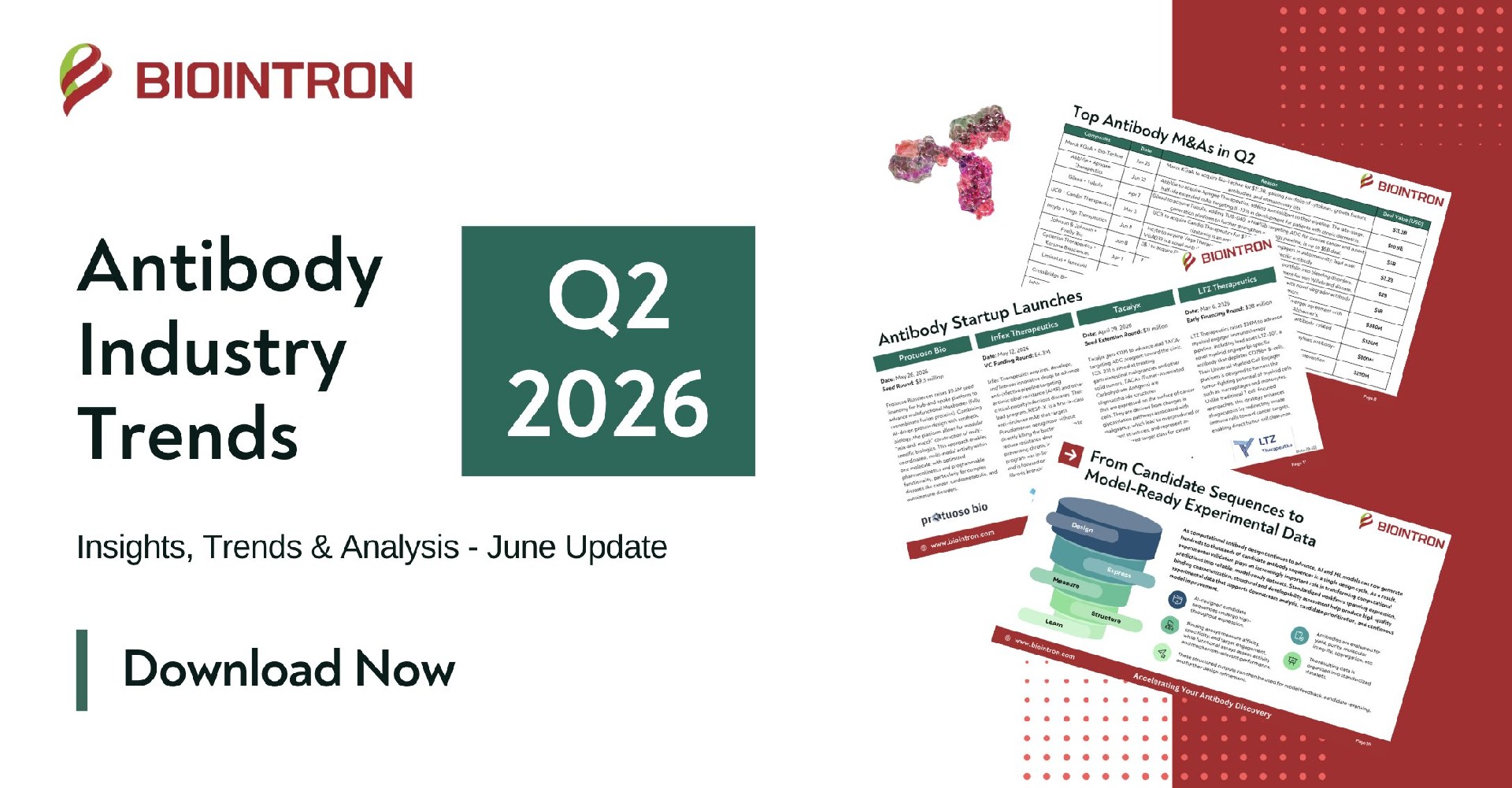
Biointron’s Q2 2026 Antibody Industry Trends report aims to explore the events a……
Artificial intelligence (AI) can be used throughout the drug development process……
Peptides and antibodies have different strengths as therapeutic molecules. Pepti……
Therapeutic antibodies are often used to block receptors or neutralize soluble m……