


With the boom of artificial intelligence (AI), the landscape of antibody discovery and engineering is undergoing an exciting transformation. AI is increasingly embedded across all stages of the antibody development pipeline, driving rapid advances in computational biology and enabling the emergence of specialized AI-powered platforms for antibody design, discovery, and optimization. Among the most transformative developments is de novo antibody design, which is the generation of entirely novel antibody sequences and structures in silico. This builds upon earlier AI-assisted approaches that focused primarily on improving antibodies generated through conventional techniques such as phage display, hybridoma technology, or immunization.
Modern AI-enabled platforms integrate predictive modeling with high-throughput wet-lab validation to accelerate candidate optimization cycles. They can predict key molecular properties, propose beneficial mutations, and rank optimized variants for synthesis and testing, effectively compressing timelines that traditionally required months into a matter of weeks. This shift is enabling a more systematic, data-driven exploration of antibody sequence and structural space.

The concept of applying AI to molecular design has its roots in early demonstrations of machine learning for biological prediction tasks, such as protein folding and binding affinity estimation. Over time, increasingly sophisticated architectures have been adopted, including convolutional neural networks (CNNs) for structural feature learning, recurrent neural networks (RNNs) for sequence modeling, and more recently, transformers, variational autoencoders (VAEs), generative adversarial networks (GANs), and reinforcement learning (RL) frameworks.
These models have been applied to improve multiple critical properties of antibodies, including affinity, specificity, stability, solubility, and developability. A major focus has been complementarity-determining region (CDR) loop modeling, especially CDR-H3, whose structural variability plays a key role in antigen recognition. Transformer-based and diffusion models now enable highly accurate modeling. AI is also increasingly used for epitope prediction and antibody-antigen interaction modeling.
One turning point for the field was the development of AlphaFold by DeepMind, which demonstrated that deep learning could predict protein structures with near-experimental accuracy. This breakthrough extended to the accurate prediction of epitopes, paratopes, and antibody-antigen interfaces, dramatically reducing reliance on time- and resource-intensive structural methods such as X-ray crystallography or cryo-EM.
Building on these advances, transformer-based language models and diffusion models now represent the cutting edge. Trained on massive antibody sequence and structure datasets, these models can generate entire antibody molecules conditioned on desired epitope features, structural scaffolds, or biophysical constraints. This de novo design capability is enabling the rational creation of antibodies with pre-optimized developability and functionality, substantially lowering the cost and time of early-stage discovery.

Commercial and academic groups are rapidly translating these computational innovations into drug development pipelines. Platforms such as BenchSci, Atomwise, and NVIDIA BioNeMo, along with a growing number of biotech startups, integrate AI-based prediction and generative design with high-throughput screening, rapid expression systems, and automated developability assessments. This end-to-end integration allows large virtual libraries to be filtered down to a small number of highly optimized candidates for wet-lab testing, minimizing experimental burden while maximizing lead quality.
AI-designed antibodies are no longer theoretical. Several have advanced into clinical development, targeting diseases such as cancer, COVID-19, and inflammatory disorders. Companies including AbCellera, Adagene, and Biolojic Design are leading efforts to integrate AI into therapeutic antibody pipelines at scale.
A landmark example is Imneskibart (AU-007) by Aulos Biosciences: as the first fully computationally designed antibody to enter clinical trials. Imneskibart is a human monoclonal antibody engineered to bind to the IL-2 interface with the CD25 receptor subunit, thereby blocking regulatory T-cell (Treg) expansion while preserving IL-2 signaling to CD8⁺ effector T cells. This selective modulation enhances effector T-cell proliferation and promotes tumor cell killing without the immunosuppressive side effects typically associated with IL-2 therapy. Imneskibart’s progression into clinical testing represents a significant proof-of-concept for AI-enabled antibody design.

De novo antibody design represents a major leap in biotechnology, combining generative models with large-scale biological data and experimental validation. These platforms can create antibodies with high affinity, specificity, and therapeutic potential against even the most challenging targets.
Xaira Therapeutics launched in April 2024 with $1 billion in capital. They are advancing de novo design using powerful generative models like RFdiffusion and RFantibody, originally built for protein engineering. Its platform combines large-scale biological data with AI to design antibodies and other biologics against targets that are difficult or impossible to address with traditional methods.

Absci has built a closed-loop Integrated Drug Creation™ platform that couples generative AI with massive wet lab throughput. Its system designs antibodies de novo at the epitope level, generates billions of protein variants, and validates them at >4,000× the throughput of conventional assays.

Nabla Bio has developed Joint Atomic Modeling (JAM), a system to design de novo antibodies with strong affinity, specificity, and developability without optimization. JAM uniquely demonstrated designs against multipass membrane proteins such as Claudin-4 and CXCR7, long considered undruggable, and shows evidence of “test-time scaling laws” that improve performance with more compute.

Chai Discovery is pioneering all-atom structure prediction integrated directly with generative modeling. Its Chai-2 model achieved a 15.5% hit rate across de novo antibody formats, which is over 100× better than previous methods. It also generated at least one successful binder for half of the tested targets, setting a new benchmark for practical AI-driven antibody design.

Biointron offers Antibody Discovery services such as:
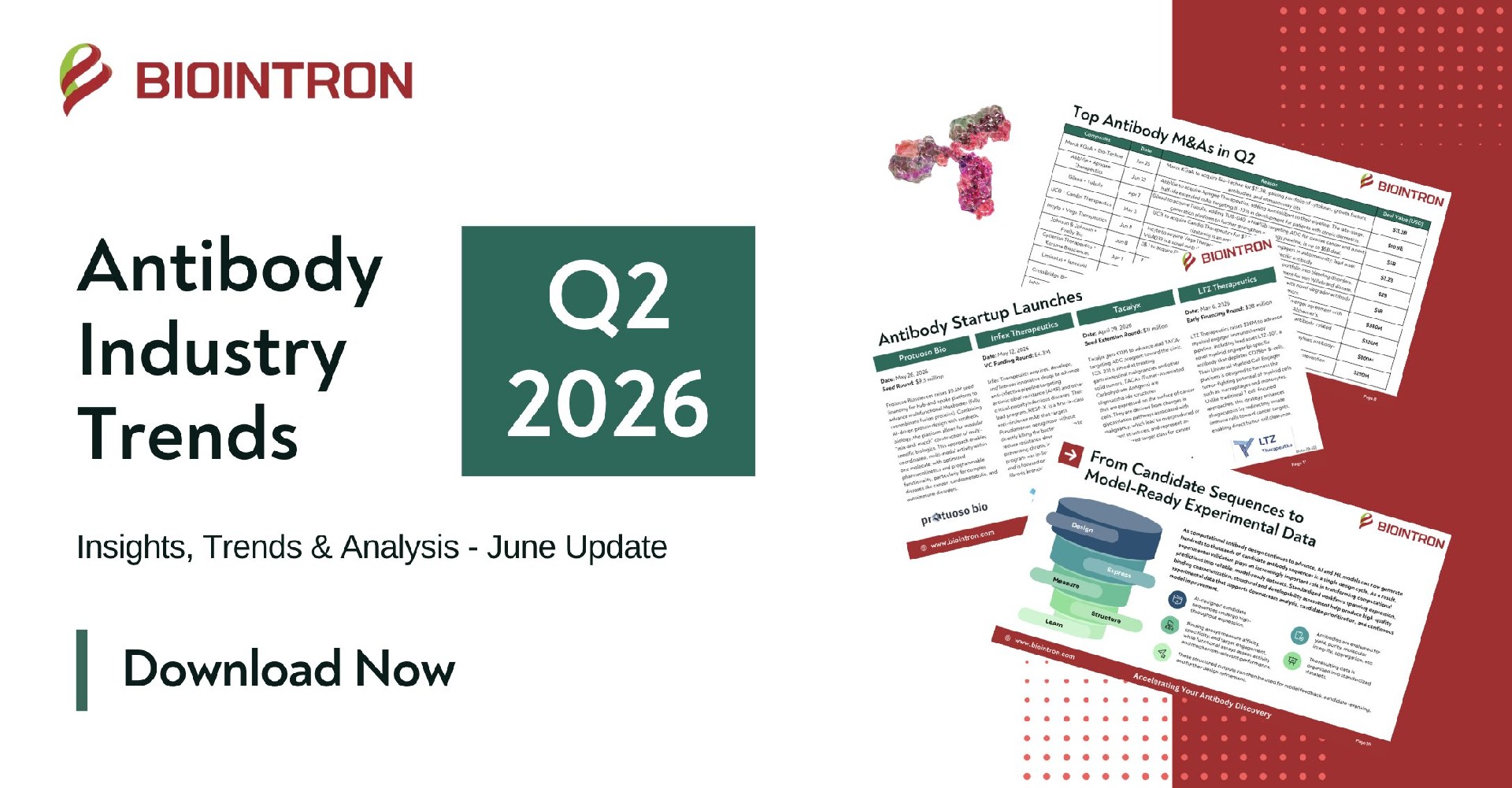
Biointron’s Q2 2026 Antibody Industry Trends report aims to explore the events a……
Artificial intelligence (AI) can be used throughout the drug development process……
Peptides and antibodies have different strengths as therapeutic molecules. Pepti……
Therapeutic antibodies are often used to block receptors or neutralize soluble m……