


Sjögren’s disease (SjD) is a chronic, systemic autoimmune disorder characterized by lymphocytic infiltration of exocrine glands, most commonly the salivary and lacrimal glands, often accompanied by multi-organ extra-glandular involvement. Despite its substantial morbidity, therapeutic interventions have historically been limited to symptomatic management, with no approved disease-modifying treatments. Early biologic interventions, including the anti-CD20 monoclonal antibody rituximab, have failed to meet primary endpoints in pivotal trials, underscoring the heterogeneity of disease mechanisms and the need for more refined therapeutic strategies. Recent advances in our understanding of SjD pathogenesis have renewed interest in targeted antibody-based drugs, particularly agents modulating B and T cell activity, cytokine signaling, and co-stimulatory pathways, reflecting a broader shift from symptomatic relief toward immune-modulatory precision medicine.

Yesterday, Novartis made headlines with the announcement of successful phase 3 results for two indications for ianalumab! Ianalumab (VAY736) was tested in adults with active Sjögren's disease, and both trials met the primary endpoint of demonstrating statistically significant improvements in disease activity. Ianalumab is a novel fully human monoclonal antibody with a dual mechanism of action, B cell depletion via antibody-dependent cellular toxicity (ADCC) and interruption of BAFF-R mediated signals of B cell function and survival. Novartis plans to present its data at an upcoming medical congress and submit to health authorities globally, as the drug has the potential to become the first and only targeted treatment approved for patients with Sjögren’s disease.
This news comes at the heels of Johnson & Johnson’s nipocalimab, the first investigational treatment to be granted U.S. FDA Breakthrough Therapy designation and Fast Track designation for the treatment of adults with moderate-to-severe SjD, back in March this year. Nipocalimab is an investigational monoclonal antibody, designed to bind with high affinity to block FcRn and reduce levels of circulating immunoglobulin G (IgG) antibodies potentially without impact on other immune functions. This includes autoantibodies and alloantibodies that underlie multiple conditions across three key segments in the autoantibody space including Rare Autoantibody diseases, Maternal Fetal diseases mediated by maternal alloantibodies and Rheumatic diseases. Blockade of IgG binding to FcRn in the placenta is also believed to limit transplacental transfer of maternal alloantibodies to the fetus.
However, it is important to note that antibody treatments for SjD has had many more failures than approvals.
February 25, 2025: Kiniksa Pharmaceuticals discontinued SjD prospect abiprubart, an anti-CD40 mAb
January 31, 2025: Novartis’ other candidate iscalimab was discontinued for SjD
April 25, 2024: Sanofi removed SjD from the list of targeted indications for its CD40L mAb frexalimab after seeing phase 2 efficacy data

Meanwhile, phase 1 and 2 trials for other antibody candidates are currently underway. Otsuka Pharmaceuticals’ sibeprenlimab is currently recruiting for a phase 2 study to evaluate the effects of sibeprenlimab 400 mg administered subcutaneously (SC) every 4 (Q4) weeks as an add-on to background treatment in participants with SjD. Sibeprenlimab is an mAb that blocks the action of APRIL (A PRoliferation-Inducing Ligand).
argenx also recently announced that the U.S. Food and Drug Administration (FDA) has granted efgartigimod Fast Track designation (FTD) for the treatment of primary Sjogren’s disease. This was based on positive phase 2 proof-of-concept results. Efgartigimod (efgartigimod alfa and hyaluronidase-qvfc) is a human IgG1 antibody fragment designed to reduce pathogenic immunoglobulin G (IgG) antibodies by binding to the neonatal Fc receptor (FcRn) and blocking the IgG recycling process.

Cullinan Therapeutics has also begun a phase 1 trial of CLN-978 in the US to treat Sjögren’s disease. The drug is a novel highly potent CD19xCD3 bispecific T cell engager with a molecular size of 65 kilodaltons (kDa). It triggers redirected lysis of CD19-expressing target cells in vitro and in vivo andis designed for high-affinity CD19 binding to target B cells, including those with very low levels of CD19. CLN-978 contains two single-chain variable fragments and a single-domain antibody binding to human serum albumin to extend serum half-life.
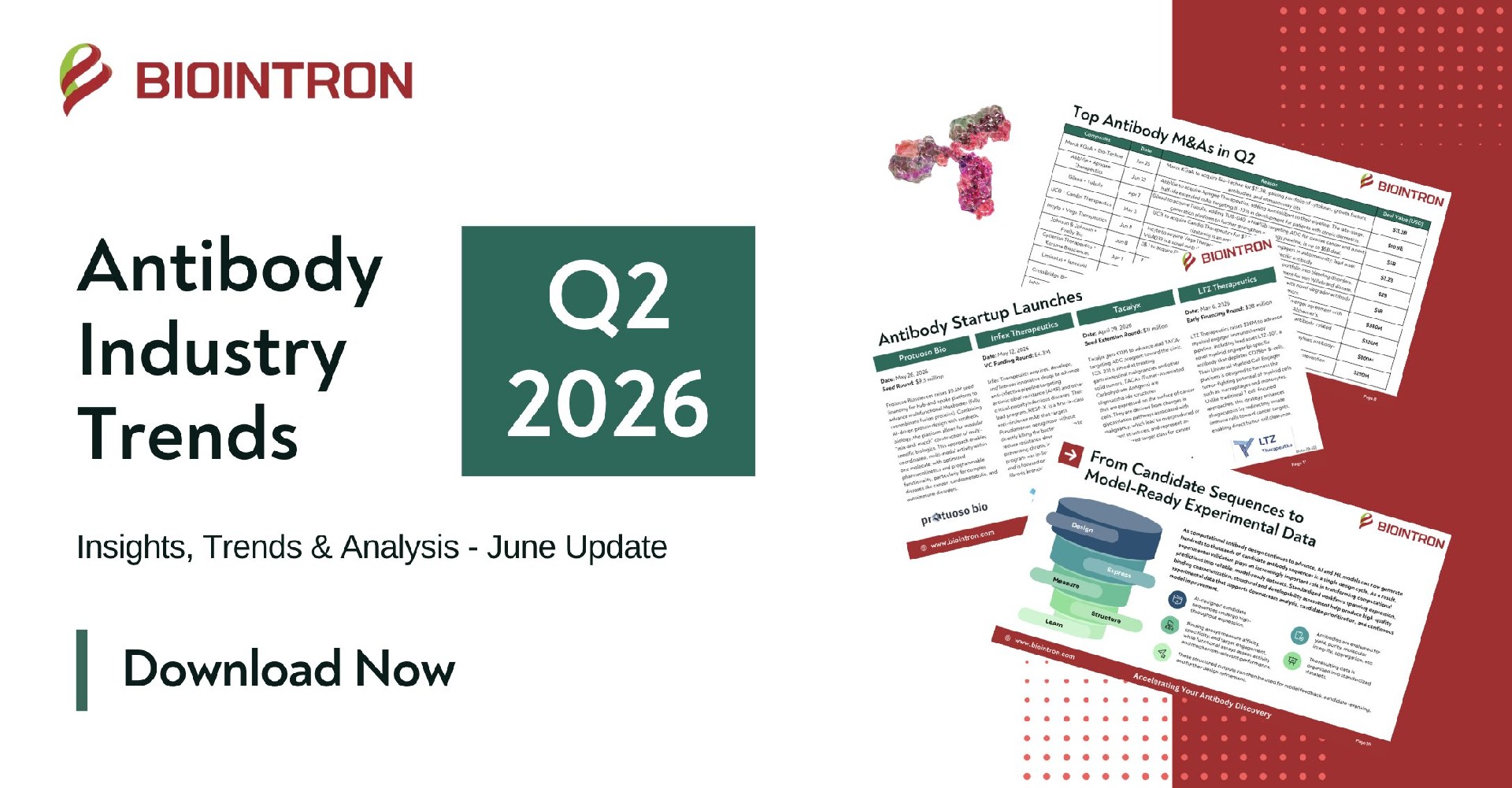
Biointron’s Q2 2026 Antibody Industry Trends report aims to explore the events a……
Artificial intelligence (AI) can be used throughout the drug development process……
Peptides and antibodies have different strengths as therapeutic molecules. Pepti……
Therapeutic antibodies are often used to block receptors or neutralize soluble m……