


Over the past year, a surge of billion-dollar alliances has drawn attention to an increasingly dynamic Asian landscape, where novel antibodies, bispecifics, and antibody-drug conjugates (ADCs) are fast becoming the region’s calling cards.
Across China, Japan, and Korea, major pharmaceutical companies are striking deals that signal a deeper confidence in Asia’s ability to generate next-generation biologics with global potential. Besides licensing deals, strategic and R&D partnerships for new modalities, platform technologies, and scalable development pipelines are reshaping the global supply of clinical-ready assets.
A recent analysis published in Nature describes some of these partnerships. Between 2015 and 2024, Chinese companies initiated more first-in-human studies of “enhanced antibodies”, aka ADCs and multispecifics, than the combined total from the United States and Europe. That surge, driven by sustained policy support and advanced manufacturing capabilities, reflects how regional innovation capacity has overtaken geographic stereotypes. More than half of the ~500 enhanced antibody therapeutics currently in the global clinic trace their origins to companies in China, a figure that highlights Asia’s outsized contribution to the next generation of biologics.

In late October, Japan’s Takeda made headlines by inking a partnership worth up to $11 billion with Innovent Biologics for three oncology candidates. Through the alliance, Takeda will gain rights outside Greater China to two late-stage cancer therapies and an option for a third in earlier development.
The deal is transformational for Takeda, which has been restructuring its R&D portfolio following the loss of exclusivity for several key drugs, including ADHD blockbuster Vyvanse. Innovent’s late-stage candidates include IBI363, a dual-targeting antibody that hits both PD-1 and IL-2, and IBI343, an ADC directed at Claudin 18.2, which is a protein overexpressed in gastrointestinal tumors. Both programs have shown early signals of efficacy across multiple solid tumor types. Takeda’s move suggests a deliberate intent to broaden its oncology base through regional partnerships that can deliver differentiated, modality-driven therapies.
Across East Asia, a series of similarly high-value transactions is playing out between large, global pharmas.
In mid-October, Roche announced an exclusive global license from Chinese biotech Hansoh Bio (Hansoh Pharma) for HS-20110, a CDH17-targeting ADC for colorectal and other solid tumors. The deal includes $80 million upfront and up to $1.45 billion in milestones. The Swiss pharma followed that move just weeks later with another alliance, this time with Qyuns Therapeutics, a Shanghai-based biotech developing QX031N, a bispecific antibody that targets both TSLP and IL-33 for respiratory diseases. That partnership, valued at over $1 billion in potential payments, gives Roche a fresh shot at a therapeutic area it’s been trying to rebuild following recent trial setbacks.
Meanwhile, Rani Therapeutics teamed with Chugai Pharmaceutical Co., Ltd., a Japanese drug manufacturer, in a deal worth up to $1.08 billion for multiple oral biologics programs, while Kaigene, Inc and South Korean-founded Celltrion Inc signed a $744 million deal for autoimmune antibody therapeutics.
Antibody-drug conjugates and bispecific antibodies dominate the current generation of licensing deals.
Hansoh Bio’s CDH17-targeting ADC and Innovent Biologics’s Claudin 18.2-directed molecule are within one of the most competitive and fastest-moving segments of oncology drug development, with global pharmas competing fiercely for differentiated ADCs that can outperform first-generation agents like Enhertu and Padcev.
At the same time, bispecific and dual-payload constructs are advancing from early research to clinical stages. A January partnership between Beijing-headquartered Biocytogen and Taipei-based Acepodia provides an example: the two companies will co-develop dual-payload bispecific ADCs (BsAD2Cs). The approach, which enables site-selective conjugation of two distinct payloads via bio-orthogonal chemistry, aims to overcome tumor heterogeneity and resistance.
For multinational drugmakers, patent cliffs and R&D attrition are forcing a rethink of pipeline strategy. In parallel, Asia’s biopharma sector has reached a stage where molecules are not only discovery-ready but also clinical-validated and manufacturing-scalable.
Evidence also suggests that molecules emerging from these regional programs may carry lower development risk. According to Crescioli & Reichert (2025), enhanced antibodies originating from Chinese developers showed markedly higher phase-to-approval success rates at 57% versus 15% for those from U.S. or European counterparts, largely because fewer were terminated at early clinical stages. Analysts attribute this to both the focused indication selection in oncology and the use of newer payloads such as topoisomerase-I inhibitors, which now dominate ADC programs across Asia.
Partnership | Therapeutic Focus | Deal Value (Up to) |
Takeda – Innovent | Oncology (PD-1/IL-2 bispecific, ADCs) | $11.4B |
Roche – Hansoh | Oncology (CDH17 ADC) | $1.45B |
Roche – Qyuns Therapeutics | Respiratory (TSLP/IL-33 bispecific) | $1.0B |
Zenas BioPharma – InnoCare | Autoimmune diseases | $2.0B |
Dianthus Therapeutics – Leads Biolabs | Bifunctional fusion protein | $1.0B |
Rani Therapeutics – Chugai | Oral biologics | $1.08B |
Boehringer Ingelheim – Aimed Bio | Oncology ADC | $991M |
Kaigene – Celltrion | Autoimmune antibodies | $744M |
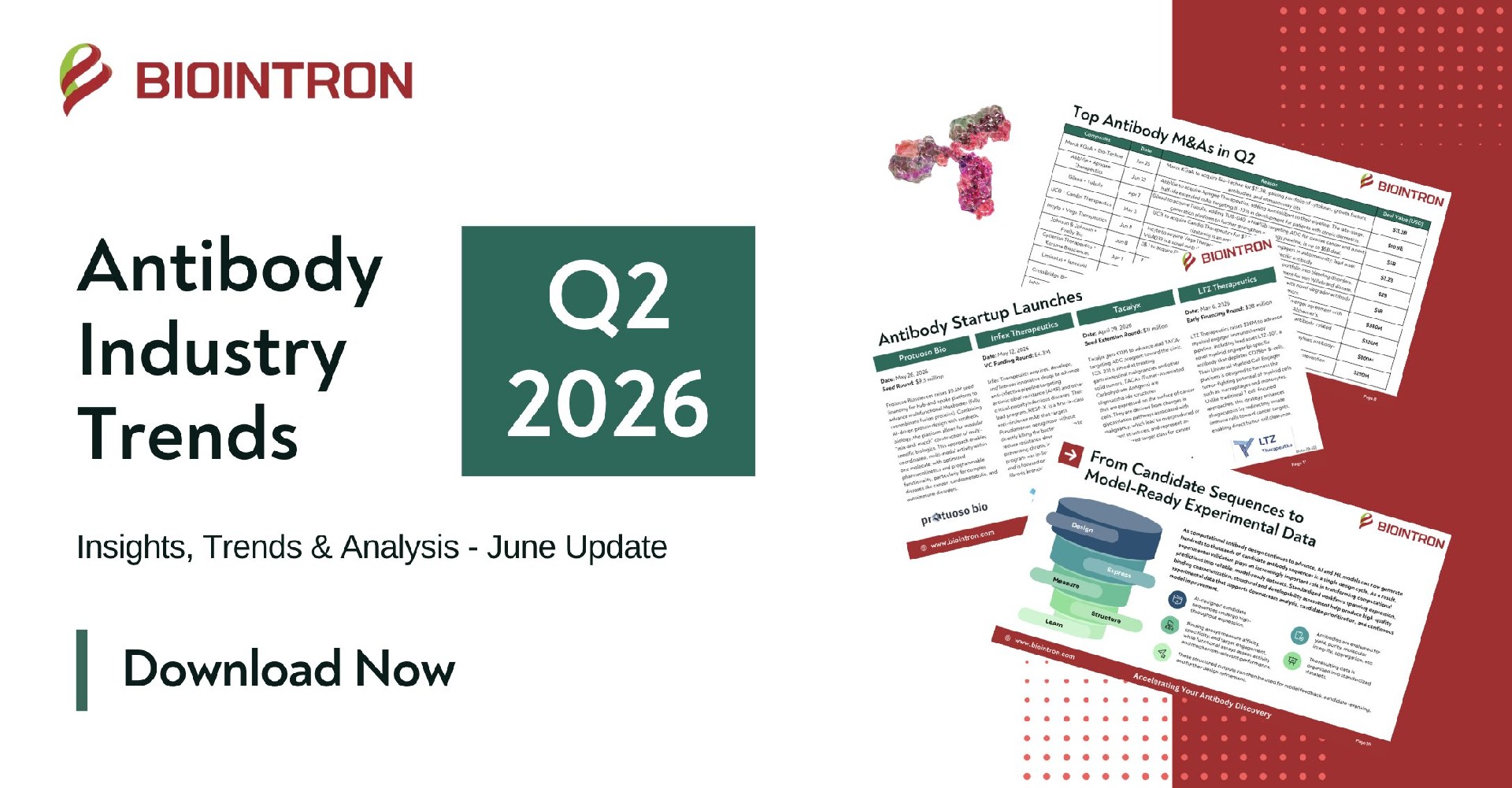
Biointron’s Q2 2026 Antibody Industry Trends report aims to explore the events a……
Artificial intelligence (AI) can be used throughout the drug development process……
Peptides and antibodies have different strengths as therapeutic molecules. Pepti……
Therapeutic antibodies are often used to block receptors or neutralize soluble m……