


The last decade has seen a dramatic shift in the strategic development of antibody-based therapeutics for infectious diseases. Monoclonal antibodies (mAbs) have emerged as central agents in pandemic preparedness and the treatment of resistant infections. Driven by technological advances in sequencing, display platforms, and artificial intelligence, as well as the urgency of global health crises such as COVID-19, the field is evolving toward a future where antibody therapeutics may be developed and deployed in near real-time. Innovations such as bispecifics, nanobodies (VHH), and AI-guided design are positioning antibodies as versatile and rapid-response tools in infectious disease pharmacotherapy.

A recent review highlights the evolution of therapeutic antibodies from the early use of murine-derived mAbs to recombinant human antibodies now central in infectious disease treatment. Therapeutic antibodies, once developed only for oncology and rare infectious indications, have become essential tools in pandemic response, particularly during COVID-19. The review traces landmark approvals, such as Palivizumab for RSV and Inmazeb for Ebola, and notes that the majority of mAbs targeting infectious diseases have been approved in the past decade, thus reflecting accelerated innovation. The COVID-19 pandemic highlighted agents like Bamlanivimab and Casirivimab–Imdevimab, which were developed and deployed at unprecedented speed, yet their efficacy was rapidly diminished by emergent viral variants like Delta and Omicron. To overcome this, strategies like targeting conserved epitopes, developing multi-specific antibodies, and incorporating predictive AI-based design are being explored.

For example, a new collaboration between CEPI and AstraZeneca aims to develop multi-specific VHH antibodies targeting pandemic influenza strains (H1, H3, H5, H7). These camelid-derived nanobodies offer key advantages: smaller molecular size, higher stability, simplified production, and cost-effectiveness. Their thermostability makes them particularly suitable for outbreak responses in resource-limited settings. The collaboration is positioned to expand the utility of VHHs for broader pathogen targets, setting the stage for accessible, scalable antibody interventions during emerging pandemics.
Meanwhile, an in-depth review of monoclonal antibody pharmacology underscores their unique role in personalized medicine. mAbs are now being applied to a set of infectious targets such as RSV (Palivizumab), drug-resistant HIV, Clostridium difficile (Bezlotoxumab), anthrax, and rabies exposure. These approvals underscore the potential of antibody-based molecules to offer both prophylaxis and therapeutic benefit, particularly in cases where vaccines are unavailable or standard treatments are compromised by resistance or immunodeficiency. Importantly, the study draws attention to respiratory viral infections (citing influenza and RSV) as high-priority areas due to their global morbidity and mortality. Monoclonal antibodies offer a route to targeted intervention, especially in immunocompromised or pediatric patients, where traditional antivirals or vaccines are less effective. VHH antibodies, due to their small size, high stability, and potential for inhalational delivery, are well-suited for neutralizing respiratory RNA viruses like influenza and SARS-CoV-2. Their ability to penetrate sterically shielded viral epitopes and function at mucosal surfaces gives them an edge in early-stage viral neutralization.
Though sepsis is not a classic infectious disease, it often arises from severe infections and exemplifies how dysregulated immune responses complicate infection-related pathologies. A recent preclinical study introduces hCitH3-mAb, a humanized monoclonal antibody targeting citrullinated histone H3 (CitH3), a pro-inflammatory driver in sepsis. By neutralizing CitH3, the antibody interrupts a self-perpetuating inflammatory feedback loop involving TLR2 activation and PAD2 nuclear translocation. In murine models, hCitH3-mAb reduced cytokine production, restored macrophage function, and improved survival in sepsis-induced acute lung injury. These findings offer a novel immunomodulatory strategy that could extend antibody therapeutics beyond pathogen neutralization to broader regulation of immune dysfunction in infectious syndromes.

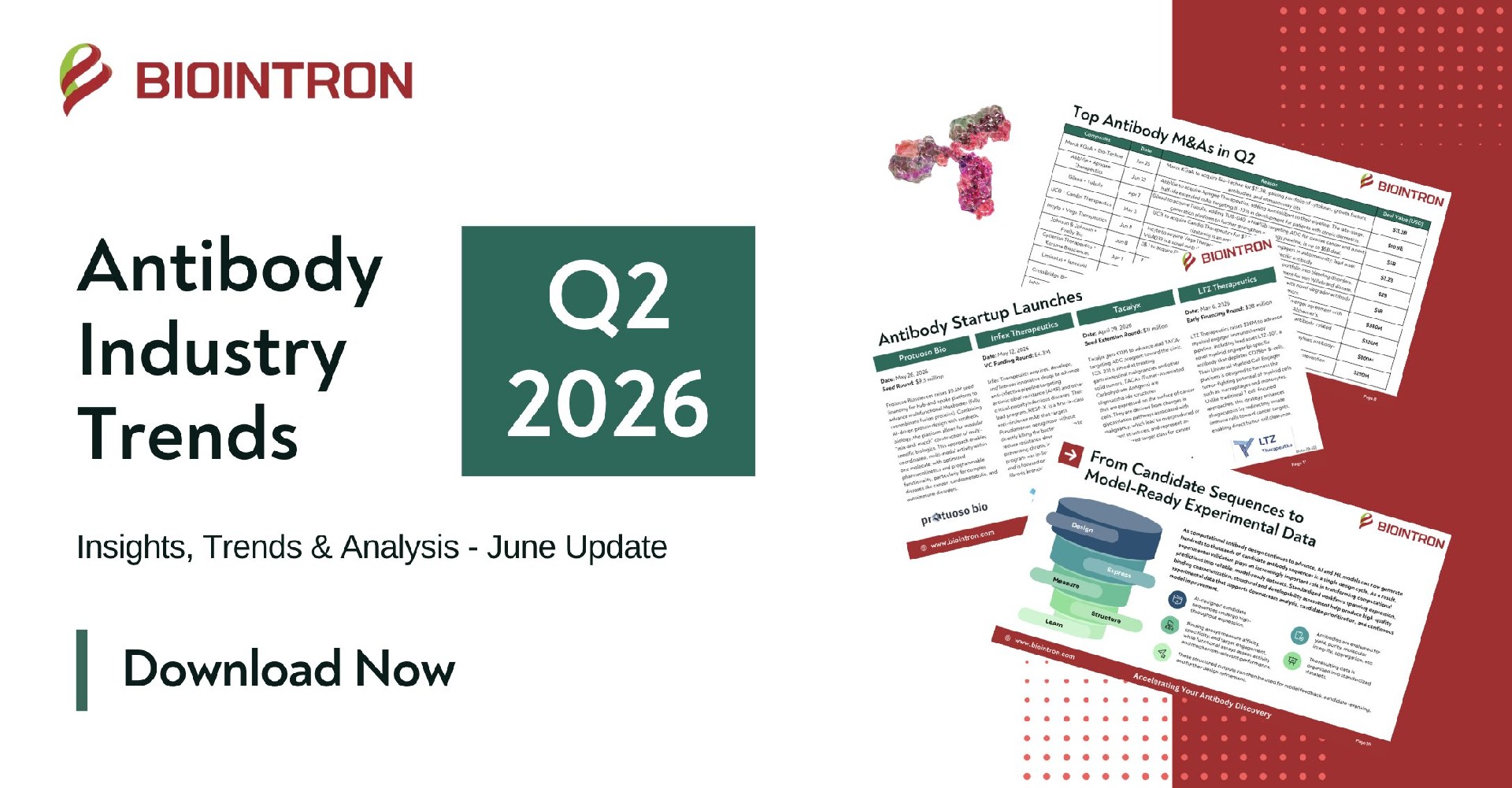
Biointron’s Q2 2026 Antibody Industry Trends report aims to explore the events a……
Artificial intelligence (AI) can be used throughout the drug development process……
Peptides and antibodies have different strengths as therapeutic molecules. Pepti……
Therapeutic antibodies are often used to block receptors or neutralize soluble m……