


Recent studies in antibody formulation highlight challenges in achieving high-concentration, stable, and patient-friendly formulations. These efforts include possible solutions in improving self-administration, global distribution without cold-chain reliance, and reducing healthcare system burdens.
A new solvent-based dehydration platform introduced by Massachusetts Institute of Technology researchers offers a new way to deliver antibodies could make treatment much easier for patients. Therapeutic antibodies packaged into microparticles could be injected with a standard syringe, avoiding the need for lengthy and often uncomfortable infusions. The platform enables the formulation of monoclonal antibodies at concentrations exceeding 360 mg/mL in aqueous suspensions, which are levels previously only achievable in non-aqueous systems. This method encapsulates antibodies in alginate hydrogel microparticles via continuous microfluidic processing. Unlike traditional lyophilized or liquid systems, this formulation maintains structural stability and injectability (glide force <20 N) for over four months. The use of amorphous solid dispersions (ASDs) within a hydrated hydrogel matrix represents a paradigm shift: combining the biophysical benefits of solid formulations with the delivery advantages of aqueous systems.

Achieving high concentration is only one piece of the challenge. Ensuring long-term stability and manufacturability under these conditions requires a multifaceted approach. Zäh et al. introduced a predictive framework that integrates water activity and glass-transition temperature (Tg) to guide the design of lyophilized antibody formulations. Their model enables rational excipient selection, such as sucrose/ectoine systems, to stabilize formulations within an optimal water activity range (0.025–0.25), thus reducing the empirical burden of traditional screening methods.

Complementing this work, Mijangos et al. outline the major biophysical barriers to high-concentration antibody formulation, particularly for subcutaneous administration. These include increased viscosity, macromolecular crowding, and protein aggregation. While arginine hydrochloride and salts can reduce viscosity, they must be carefully balanced to avoid compromising antibody stability. Peng et al.'s analysis of marketed and patented mAb formulations further illustrates how excipient choices vary with product format and concentration. Histidine, hyaluronidase, and arginine dominate in high-concentration subcutaneous products, while phosphate and citrate are more common in IV formulations. Thus, successful formulation could use predictive modeling with understanding of physicochemical properties.

Beyond traditional monoclonal antibodies, antibody formulations for formats such as ADCs and VHH-based therapeutics are being optimized. Wen et al. provide a detailed review of formulation challenges unique to ADCs. Given the instability of the linker-payload complex, 14 of the 16 commercial ADCs are lyophilized, relying on trehalose, sucrose, and polysorbates to stabilize their intricate structures. However, lyophilization introduces its own risks, such as payload degradation or reconstitution failure. Thus, expanding formulation solutions for ADCs remains a critical goal.

In contrast, nanobody (VHH) formulations benefit from inherent thermal stability and reduced aggregation propensity. Moritani et al. demonstrate how fine droplet drying (FDD) technology can convert VHHs into uniform inhalable dry powders with excellent aerodynamic properties. While only 30% of the VHHs retained full activity post-drying, the stability over two years at ambient conditions is promising for pulmonary delivery applications. This approach exemplifies the growing interest in alternative routes of administration for antibody-based therapies.
The convergence of formulation engineering, excipient science, and predictive modeling is transforming the development of antibody therapeutics. Whether addressing the challenges of high-concentration delivery, designing lyophilized formulations for global distribution, or enabling novel delivery formats such as inhalable nanobodies and ADCs, recent innovations are moving the field beyond empirical optimization. As exemplified by the solvent-based dehydration platform and predictive thermodynamic models, the future of antibody formulation lies in integrated, rational design strategies that meet the growing demand for effective, stable, and user-friendly biologics.

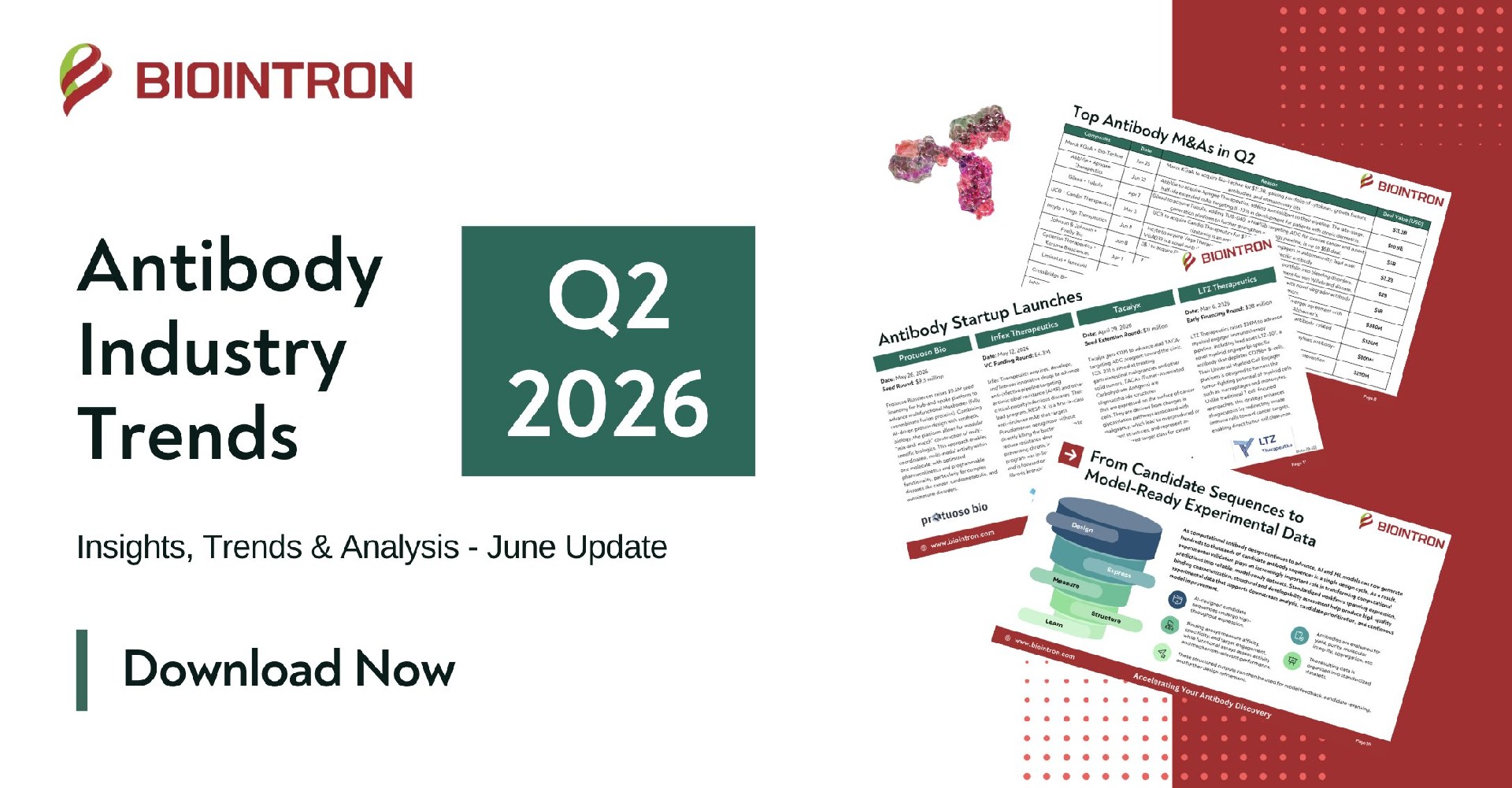
Biointron’s Q2 2026 Antibody Industry Trends report aims to explore the events a……
Artificial intelligence (AI) can be used throughout the drug development process……
Peptides and antibodies have different strengths as therapeutic molecules. Pepti……
Therapeutic antibodies are often used to block receptors or neutralize soluble m……