


Understanding how proteins interact with each other to form functional complexes at the atomic level is key to understanding biological processes. Progress in structural characterization, modeling, and analytical sensitivity has deepened insights into binding interfaces, multivalent interactions, and epitope targeting. Meanwhile, machine learning is emerging as a transformative tool for predicting antibody specificity and engineering optimized interactions. Together, these developments are exciting innovations in antibody discovery and design.
A recent study has revealed a surprising contributor to functional potency of bispecific antibodies (bsAbs): domain order. Using cryo-electron microscopy (cryo-EM), researchers compared the Ex3HL and Ex3LH formats of a diabody-type BsAb targeting EGFR and CD3. The Ex3LH format exhibited over 100-fold greater antitumor activity than its HL counterpart. This enhancement was attributed to a favorable inter-antigen bridging angle conferred by domain rearrangement, which mitigates steric hindrance and optimizes cellular engagement. These findings underscore the critical role of geometric alignment in designing potent BsAbs and offer a structural rationale for optimizing domain architecture in future constructs.

The dynamic nature of antibody-antigen interfaces demands a detailed understanding of how structural features mediate binding specificity. A comprehensive structural analysis revealed that antibody complementarity-determining regions (CDRs), especially H3 loops in nanobodies, exploit deep antigen concavities to achieve high specificity. Tryptophan residues frequently engage these concave surfaces, while antigens often use arginine to penetrate into antibody paratopes. These findings illuminate conserved strategies of mutual interface engagement and provide a framework for designing antibodies that target elusive or poorly accessible antigenic surfaces.
Mathematical modeling provides critical insight into the multivalent binding behavior of antibodies and the resulting avidity effects. A recent study developed an ordinary differential equation model simulating IgG binding to membrane-bound antigens, revealing how parameters such as antigen density and antibody concentration affect occupancy and bivalent binding. The model highlighted regimes in which the avidity effect is maximized, which is an important consideration for optimizing therapeutic efficacy. This quantitative framework supports rational antibody engineering by predicting conditions that improve binding strength and functional outcomes.

While traditional approaches often miss low-abundance antibodies in polyclonal responses, photo-cross-linking techniques coupled with single-particle electron microscopy have significantly improved detection sensitivity. Applied to viral glycoproteins, this method enabled visualization of weak and transient antibody interactions, uncovering previously undetectable epitopes and intermediate binding states. Such resolution is particularly valuable during early and late immune response phases and holds promise for accelerating vaccine development through comprehensive structural characterization of human and animal immune repertoires.

X-ray crystallography remains the gold standard for resolving antibody-antigen interfaces at atomic resolution. Through a robust pipeline involving Fab fragment production, complex purification, and crystallographic mapping, researchers can obtain precise models of interaction interfaces, including conformational epitopes. These structures inform targeted engineering, elucidate mechanisms of action, and refine epitope-based vaccine designs. The method’s adaptability across diverse antigens ensures its continued relevance in both basic and translational immunology.
Machine learning (ML) methods are revolutionizing the prediction and design of antibody-antigen interactions. AntiBinder, a novel cross-attention-based model, integrates sequence and structural information to predict binding across known and novel antigens with superior accuracy. Complementary deep learning strategies have demonstrated high-precision prediction of spike-RBD antibody interactions from SARS-CoV-2, particularly when informed by B cell sequencing data. The Antigen-Antibody Complex Database (AACDB) is another example database with a set of over 7,000 annotated complexes, complete with paratope and epitope metadata for benchmarking and training purposes. This synergy promises to accelerate the design of highly specific, potent antibodies and guide the next generation of immunotherapies and vaccines.

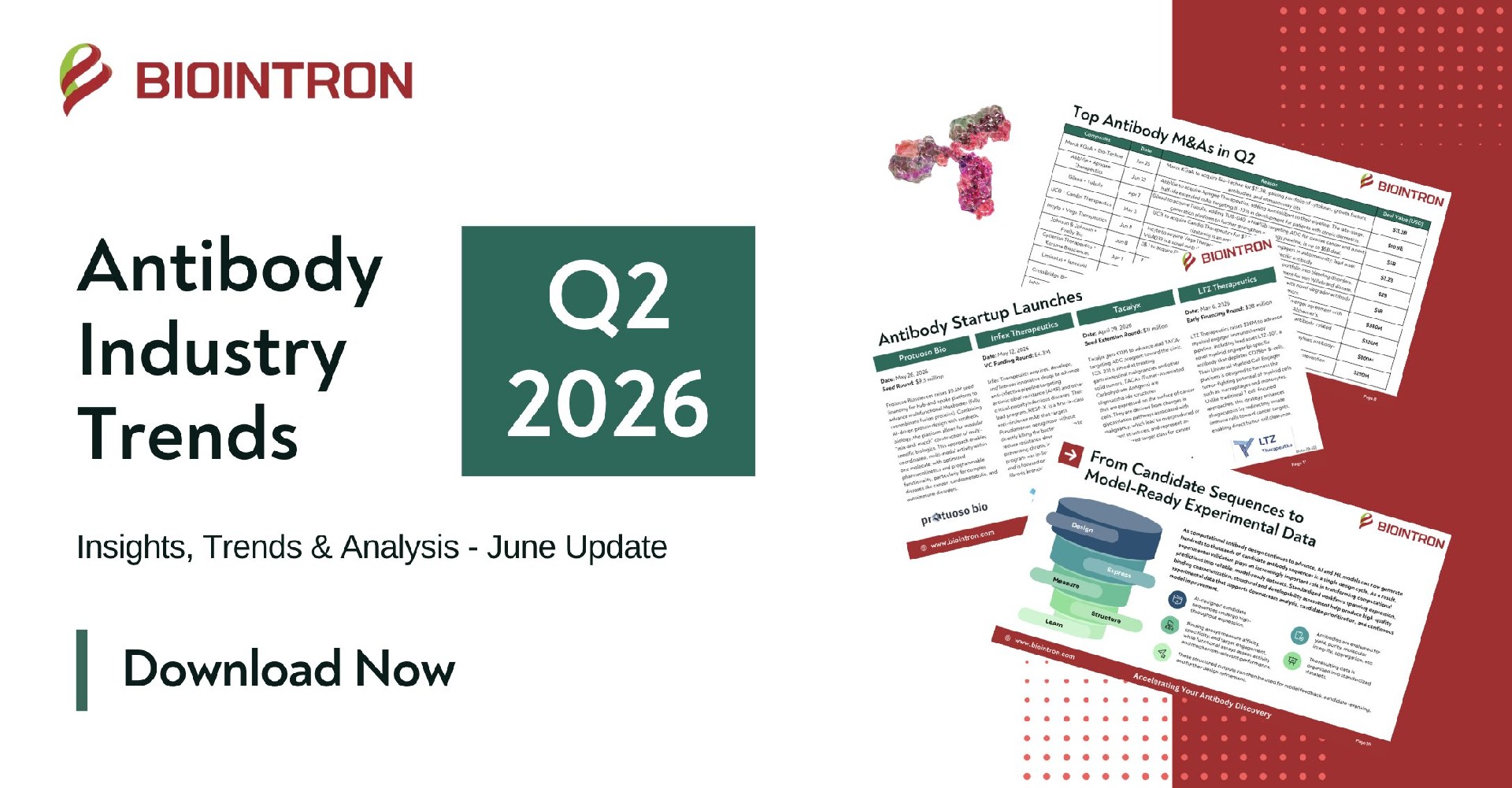
Biointron’s Q2 2026 Antibody Industry Trends report aims to explore the events a……
Artificial intelligence (AI) can be used throughout the drug development process……
Peptides and antibodies have different strengths as therapeutic molecules. Pepti……
Therapeutic antibodies are often used to block receptors or neutralize soluble m……