


Angiogenesis plays a fundamental role in both physiological processes such as wound healing and reproduction, as well as in pathological contexts including tumor growth, progression, and metastasis. Vascular endothelial growth factor (VEGF) is a regulator of angiogenesis and has been a major focus in anti-cancer therapeutic development. Novel regulatory approvals, the emergence of bispecific and trispecific antibody formats, antibody conjugates, and an increasingly diverse clinical pipeline reflect the potential of VEGF-targeted interventions.

On June 30, 2025, the National Medical Products Administration (NMPA) of China approved the novel drug Enzeshu (suvemcitug), developed by Simcere Pharmaceutical Group and Pyxis Oncology, Inc.! The recombinant humanized monoclonal antibody works by potently blocking the binding of VEGF to its receptor, thus inhibiting tumor angiogenesis and achieving an anti-tumor effect. It is currently indicated for the treatment of recurrent ovarian cancer, fallopian tube cancer, or primary peritoneal cancer in combination with paclitaxel, liposomal doxorubicin, or topotecan in adults who have received no more than one systemic therapy after platinum resistance.
Enzeshu is not the only anti-VEGF antibody in the news, as Pfizer recently put down $6B for 3SBio’s PD-1/VEGF bispecific antibody (SSGJ-707) for various solid tumors. SSGJ-707 is a recombinant humanized bispecific molecule built on IgG4 that targets the human programmed death 1 (PD-1) and VEGF. The PD-1/VEGF mechanism has been garnering significant attention, with Summit Therapeutics and Akeso's bispecific antibody ivonescimab demonstrated superior efficacy to Merck’s blockbuster PD-1 inhibitor Keytruda in a late-stage non-small cell lung cancer (NSCLC) trial, in addition to outperforming BeiGene’s Tevimbra in comparative studies.
Other than PD-1, bispecific antibodies targeting VEGF/TGF-β or DLL4/VEGF are also under investigation. For example, Y332D, a bispecific antibody against VEGF and TGF-β, was shown to synergize with local radiotherapy by mitigating RT-induced immunosuppressive pathways while amplifying immune activation. This approach effectively reprogrammed the tumor microenvironment from immune-cold to inflamed, boosting both local tumor control and systemic antitumor immunity, including abscopal effects. In another example, a bispecific molecularly imprinted nanomissile (bsMINM) was developed to simultaneously inhibit VEGF-VEGFR and DLL4-Notch signaling pathways in endothelial and tumor cells. By disrupting the crosstalk between these pathways, bsMINM effectively suppressed compensatory angiogenesis and reduced tumor growth in preclinical models.

Beyond bispecifics, trispecific antibodies like TAVO412 was engineered to inhibit EGFR, cMET, and VEGF-A signaling (three pathways commonly implicated in NSCLC progression and resistance to standard therapies). In preclinical models, TAVO412 not only blocked receptor phosphorylation and promoted receptor degradation but also enhanced Fc-mediated tumor cell cytotoxicity. Additionally, novel antibody conjugates, such as an enzyme-responsive DNA origami-antibody conjugate were developed to treat choroidal neovascularization (CNV), addressing both VEGF signaling and oxidative stress. This platform combines anti-VEGF antibodies with VEGF-targeting aptamers on a DNA origami scaffold, linked via MMP-cleavable peptides. Upon accumulation in neovascular lesions, MMPs trigger localized antibody release while the DNA nanostructure remains to scavenge reactive oxygen species.

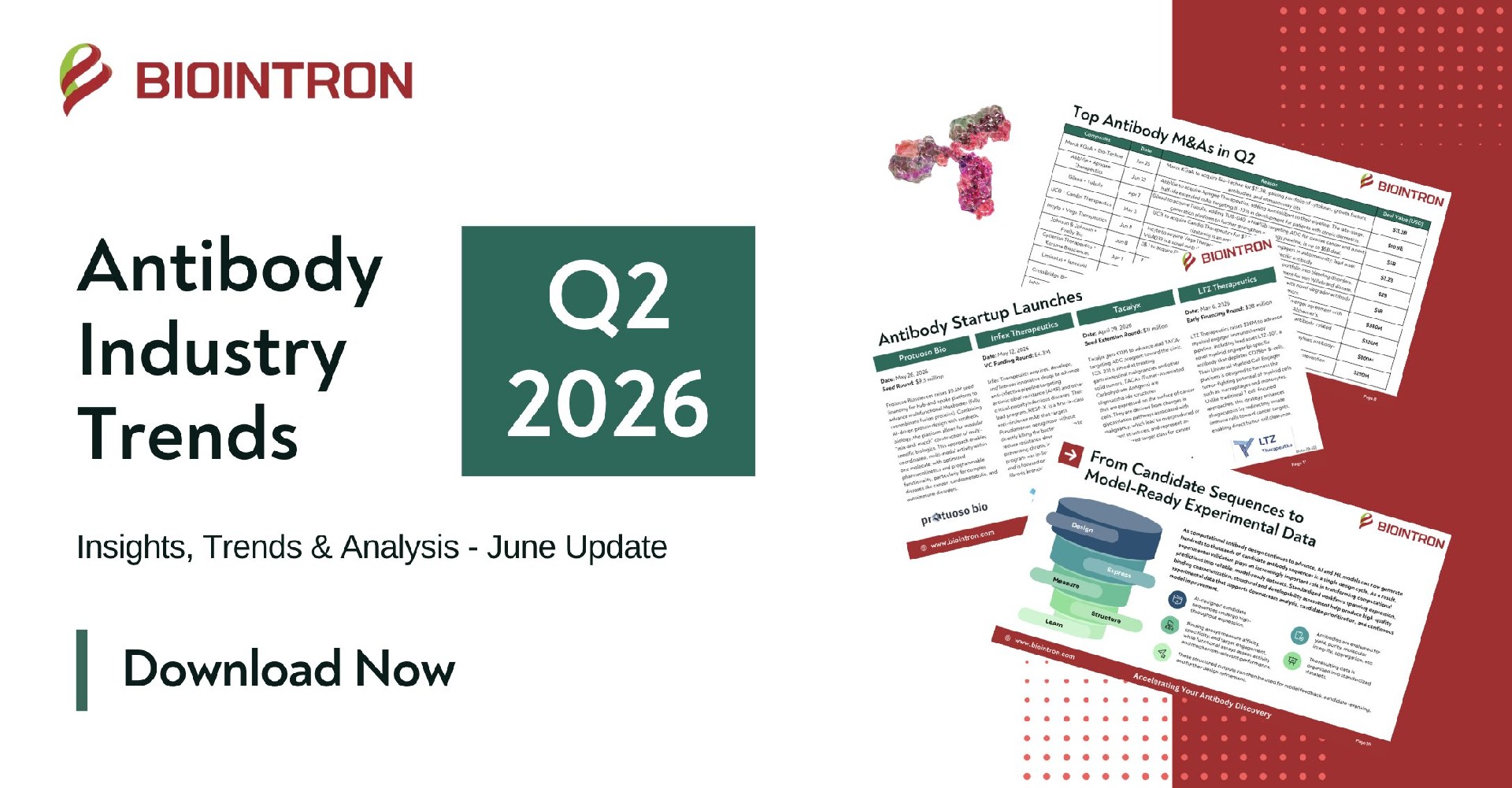
Biointron’s Q2 2026 Antibody Industry Trends report aims to explore the events a……
Artificial intelligence (AI) can be used throughout the drug development process……
Peptides and antibodies have different strengths as therapeutic molecules. Pepti……
Therapeutic antibodies are often used to block receptors or neutralize soluble m……