



“Programmable antibodies” can describe several related approaches that make antibody-based systems more designable and controllable. A traditional antibody has two main functional parts: the Fab region, which recognizes a target antigen, and the Fc region, which interacts with immune receptors and helps determine downstream immune activity. In newer research, “programming” can mean changing the antibody sequence, arranging antibody fragments in defined positions, controlling when antigen binding occurs, or connecting antibody recognition to a molecular readout. Several recent papers illustrate how antibody-related technologies are being designed with more modularity, external control, and functional tuning.
A recent preprint proposes computationally designed antibody Fc variants. The Fc domain does not bind the disease target itself, but it helps determine how an antibody communicates with immune cells through Fc receptors. Here, the authors used yeast display, deep mutational scanning, receptor-binding screens, deep sequencing, and machine learning to study how Fc sequence changes affect binding to eight Fc receptors. The paper suggests that the Fc region can be treated as a programmable layer for tuning antibody effector functions, rather than as a fixed structural component attached to a target-binding region.
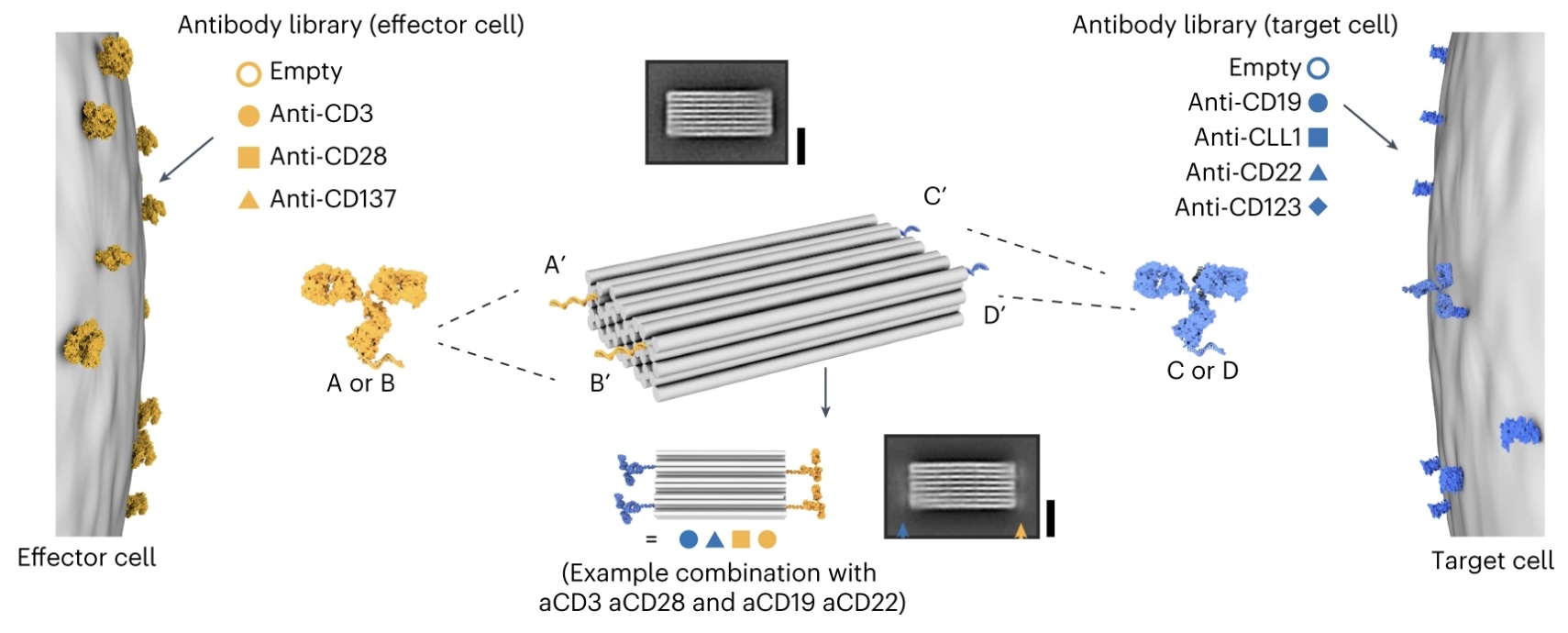
Another example programs antibody function through physical arrangement rather than sequence alone. In a study led by Technical University of Munich researchers, DNA origami was used as a nanoscale scaffold to assemble antibody fragments into programmable T-cell engagers. DNA origami is a method for folding DNA into nanoscale structures that can position biomolecules. The platform allowed IgG, F(ab), or scFv antibody fragments to be placed with control over valency (the number of binding units), orientation, and spacing. They showed that antibody behavior can depend not only on what the binding domains recognize, but also on how those domains are positioned in space.
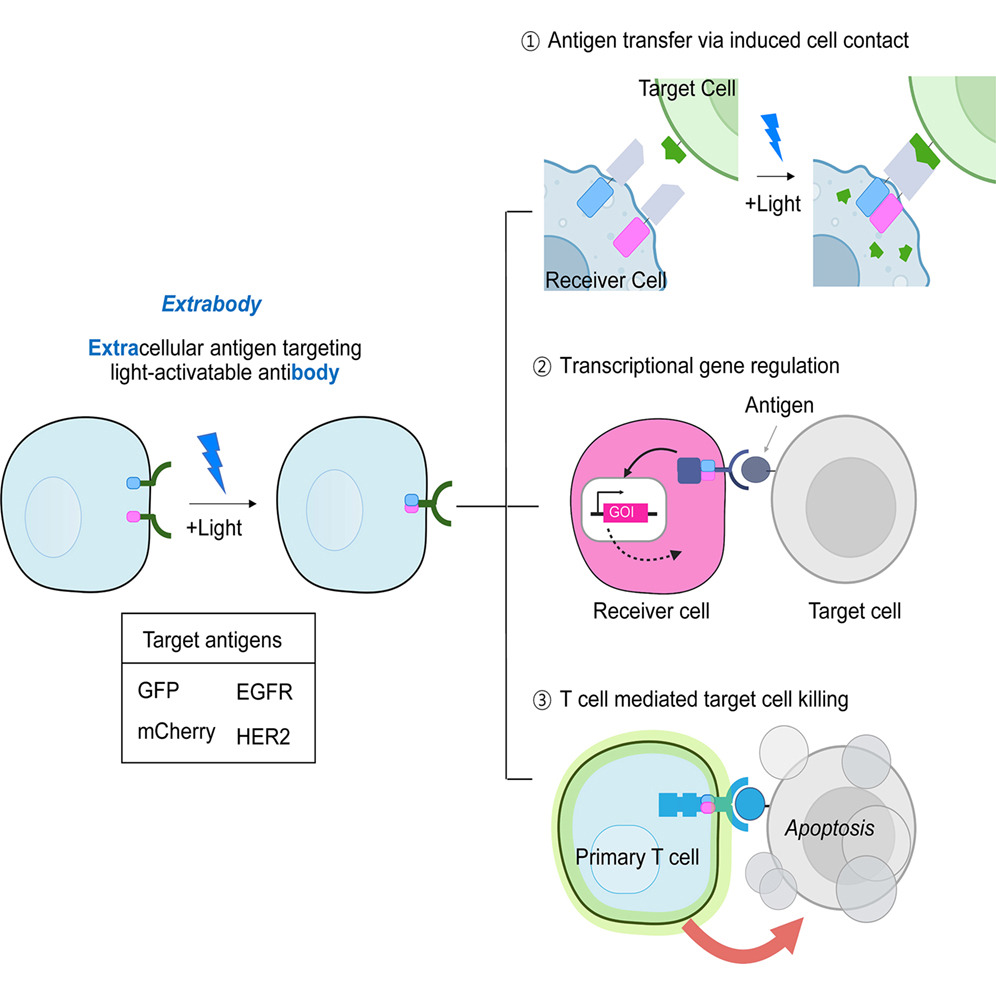
Most recently, another paper adds a different type of control: making antigen recognition conditional through light activation. The Korea Advanced Institute of Science and Technology authors developed extrabody, a split antibody-fragment platform in which antigen-binding domains are divided into inactive halves that reassemble only after stimulation by blue light or a chemical inducer. This allowed extracellular antigen binding to be gated by an external input. The system was tested with targets including GFP, mCherry, EGFR, and HER2, and it supported both nanobody- and scFv-derived recognition formats. The study also connected extrabody modules to synthetic receptor systems, allowing dual-input control of gene expression, cytokine release, T-cell activation, and antigen-specific cytotoxicity.
Meanwhile, a more diagnostic-oriented example uses programmable molecular circuits to detect antibodies. In this paper, the University of Rome Tor Vergata authors built cell-free transcriptional switches that respond to specific antibodies. Cell-free transcriptional switches are test-tube molecular circuits that produce a signal without living cells. The system uses antigen-conjugated DNA strands that are brought together when the target antibody binds; this activates a DNA transcriptional switch. The platform was adapted to detect multiple antibodies and was shown to measure antibody levels in serum. Thus, antibody binding becomes an input that can trigger a programmable biochemical signal.
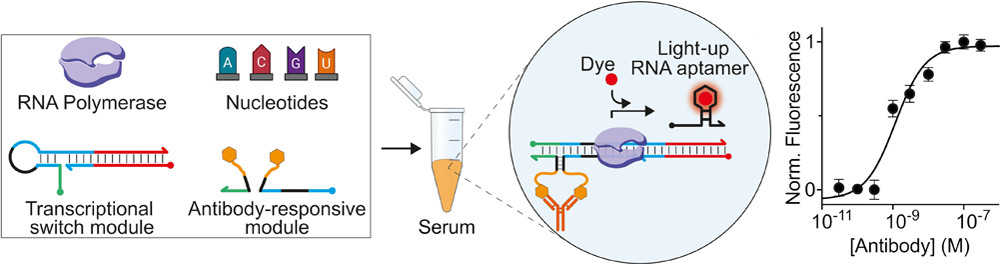
Taken together, these papers show programming at different layers: Fc sequence design for receptor engagement, nanoscale assembly for multispecific T-cell engagement, stimulus-gated antigen recognition, and antibody-responsive diagnostic circuits. These approaches are still at different stages of development, and many questions remain around translation, manufacturability, safety, and performance across biological contexts. Still, they provide useful snapshots of how antibody-related systems are being designed with more control over what they bind, how they are arranged, when they act, and what signals they produce.
Biointron's Q3 2026 Antibody Industry Trends report aims to explore the events a……
On September 18, 2026, the FDA approved Isembyld (apitegromab-mstn) from Scholar……
mRNA-encoded antibodies are an approach in which synthetic messenger RNA carries……
Artificial intelligence (AI) can be used throughout the drug development process……