




Antibody Engineering & Therapeutics Europe 2026 was held on May 27-29 in Basel, Switzerland, bringing together researchers working across antibody discovery, multispecific engineering, Fc modulation, ADCs, AI-enabled design, and non-oncology antibody applications. Antibody innovation is clearly advancing towards engineered, data-driven, and conditionally active therapeutics.
Multispecific antibodies are becoming more design-driven, with increasing attention to synapse geometry, avidity, target pairing, and conditional activation.
AI and machine learning are now embedded across antibody discovery, from de novo antibody design to affinity maturation, Fc engineering, and conditionally active biologics.
ADC development involves better therapeutic index, with novel payloads, dual-payload strategies, linker innovation, and tumor-selective targeting approaches.
Fc engineering remains important for antibody performance, especially for half-life extension, Fc receptor engagement, effector function tuning, and IgG clearance.
Antibody applications include autoimmune disease, respiratory infection prevention, allergy, malaria, mpox, influenza, and inflammatory disorders.
Intermembrane distance and molecular flexibility shape bispecific T cell engager potency. Tighter synapse formation and reduced flexibility can enhance co-stimulatory interactions and cytotoxic responses, providing practical design rules for next-generation TCEs. (University of Salzburg)
Multispecific T cell engagers for hematologic malignancies were discussed, including trispecific approaches targeting two tumor-associated antigens in multiple myeloma and lymphoma. (Johnson & Johnson)
Conditional, dual-targeting trispecific T-cell engagers designed with synapse-gated logic and affinity-tuned binding arms can improve therapeutic index by enabling AND-gated tumor selectivity. (AstraZeneca)
Germinal: a model created for epitope-targeted de novo design of nanobodies and scFvs. (Stanford University)
AbiLeap: an AI-enabled platform for generating conditionally active antibodies. (Ability Biotherapeutics)
mBER: an open-source system for de novo antibody binder design supported by million-scale experimental screening. (Manifold Bio)
FcGPT: a protein language model for designing Fc variants with programmable Fc receptor binding profiles. (ETH Zurich)
Since ADCs interact with the tumor microenvironment, including macrophage effects, protease activity, and immune activation, ADC design should look at local tumor biology. (University of Michigan)
Computational “virtual cell” models for ADC payload biology were described, including prediction of resistance mechanisms and prioritization of synergistic payload combinations.
Interesting payloads:
Amanitin-based ADCs, which use α-amanitin (a potent toxin derived from the Death Cap mushroom) as a payload.
N-myristoyltransferase inhibitors are a novel ADC payload class. NMTis disrupt cancer cell trafficking and trigger stress and apoptosis.
Hinge engineering is a strategy to tune receptor agonism in immunostimulatory antibodies, particularly for TNFR superfamily targets. (University of Southampton)
Structural and Fc-FcRn engineering must be customized to the specific structural format and Fv charge of a complex antibody to optimize its clearance and pharmacokinetic relationships. (Roche)
FcRL5 is a prominent target in B cell malignancies. Human FcRL5 acts as an avidity-dependent IgG Fc receptor that recognizes immune complexes by binding two IgG-Fc molecules in close proximity.
Tetraspanin proteins, including CD37 and CD20 in lymphocytes and B-cell lymphoma, have therapeutic potential. (Radboud University)
Anti-FcγRI antibodies for autoimmune disease blocks IgG and immune complex binding in models of ITP and rheumatoid arthritis without receptor activation. (University Medical Center Utrecht)
Intranasal antibody administration could be used for prevention of respiratory viral infection, highlighting local antibody delivery at the portal of viral entry. (Leyden Labs)
Infectious disease:
Human antibodies against influenza A viruses can target cross-reactive immune responses and conserved vulnerabilities, revealing precise targets for both antibody therapeutics and universal vaccine design. (University of Cologne)
Potent neutralizing antibodies target mpox (specifically the A28 protein), and mouse vaccination data demonstrates that targeting this specific component can successfully drive protective immune responses. (Tel Aviv University)
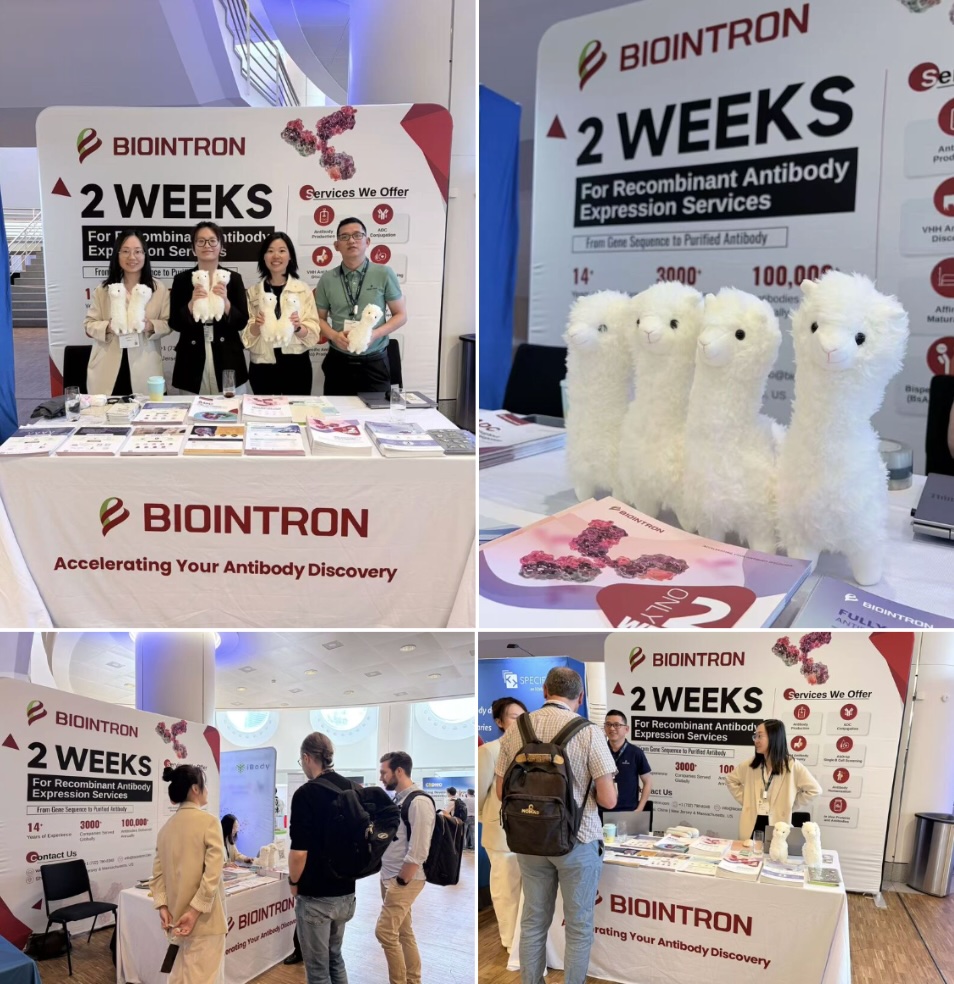
Thank you to everyone who visited our booth at AET Europe 2026 to learn about our services! We had a fantastic time chatting with you and how it can help you achieve antibody development. Our expert team would be happy to answer any follow-up questions. Feel free to email us at info@biointron.com or visit our website at www.biointron.com.
Biointron announces limited-time RushData launch pricing for high-throughput ant……
August 2026 brought another mix of acquisitions, licensing agreements, strategic……
Antibody discovery often begins with a highly diverse population of B cells, onl……
As larger candidate panels move from computational design into the laboratory, a……