






For an antibody candidate, strong target binding is only part of the path toward a successful therapeutic. A molecule can show high affinity and selectivity yet encounter problems later because of poor stability, low expression, aggregation, non-specific binding, or other unfavorable biophysical properties.
These characteristics are often grouped under developability, which is the set of molecular properties that influence whether a drug candidate can be produced, formulated, administered, and ultimately developed into a therapeutic.
Usually, many of these properties are examined after initial antibody discovery has already narrowed the field to a relatively small number of leads. Increasingly, however, developability assessment is moving earlier. Rather than asking only which antibodies bind the target most strongly, discovery teams can ask a second question at the same time: which of these molecules have properties compatible with further development?
Evidence from both computational and experimental studies suggests that making this distinction earlier may help reduce downstream attrition.
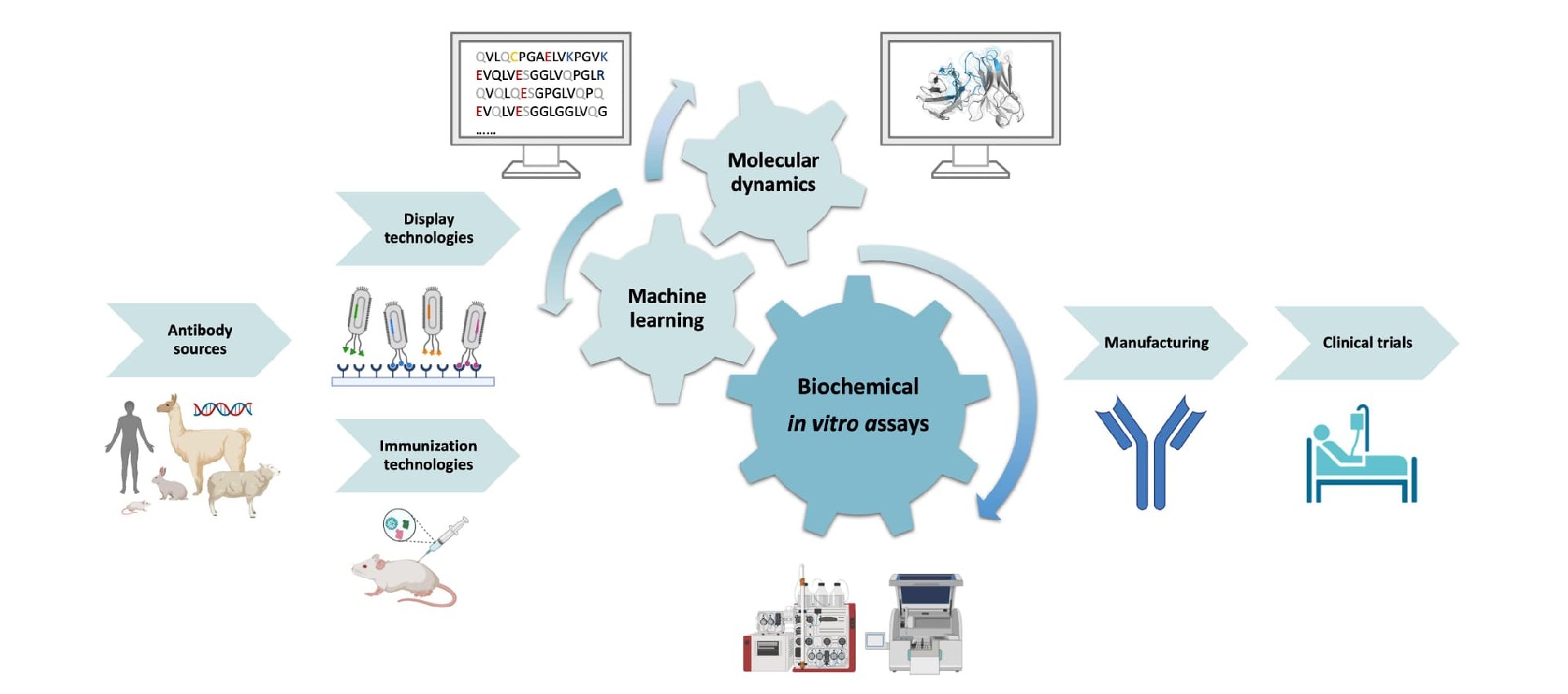
Affinity is the strength of the interaction between an antibody and its target. It is an important criterion during antibody discovery, but it provides less information about how the molecule will behave under the conditions required for development and manufacturing.
An antibody may, for example, bind its intended target strongly while also interacting non-specifically with unrelated molecules. It may have a tendency to self-associate, expose hydrophobic surface patches, or become unstable under thermal stress. These liabilities may affect pharmacokinetics, formulation, expression, purification, or long-term stability.
One strategy is therefore to introduce developability pressure during the discovery process itself.
Display technologies provide one example. In phage display, antibody libraries can be exposed to elevated temperatures or acidic conditions before selection, enriching molecules that retain desirable properties under stress. Mammalian display offers another route: because poorly folded or aggregation-prone proteins are subject to cellular quality-control mechanisms, surface expression can provide information about intrinsic antibody stability alongside target binding.
Once antibody sequences have been identified, in silico screening (computational assessment performed without physical experiments) can provide another early filter. Sequence-based tools can identify potential liabilities such as oxidation, deamidation, Asp isomerization, non-canonical cysteines, unintended N-glycosylation sites, or predicted immunogenic epitopes. Structural models can also be used to estimate properties including charge distribution, hydrophobic surface patches and VH–VL interface stability.1
These approaches can reduce the number of clearly unfavorable sequences entering experimental characterization. But computational prediction does not eliminate the need for experimental testing.
According to Fernández-Quintero et al. (2023), experimentally measured properties. particularly polyspecificity and hydrophobicity, were substantially more predictive of clinical progression than computational flagging systems. Antibodies that progressed from clinical trials to regulatory approval showed fewer unfavorable biophysical outliers, particularly within hydrophobicity and polyreactivity clusters, than molecules that were terminated or otherwise failed to progress.
Polyspecificity, sometimes called non-specific binding or polyreactivity in related assay contexts, describes an antibody's tendency to interact with molecules other than its intended target. Excessive polyspecificity can contribute to undesirable biological behavior, including faster clearance from circulation.
Charge appears to be one contributor. High overall positive charge and basic complementarity-determining regions, or CDRs (the antibody regions that make many of the direct contacts with an antigen) were associated with increased non-specificity and polyreactivity. Larger negatively charged surface patches, by contrast, appeared to be protective against some of these liabilities.
Hydrophobicity represents another important aspect. Hydrophobic regions are areas of a protein surface that tend to avoid interaction with water. When unusually large hydrophobic patches are exposed on an antibody surface, they can promote unwanted interactions, self-association, and aggregation. Surface-exposed hydrophobic clusters in the CDRs were identified as major drivers of increased retention in hydrophobic interaction chromatography and related assays.
These findings support a discovery strategy in which sequence and structural predictions are used as filters, but experimental data are introduced before final lead selection.2
Developability is made up of different experimental methods for different aspects of antibody behavior. For example:
Size-exclusion chromatography (SEC-HPLC) separates molecules according to their apparent size and can be used to assess monomer content and detect aggregates or other higher-molecular-weight species.
Differential scanning fluorimetry (DSF) measures thermal stability. Two commonly reported parameters are Tm, the temperature at which a protein undergoes a major unfolding transition, and Tonset, the temperature at which unfolding begins.
Self-association can be investigated using affinity-capture self-interaction nanoparticle spectroscopy (AC-SINS), a low-material assay designed to identify antibodies with a propensity to interact with themselves.
Hydrophobicity can be assessed experimentally using hydrophobic interaction chromatography (HIC-HPLC), while dynamic light scattering (DLS) measures the size distribution of molecules or particles in solution and can provide information relevant to aggregation and colloidal behavior.
Other chromatographic and electrophoretic measurements examine complementary molecular characteristics.
Heparin HPLC can provide information related to interactions with the negatively charged heparin surface and has been used as a surrogate measurement associated with non-specific interactions.
Ion-exchange chromatography (IEX-HPLC) separates molecules according to charge.
Capillary isoelectric focusing (iCIEF) characterizes charge variants and measures the isoelectric point, the pH at which a protein has no net electrical charge.
Capillary electrophoresis–sodium dodecyl sulfate (CE-SDS) evaluates protein size and purity under electrophoretic conditions and can reveal fragments or other product-related species.
Furthermore, assays such as polyspecificity reagent ELISA (PSR ELISA) directly test a candidate's tendency to interact with a complex mixture of non-target molecules, providing an experimental view of non-specific binding behavior.
Together, measurements such as these provide a multidimensional profile.
The case for experimental characterization becomes stronger when considering how computational models behave outside the datasets on which they were developed.
AI and machine-learning approaches can generate or prioritize large numbers of sequences, but the results may occupy regions of sequence or structural space that are poorly represented in historical datasets. In such cases, model predictions may be most useful when paired with experimental measurements rather than treated as substitutes for them.
This creates a practical challenge: traditional characterization workflows can become a bottleneck when the number of candidates entering the laboratory increases substantially.
High-throughput experimental data generation offers one way to narrow that gap. Instead of postponing experimental characterization until a few leads remain, larger candidate panels can be compared earlier across relevant assay dimensions. Biointron's RushData workflow is designed around this type of high-throughput assay data generation, allowing experimental measurements to be incorporated into rapid antibody screening cycles rather than reserved only for late-stage candidates.
From Fernández-Quintero et al. (2023)’s paper, more testing does not automatically mean better prediction. Assay reproducibility also matters. They reported substantial differences in structural descriptors depending on the software or modeling protocol used. Correlations between metrics calculated using different structural models ranged from relatively poor to moderate, with reported R² values of 0.31–0.69.2
Experimental methods also differed in reproducibility. Complex assays using cell-derived polyspecificity reagents or AC-SINS showed poor quantitative agreement between laboratories, even when they identified similar extreme outliers. By contrast, column-based assays such as FcRn retention time and HIC retention time showed high reproducibility, with reported R² values above 0.95.2
Published human clearance measurements presented another complication: different studies sometimes reported very different values for the same clinical antibody.
These observations argue against interpreting any developability measurement by itself, as the context of the assay, its reproducibility, and its relationship to other measurements, all matter.
A practical developability workflow therefore benefits from combining orthogonal methods — assays that examine a molecule through different physical principles. Biointron's developability testing panel includes SEC-HPLC, CE-SDS, DSF Tm and Tonset, AC-SINS, HIC-HPLC, DLS, Heparin HPLC, IEX-HPLC, iCIEF and PSR ELISA, providing several complementary views of stability, self-interaction, hydrophobicity, charge, purity and polyspecificity.
The goal of early developability screening is to identify liabilities while there is still sufficient sequence diversity and time to act on them. When hundreds or thousands of computationally designed antibodies are being evaluated, experimental characterization can provide the feedback needed to determine whether predicted improvements translate into favorable molecular behavior.
This is particularly relevant to iterative design–build–test–learn cycles, in which computational designs are produced, experimentally tested, and the resulting data are used to guide the next round of design.
As antibody discovery becomes faster and more computational, developability assessment may need to follow the same trajectory. Moving experimental screening upstream and generating sufficiently broad datasets to compare candidates across multiple properties offers a way to select antibodies with a stronger foundation for what comes next.
Jain, T., Boland, T., & Maximiliano Vásquez. (2023, April 18). Identifying developability risks for clinical progression of antibodies using high-throughput in vitro and in silico approaches. mAbs; Taylor & Francis. https://www.tandfonline.com/doi/full/10.1080/19420862.2023.2200540#abstract
Fernández-Quintero, M. L., Ljungars, A., Franz Waibl, Greiff, V., Andersen, J. T., Gjølberg, T. T., Jenkins, T. P., Voldborg, B. G., Grav, L. M., Kumar, S., Georges, G., Kettenberger, H., Liedl, K. R., Tessier, P. M., McCafferty, J., & Laustsen, A. H. (2023, February 23). Assessing developability early in the discovery process for novel biologics. mAbs; Taylor & Francis. https://www.tandfonline.com/doi/full/10.1080/19420862.2023.2171248#abstract
Biointron’s Antibodies After Hours: From Algorithms to Antibodies was held at Th……
Discover how high-throughput wet-lab validation connects AI-designed antibody se……
Understand the hybridoma generation process for monoclonal antibody production, ……
Learn how AI antibody discovery connects computational design with antibody expr……