



Artificial intelligence is quickly becoming part of monoclonal antibody discovery. Models can now help generate antibody sequences, predict three-dimensional structures, identify likely binding sites, estimate antibody-antigen interactions, and flag developability risks before a candidate reaches the bench.
This is meaningful because while traditional antibody discovery and optimization are reliable, they are often time-consuming, labor-intensive, and challenging to scale. AI-driven in silico tools, meaning computational methods performed “in the computer” rather than in the laboratory, offer a way to explore larger design spaces faster and at lower early-stage cost.
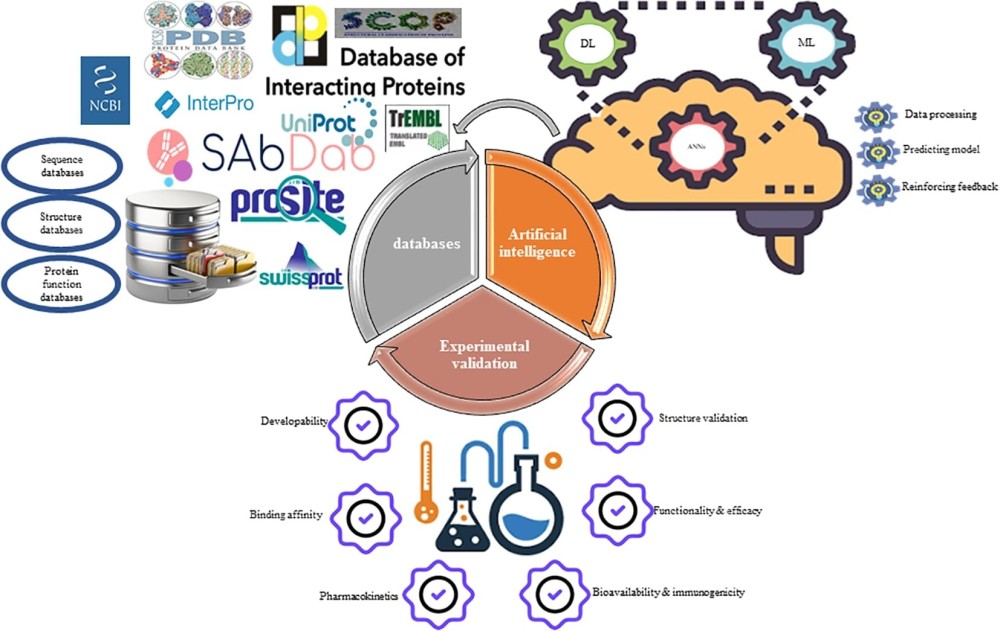
But as a recent review in Frontiers in Immunology emphasizes, the most effective strategy for next-generation monoclonal antibody development is not AI by itself, but the integration of computational prediction and design tools followed by experimental validation.1
In other words: AI can propose. Experiments still need to confirm.
Monoclonal antibodies are lab-produced proteins designed to bind a specific target, usually a molecule involved in disease. Their clinical value comes from their high specificity, which is the ability to recognize one target with precision, and their binding affinity, which describes how strongly an antibody binds to its antigen.
An antigen is any molecule recognized by the immune system. The exact part of the antigen bound by an antibody is called the epitope. The corresponding binding surface on the antibody is called the paratope. Much of the paratope is formed by complementarity-determining regions, or CDRs (flexible loops in the antibody variable region that largely determine target recognition).
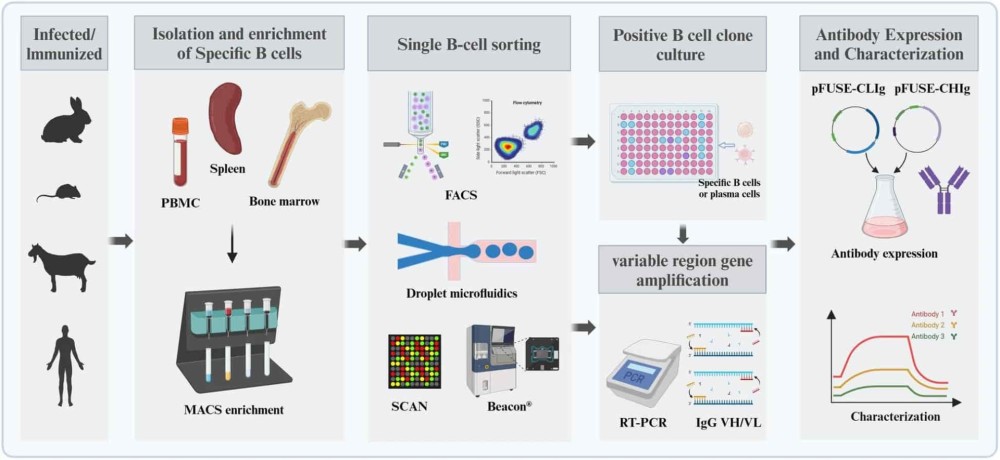
Historically, antibody discovery has relied on experimental platforms such as hybridoma technology, B-cell immortalization, display technologies, recombinant monoclonal antibody technology, and transgenic animals. These methods remain essential, particularly for validating whether an antibody actually binds and functions as intended. However, they do require screening and optimization.
AI is now being used as a complementary approach to accelerate these workflows. According to Ammar et al. (2026), AI models are increasingly applied to sequence design, epitope-paratope predictions, affinity optimization, structural prediction, and developability assessment.1
Antibody sequence design involves choosing the amino acid order that forms the antibody protein. Because antibody function depends strongly on sequence, AI models trained on large antibody datasets can suggest new candidate sequences or mutations.
Generative models are especially important here. These are AI systems that can create new outputs — in this case, antibody sequences — based on patterns learned from existing data. Tools have been created for this, such as IgLM, a deep generative model trained on a large antibody sequence dataset, and models such as PALM-H3, AbGAN-LMG, IgDiff, and IgFlow, which are designed to generate or optimize antibody regions including CDR loops.
These models can help researchers explore sequences more efficiently than purely random experimental screening. But, generated sequences are still predictions. They need to be expressed, purified, and tested before they can be considered antibody candidates.
Protein structure refers to the three-dimensional shape a protein adopts. For antibodies, binding depends on structure, specifically on how CDR loops and framework regions fold in space.
There are several computational tools for antibody structure prediction and modeling, including DeepAb, Rosetta Antibody Design, AlphaFold2, AlphaFold3, IgFold, ImmuneBuilder, AbDiffuser, and DeepSCAb.
AlphaFold2 is noted for predicting protein structures with near-atomic accuracy, even for targets without known homologous structures. AlphaFold3 extends these capabilities to more complex biological assemblies, including antibodies and protein-ligand interactions. The newer model showed higher accuracy for protein-nucleic acid interactions compared with nucleic-acid-specific predictors and significantly higher antibody-antigen prediction accuracy.2 Antibody-specific tools such as IgFold and ImmuneBuilder provide rapid antibody modeling and confidence estimate.
However, antibody structure prediction remains challenging. Antibodies are flexible molecules, and binding can involve conformational changes that are difficult to capture computationally. Experimental structural biology methods such as X-ray crystallography, cryo-electron microscopy, and nuclear magnetic resonance spectroscopy still provide essential empirical data for training and validating these models.
Epitope prediction aims to identify which region of an antigen is likely to be recognized by an antibody. Paratope prediction aims to identify which antibody residues participate in binding.
There exists multiple epitope prediction tools, including BepiPred-3.0, EpiPred, SEPPA 3.0, Epitope3D, DiscoTope-3.0, ElliPro, EM-DMS, and SEMA. Some focus on linear epitopes, which are continuous amino acid stretches. Others attempt to predict conformational epitopes, which are formed by amino acids that may be distant in sequence but close together in the folded protein.
For paratope prediction and antibody-antigen interaction modeling, tools such as Paragraph, ProtTrans, AbAgIPA, DLAB, AbAgIntPre, PECAN, CSM-AB, and RLEAAI have been used. These models use sequence, structure, geometric deep learning, graph neural networks, and protein language models to estimate where and how antibodies may bind antigens.
This is one of the most promising areas for AI-guided antibody design, but also one of the most difficult. Antibody-antigen binding is mediated by non-covalent interactions such as hydrogen bonds, van der Waals forces, hydrophobic interactions, and ionic bonds. These interactions are highly dependent on shape, charge, flexibility, and local molecular environment.
Predicting antibody-antigen interactions remains challenging because of protein conformational flexibility, the diversity of epitope-paratope interfaces, and the limited availability of experimentally validated complex structures for model training.
Affinity describes the strength of binding between an antibody and its antigen. Higher affinity is often desirable.
Affinity maturation is the process of improving antibody binding strength. It often involves generating large libraries of variants through error-prone PCR, random mutagenesis, or site-directed mutagenesis, followed by screening. These approaches can work well, but they are labor-intensive,
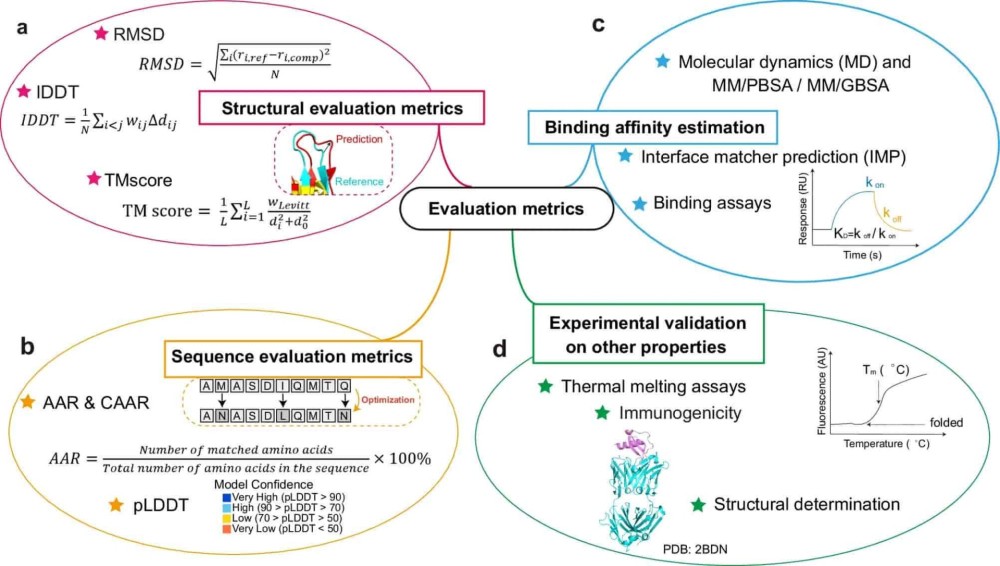
Computational methods can estimate how amino acid substitutions may affect antibody-antigen binding and interaction energy. Tools such as OptMAVEn, OptCDR, Ens-Grad, PALM-H3, and A2Binder are highlighted in the review as approaches that support CDR optimization, de novo antibody design, or affinity-related predictions.
However, predicted affinity is not the same as measured affinity. Binding assays remain essential to determine whether a computationally designed antibody actually binds its target, how strongly it binds, and whether that binding is specific.
Developability refers to whether an antibody candidate has properties that make it feasible to manufacture, formulate, store, and use as a therapeutic. It includes characteristics such as solubility, stability, aggregation propensity, viscosity, immunogenicity, specificity, manufacturability, and pharmacokinetic behavior.
This concept matters because an antibody that binds well may still fail later if it aggregates, expresses poorly, becomes too viscous at high concentration, or triggers unwanted immune responses.
Computational tools for developability assessment include the Therapeutic Antibody Profiler, SOLpro, CamSol, PaRSnIP, PROSO II, solPredict, ESM1b, DeepSol, Aggrescan3D, CABS-flex, FoldX, and the High Viscosity Index. These tools can help identify risks such as poor solubility, aggregation-prone regions, and high viscosity.
Still, developability prediction depends heavily on experimental datasets, although the assessment and evaluation of developability attributes remain challenging because of the limited availability of large, high-quality experimental datasets. Biointron’s Antibody Developability Platform is designed to accelerate biologic drug discovery with precision and efficiency. This comprehensive service integrates high-throughput expression and a comprehensive panel of in vitro assays to enable rapid evaluation of antibody candidates for binding, stability, and developability.
With a rapid turnaround time of just 3-5 days per analysis, Biointron delivers actionable data early in the discovery process, helping teams prioritize the most promising candidates.
AI models are only as reliable as the data used to train and test them. In antibody discovery, that data may include sequences, structures, binding affinities, functional properties, and developability measurements.
The review repeatedly returns to this point: computational methods are powerful, but laboratory assays remain essential for validating AI-generated predictions. AI tools may face predictive inaccuracies, high computational demands, limited generalization across biological systems, biased training data, and insufficient high-quality datasets.
This is especially important in antibody engineering because optimizing one property can unintentionally impair another. For example, a mutation predicted to improve affinity could affect stability, solubility, immunogenicity, or expression yield. A de novo sequence may look promising computationally but fail during expression or show poor binding in vitro.
The relationship between AI and experimental data is bidirectional. Better datasets improve model training. Better models help researchers select more informative candidates to test. Those test results then feed back into future model refinement.
For antibody AI, useful datasets need more than sequence information alone. They benefit from experimentally measured properties collected under consistent conditions, including:
Expression data — whether a candidate can be produced successfully.
Binding data — whether the antibody binds the intended antigen and with what apparent strength.
Specificity data — whether binding is directed toward the desired target or epitope.
Developability data — solubility, aggregation propensity, stability, viscosity, or related biophysical properties.
Consistent experimental conditions — so measurements can be meaningfully compared across candidates.
Large numbers of candidates — because machine learning models improve when trained on broad, diverse, high-quality datasets.
Without standardized experimental data, model refinement becomes harder. Predictions may appear accurate in one setting but fail to generalize to new antibody formats, targets, or assay conditions.
The emerging antibody discovery workflow is not a competition between AI and the bench. It is a loop:
In silico prediction and design generate antibody candidates.
High-throughput experimental testing evaluates expression, binding, and developability.
Data analysis identifies which predictions were accurate and where models failed.
Model refinement uses the experimental results to improve future predictions.
This loop reflects the central conclusion of the review: integrating computational modeling with experimental testing is the optimal strategy for designing and developing new monoclonal antibodies.
AI can reduce the number of candidates that need to be tested by prioritizing more promising designs. But experimental validation determines which candidates are real leads.
AI is rapidly transforming antibody engineering, enabling faster and more sophisticated approaches to sequence design, structure prediction, affinity optimization, and developability assessment. However, its effectiveness remains closely tied to the availability of comprehensive, high-quality experimental data. Predictive inaccuracies, limited training datasets, and challenges in generalization highlight the continued importance of experimental validation.
The future of antibody discovery therefore lies in integrating computational design with high-throughput experimental testing. Experimental measurements of binding, stability, solubility, aggregation, and other developability attributes provide the data needed to validate AI-generated predictions and build more robust models.
This is where RushData can help bridge the gap between computational design and experimental validation. By combining 1-day CHO expression, rapid binding analytics, and early developability profiling in a high-throughput workflow, RushData enables researchers to generate standardized, multi-parameter experimental data from large numbers of antibody candidates. These datasets can help researchers evaluate AI-generated designs more efficiently while providing richer experimental inputs for downstream AI/ML workflows.
As AI-driven antibody design continues to advance, the ability to rapidly generate reliable experimental data will become increasingly important. Integrating AI-powered design with scalable experimental validation can accelerate the development of higher-quality antibody candidates while creating the data foundation for the next generation of antibody discovery.
Ammar, M., Samsonov, M., Gurylina, E., & Bayzigitov, D. (2026). Artificial intelligence advancements in monoclonal antibody development technology. Frontiers in Immunology, 17, 1802038. https://doi.org/10.3389/fimmu.2026.1802038
Abramson, J., Adler, J., Dunger, J., Evans, R., Green, T., Pritzel, A., Ronneberger, O., Willmore, L., Ballard, A. J., Bambrick, J., Bodenstein, S. W., Evans, D. A., Hung, C. C., Reiman, D., Tunyasuvunakool, K., Wu, Z., Žemgulytė, A., Arvaniti, E., Beattie, C., . . . Jumper, J. M. (2024). Accurate structure prediction of biomolecular interactions with AlphaFold 3. Nature, 630(8016), 493-500. https://doi.org/10.1038/s41586-024-07487-w
Biointron announces limited-time RushData launch pricing for high-throughput ant……
August 2026 brought another mix of acquisitions, licensing agreements, strategic……
Antibody discovery often begins with a highly diverse population of B cells, onl……
As larger candidate panels move from computational design into the laboratory, a……