




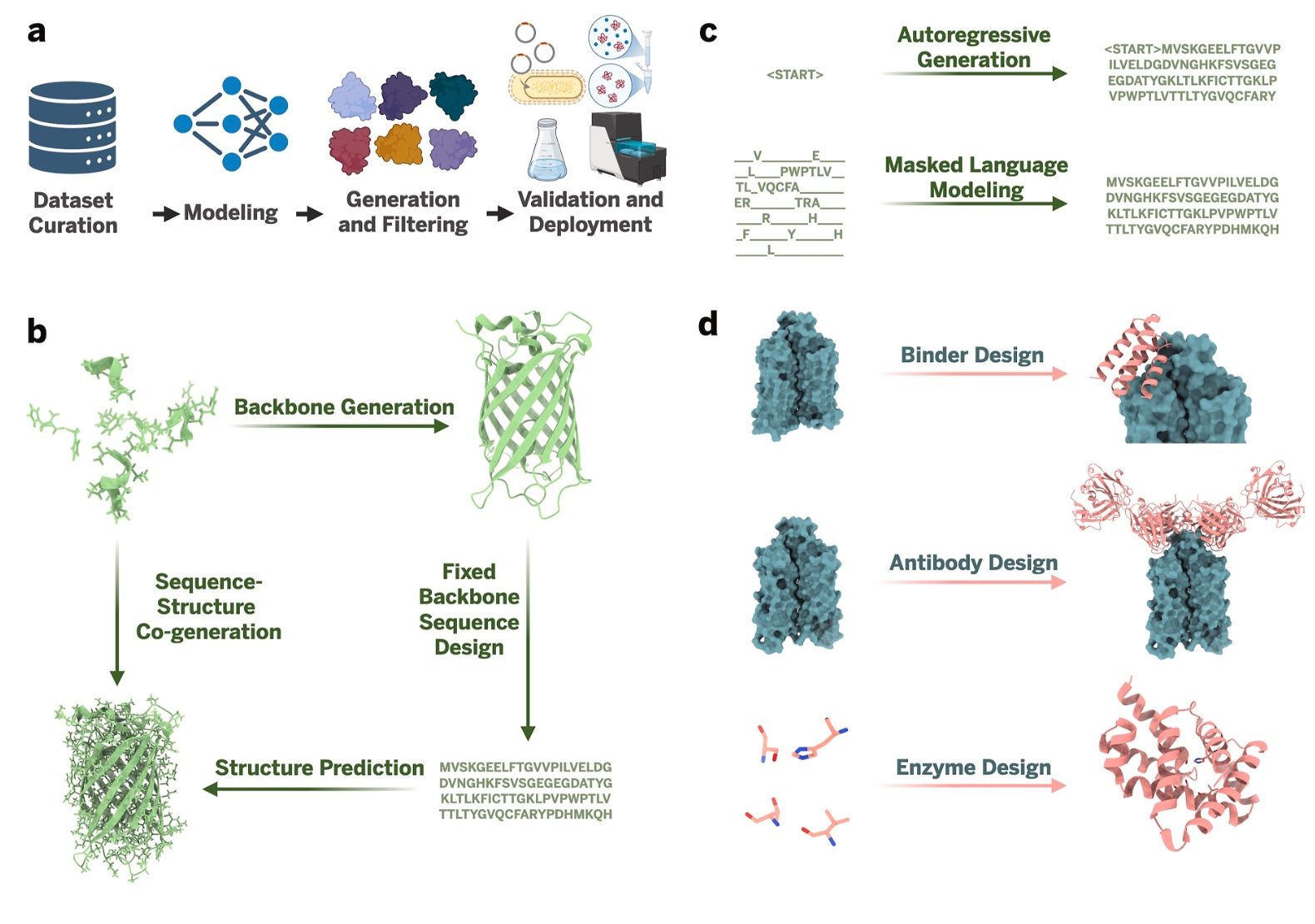
AI-driven antibody design is a process involving data curation, model development, candidate generation, computational filtering, and experimental validation.1 However, a generated sequence is not evidence of expression, correct folding, target binding, specificity, or function. For that, experimental feedback is needed for determining which computational designs work and for improving future design methods.
The data that you have determines what your models can learn. Many sequence and structure databases support current protein-design models, but the availability of data differs a lot by property. For example, binding is supported by relatively scalable assays and larger datasets, but properties such as off-target specificity, humanization, immunogenicity, intracellular behavior, and developability remain less comprehensively represented. Model performance depends on the quality, relevance, and coverage of the underlying experimental data.
Antibody-design workflows may redesign CDRs, frameworks, variable domains, VHHs, or other antibody formats:
Structure-based models use structural context to generate or evaluate sequences.
Sequence-based models learn patterns directly from protein sequence data.
Computational filters can remove candidates with poor predicted structures, unfavorable scores, or redundant sequence and structural features.
Computational filtering such as in silico ranking can help to reduce the number of candidates that must be tested, although predicted structures don’t by themselves establish expression, solubility, binding, specificity, or biological function. Instead, success rates must be interpreted alongside the filtering process, assay type, target, and definition of success used in each study.
Despite recent artificial intelligence breakthroughs, protein and antibody structure predictions still contain structural inaccuracies that alter biophysical property predictions. Besides folding or antigen-binding geometry, antibody function depends on framework-CDR compatibility, solubility, aggregation, degradation, format conversion, and the intended biological environment. For example, Galindo et al. conclude that AlphaFold-derived confidence metrics alone were insufficient to predict whether redesigned scFvs would function inside cells. Their study also shows that preserving the original CDRs does not necessarily preserve function after an antibody is reformatted or placed in a different cellular environment.2
To determine whether the sequence can be produced and whether the resulting protein shows appropriate physical behavior, measurements include high-throughput expression testing to structural characterization:
expression and yield
apparent molecular size
soluble recovery
monodispersity and aggregation
secondary or three-dimensional structure when required
To determine whether the molecule binds the intended target, relevant measurements include:
binding presence or absence
affinity and kinetic parameters
target-present and target-absent controls
competition or counter-screening assays
off-target binding assessments
The appropriate endpoint to ask whether the antibody performs its intended role in the relevant experimental environment depends on the application, such as intracellular localization or target engagement, neutralization, receptor activation or inhibition, cell killing, imaging performance, or diagnostic detection. For instance, Galindo et al. found that live-cell testing was necessary for their experiments because computational confidence did not consistently predict intracellular antibody function. Meanwhile, Kosonocky et al. found that developability was an important but comparatively data-limited area for AI antibody design.
Validation closes the loop only when experimental outcomes are retained in a form that can inform later design cycles, as useful datasets should include both successful and unsuccessful sequences. Experimental records should preserve construct format, assay conditions, quantitative measurements, controls, and definitions of success. Likewise, multi-parameter datasets are more informative than binding-only labels because antibody optimization involves several competing properties.
Current limitations include:
Success rates are difficult to compare across studies because targets, assays, candidate-selection methods, and success criteria differ.
Binding data are more abundant than data on specificity, developability, and biological function.
Models trained on general protein data may not predict performance in specialized environments or antibody formats.
Results from one scaffold, target, or format may not transfer to another.
Experimental testing therefore remains necessary when applying a method to new targets or contexts.
In conclusion, AI can generate and prioritize antibody sequences, but experimental validation determines whether those sequences produce functional molecules. Successful protein design can be viewed as a complete data-model-experiment pipeline, and computational redesign can improve antibody engineering without replacing application-specific testing. Together, progress will depend on tighter integration between computational design, structured experimental validation, and feedback from both successful and failed candidates.
Kosonocky, C. W., Alamdari, S., Yang, K. K., & Amini, A. P. (2026). Closing the loop: Experimentally validated methods in artificial intelligence–driven protein design. Current Opinion in Structural Biology, 98, 103272. https://doi.org/10.1016/j.sbi.2026.103272
Galindo, G., Maejima, D., DeRoo, J., Burlingham, S. R., Fixen, G., Morisaki, T., Febvre, H. P., Hasbrook, R., Zhao, N., Ghosh, S., Mayton, E. H., Snow, C. D., Geiss, B. J., Ohkawa, Y., Sato, Y., Kimura, H., & Stasevich, T. J. (2026). AI-assisted protein design to rapidly convert antibody sequences to intrabodies targeting diverse peptides and histone modifications. Science Advances, 12(1). https://doi.org/10.1126/sciadv.adx8352
Fernández-Quintero, M. L., Kokot, J., Waibl, F., Fischer, A. M., Quoika, P. K., Deane, C. M., & Liedl, K. R. (2023). Challenges in antibody structure prediction. mAbs, 15(1), 2175319. https://doi.org/10.1080/19420862.2023.2175319
Biointron’s Antibodies After Hours: From Algorithms to Antibodies was held at Th……
Discover how high-throughput wet-lab validation connects AI-designed antibody se……
Understand the hybridoma generation process for monoclonal antibody production, ……
Artificial intelligence (AI) is changing how therapeutic antibodies are discover……