


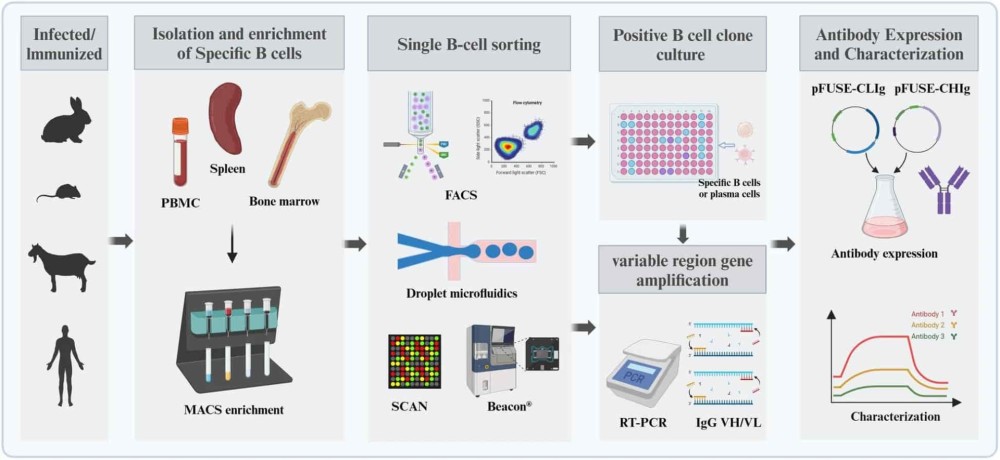


Monoclonal antibodies (mAbs) are immunoglobulins that recognize a single epitope on a target antigen. Their specificity and reproducibility make them useful in therapeutic development, diagnostics, and life science research. In contrast to polyclonal antibodies, which consist of multiple antibody species with varying affinities and specificities, mAbs provide consistency across applications, manufacturing batches, and time. As a result, they are widely employed for antigen detection, functional blocking, immune cell targeting, and as components in companion diagnostics.
The hybridoma method, developed by Köhler and Milstein in 1975, remains one of the most established platforms for generating monoclonal antibodies. The approach involves fusing a B cell from an immunized host with an immortal myeloma cell line, creating a hybridoma capable of indefinite antibody production. This fusion combines the desired antigen specificity of the B cell with the replicative immortality of the myeloma cell, enabling long-term production of a single antibody clone.
This technology has underpinned the development of numerous FDA-approved therapeutic antibodies and continues to support reagent production for research and diagnostic use.
The process begins with the design and preparation of an appropriate immunogen. This may include full-length proteins, peptides, overexpressed cell lines, or haptens conjugated to carrier proteins such as KLH or BSA. Antigens must exhibit both immunogenicity (ability to elicit an immune response) and antigenicity (ability to be specifically recognized by an antibody). Immunogen selection and formulation (including the use of adjuvants) strongly influence the quality and specificity of the resulting antibody.
Host animals (typically mice) are immunized with the antigen over a scheduled period to stimulate B cell responses. Boosting injections enhance the immune response and increase the proportion of antigen-specific B cells. After achieving a satisfactory serum titer, spleenocytes are harvested for fusion.
B cells from the immunized host are fused with immortalized myeloma cells. Electrofusion is preferred over PEG-mediated fusion due to its higher fusion efficiency and reliability. The resulting hybridoma cells are selected in HAT medium, which eliminates unfused parental cells, allowing only hybrid cells to survive and proliferate.
Hybridomas are plated into multi-well plates and screened for production of antigen-specific antibodies. Screening methods typically include ELISA, Western blot, and flow cytometry. For high-throughput applications, technologies such as surface plasmon resonance (SPR), FACS, and microfluidics are increasingly employed. Hybridoma clones demonstrating desirable binding properties are subcloned by limiting dilution to ensure monoclonality.
Selected hybridomas are expanded in vitro using roller bottles or stirred flasks. Antibodies are collected from culture supernatants and purified using protein A or G affinity chromatography. Alternatively, in vivo production in ascites fluid remains an option, though its use is declining due to animal welfare and regulatory considerations.

Despite their advantages, hybridoma cell lines present several challenges:
Genetic instability: Spontaneous mutations or gene loss can alter antibody specificity or reduce productivity.
Contamination risk: Hybridomas are susceptible to mycoplasma and other contaminants.
Limited flexibility: Isotype switching, Fc engineering, or humanization is not feasible with intact hybridomas.
Storage burden: Long-term viability depends on continuous cryopreservation and periodic validation.
Given these constraints, many laboratories and CROs are adopting sequence-based approaches to preserve and reproduce monoclonal antibodies.
Hybridoma sequencing captures the nucleotide sequences encoding the variable regions of an antibody’s heavy and light chains (VH and VL). This sequence defines the antibody’s binding specificity and enables its reproduction through recombinant expression.
Once the VH and VL sequences are obtained, they can be cloned into mammalian expression vectors for transient or stable expression in host cells such as HEK293 or CHO. This recombinant format allows for:
Reproducible expression from a defined genetic construct.
Long-term archival as plasmid DNA or digital sequence.
Antibody engineering, such as isotype switching, Fc region modification, or miniaturization into formats like scFv.
The approach eliminates reliance on hybridoma cell recovery and enables scalable, QC-compliant production.
Biointron offers a high-accuracy hybridoma sequencing service that supports the transition from classical hybridomas to recombinant antibody production. The process involves:
5’ RACE amplification of mRNA extracted from hybridoma cells, allowing unbiased capture of full-length VH and VL regions.
Cloning and sequencing of at least five independent clones to ensure 100% sequence accuracy.
Annotated sequence reporting with CDR regions defined.
Delivery within one week from the receipt of viable hybridoma cells.
After hybridoma sequencing, recombinant antibodies can be expressed at various production scales. Benefits of recombinant expression include:
Titer optimization: Expression systems can be selected and optimized for high-yield production.
Purity and QC: Recombinant antibodies typically achieve >95% purity and <1 EU/mg endotoxin levels.
Format flexibility: Sequences can be engineered into different IgG subclasses, Fc mutants, or antibody fragments.
This is especially relevant for biopharma companies or academic institutes developing reagents or therapeutic leads.
By integrating hybridoma sequencing into antibody development workflows, organizations can extend the utility of existing hybridomas, reduce reliance on cryopreservation, and facilitate scalable recombinant production aligned with modern manufacturing and regulatory expectations.
References:
Mitchell, K. G., Gong, B., Hunter, S. S., E., C., Templeton, K. M., Goethel, M. E., Bzymek, M., MacNiven, L. M., Murray, K. D., Settles, M. L., Froenicke, L., & Trimmer, J. S. (2023). High-volume hybridoma sequencing on the NeuroMabSeq platform enables efficient generation of recombinant monoclonal antibodies and scFvs for neuroscience research. Scientific Reports, 13(1), 1-20. https://doi.org/10.1038/s41598-023-43233-4
Biointron announces limited-time RushData launch pricing for high-throughput ant……
August 2026 brought another mix of acquisitions, licensing agreements, strategic……
Antibody discovery often begins with a highly diverse population of B cells, onl……
As larger candidate panels move from computational design into the laboratory, a……