




Post-translational modifications (PTMs) are chemical or structural changes made to a protein after it has been synthesized. They can regulate the activity and function of the proteins. These include addition of carbohydrate chains, oxidation of amino acid side chains, deamidation, disulfide bond formation or disruption, and proteolytic cleavage. PTMs are important because they influence protein folding, stability, activity, clearance, and interactions with other molecules.
For therapeutic antibodies, PTMs are directly tied to product quality. They can affect:
Biological activity
Stability during manufacturing and storage
Pharmacokinetics, meaning how the drug is absorbed, distributed, and cleared
Pharmacodynamics, meaning the biological effects of the drug in the body
Safety and immunogenicity, where immunogenicity refers to the ability to trigger an unwanted immune response
Because antibodies are complex glycoproteins, mammalian expression systems are generally preferred for their production. Compared with prokaryotic, yeast, or insect systems, mammalian cells can generate recombinant therapeutic proteins with PTMs that are more similar to those found on human proteins. This is one reason mammalian platforms are widely used for monoclonal antibody manufacturing.
Chinese hamster ovary, or CHO, cells are the preferred industrial host for recombinant therapeutic protein production, owing to their capacity to facilitate appropriate protein folding and perform accurate post-translational modifications (PTMs). According to a review, nearly 70% of approved recombinant therapeutic proteins are produced in CHO systems. Their widespread use reflects several established advantages:
Growth in serum-free suspension culture, which supports scalable bioprocessing
Lower susceptibility to human viruses than human cell lines
Stable transgene integration
Capacity for complex protein folding and secretion
Ability to perform many mammalian PTMs relevant to therapeutic protein quality
For antibodies, these capabilities are especially important because correct folding and glycosylation are required for consistent structure and function. CHO cells are therefore used not simply because they produce high protein yields, but because they can support quality attributes that are difficult to achieve in non-mammalian systems.
Several quality attributes in CHO-produced antibodies are closely linked to PTMs or PTM-related degradation processes.
Glycosylation is the enzymatic addition of carbohydrate structures, called glycans, to proteins. Therapeutic antibodies usually contain N-linked glycans in the Fc region. Fc glycosylation influences:
Fc receptor binding
Complement binding
Effector functions such as antibody-dependent cellular cytotoxicity (ADCC) and complement-dependent cytotoxicity (CDC)
Stability and circulation behavior
ADCC is a mechanism in which immune cells kill antibody-coated target cells through Fc receptor engagement. CDC is a mechanism in which antibody binding activates the complement system, leading to target cell lysis. Changes in Fc glycosylation can alter both processes.
Charge heterogeneity refers to the presence of antibody variants with different net charges. It can arise from PTMs such as deamidation, sialylation, C-terminal lysine processing, and glycation. Charge variants may affect product consistency and, in some cases, biological behavior.
Aggregation is the association of antibody molecules into higher-order species. It may result from misfolding, oxidation, disulfide bond disruption, or other destabilizing modifications. Aggregates are a major quality concern because they can reduce product stability and may increase immunogenicity risk.
Other important modifications include:
Oxidation: commonly affects methionine and tryptophan residues and can impair stability or binding
Deamidation: conversion of asparagine residues to aspartate or isoaspartate, which can change charge and structure
Disulfide bond disruption: can destabilize antibody structure and promote fragmentation or aggregation
These attributes are particularly important in monoclonal antibodies because changes in the hinge or Fc regions can impair function.
Commercial License for CHOK1BN →
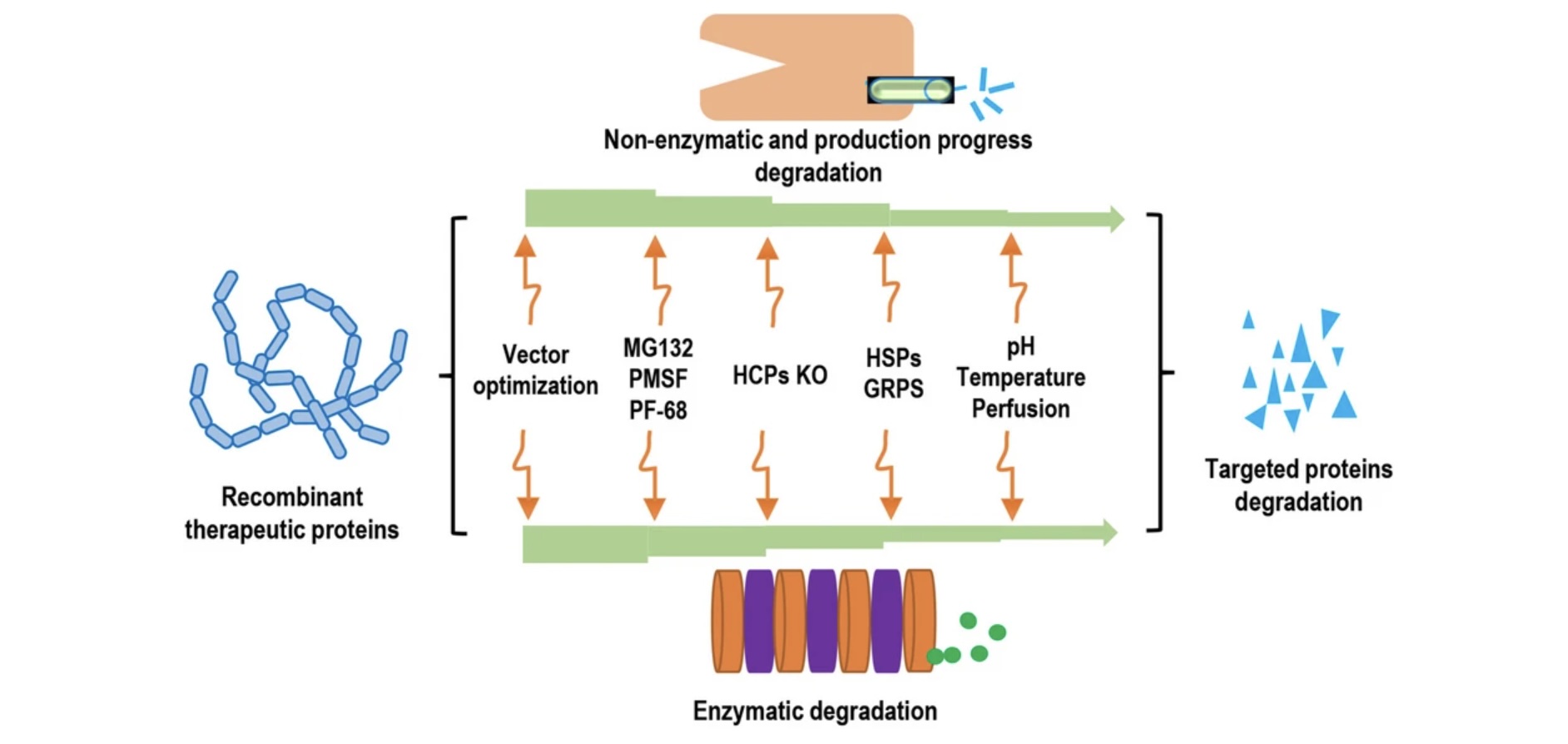
A central point from a recent paper is that recombinant therapeutic proteins produced in CHO cells can undergo both enzymatic and non-enzymatic degradation. These pathways can reduce product quality and functional activity.
Enzymatic degradation includes several intracellular and extracellular pathways.
ER-associated degradation (ERAD) is a cellular quality-control pathway in the endoplasmic reticulum, or ER, where secreted proteins are folded. Misfolded or incompletely assembled proteins are recognized and targeted for degradation rather than secretion.
The ubiquitin-proteasome system degrades proteins that have been tagged with ubiquitin, a small regulatory protein. This pathway helps remove abnormal intracellular proteins, including recombinant products that fail quality control.
Autophagy is a degradation pathway in which cellular material is delivered to lysosomes for breakdown. It can contribute to the loss of recombinant proteins under stress conditions.
Proteases, glycosidases, and sialidases: Secreted antibodies may also be degraded by:
Intracellular and extracellular proteases, which cleave peptide bonds
Glycosidases, which remove sugar residues from glycans
Sialidases, which specifically remove terminal sialic acid residues
These enzymes can alter structural integrity and glycan composition after synthesis. Degradation of antibodies can reduce Fc-mediated functions. Degraded antibody intermediates may lose the ability to bind Fc gamma receptors (Fcγ receptors) or the complement component C1q, which are required for ADCC and CDC, respectively.
Non-enzymatic degradation occurs through chemical reactions rather than enzyme action:
Oxidation
Deamidation
Isomerization (conversion of a residue into a different structural form without changing its overall chemical composition)
Hydrolysis
Deglycosylation
Disulfide bond disruption
Maillard reactions (non-enzymatic reactions between amino groups and reducing sugars that can modify proteins)
β-elimination (a chemical reaction that can disrupt certain amino acid-linked structures under destabilizing conditions)
In monoclonal antibodies, hinge-region cleavage and Fc-region oxidation are especially important because they can reduce structural stability and effector function.
Xu et al. (2021) outlines practical strategies to reduce degradation and preserve desired product attributes during CHO-based manufacturing.
One approach is host-cell engineering, meaning genetic modification of CHO cells to improve recombinant protein production or quality. This can include reducing expression of enzymes that damage the product or modifying pathways involved in folding and secretion.
A more specific strategy is protease knockout, where genes encoding problematic proteases are inactivated. Removing or reducing host-cell factors can decrease recombinant protein degradation.
Host-cell proteins (HCPs) are endogenous proteins released from the production cell line into the culture medium. Some HCPs have protease, glycosidase, or other activities that can modify the antibody product. Reducing HCP levels through cell-line engineering, purification strategy, and process control is therefore important.
The ER is central to folding and secretion of antibodies. Excessive production stress can overload ER capacity and increase misfolding or degradation. Strategies that modulate:
ER stress responses
ER-associated degradation pathways
Folding-associated chaperone systems
may improve secretion of correctly folded molecules and reduce loss of product to degradation pathways.
Process conditions also affect PTMs and degradation. Optimization may include control of:
Temperature
pH
Dissolved oxygen
Nutrient supply
Feed strategy
Culture duration
These variables can influence cellular stress, enzyme activity, glycosylation patterns, and chemical degradation rates.
To define PTMs again, they are structural changes introduced after protein synthesis, including both covalent addition of chemical groups to amino acid side chains and proteolytic cleavage of protein backbones. In cancer biology, PTMs influence the tumor microenvironment, meaning the local cellular and molecular environment surrounding a tumor. According to the review, PTMs help regulate:
Cancer-associated signaling pathways
Immune-cell activation
Hypoxia responses
Metabolic reprogramming
Antigen presentation
This matters for antibody therapy because therapeutic antibodies act within biological systems where target expression, immune responsiveness, and tumor behavior may all be shaped by PTM-dependent mechanisms.
Commercial License for CHOK1BN →
First, CHO cells remain a central platform because they combine scalability with mammalian-like processing of recombinant proteins. Second, the presence of mammalian PTM machinery alone is not sufficient to guarantee product quality. Antibody quality depends on controlling:
Glycosylation heterogeneity
Charge variants
Aggregation
Oxidation and deamidation
Protease-mediated fragmentation
Host-cell protein effects
Stress-related intracellular degradation
CHO cells are the leading mammalian platform for therapeutic antibody production because they support folding, secretion, and many clinically relevant post-translational modifications. This makes them highly suitable for generating recombinant antibodies with quality attributes closer to those required for therapeutic use.
At the same time, CHO-based production is not defined only by PTM capability, but also by the need to control degradation. Enzymatic pathways such as ER-associated degradation, ubiquitin-proteasome turnover, autophagy, protease activity, glycosidase activity, and sialidase activity can reduce product integrity. Non-enzymatic processes such as oxidation, deamidation, hydrolysis, disulfide bond disruption, and hinge fragmentation can further alter antibody quality and function.
The literature therefore supports a clear conclusion: CHO cells provide a strong manufacturing platform for antibody therapeutics, but maintaining antibody quality requires active management of PTM heterogeneity and degradation pathways throughout cell-line engineering, upstream processing, and quality control.
References:
Geng, S.-L., Zhao, X.-J., Zhang, X., Zhang, J.-H., Mi, C.-L., & Wang, T.-Y. (2024). Recombinant therapeutic proteins degradation and overcoming strategies in CHO cells. Applied Microbiology and Biotechnology, 108(1). https://doi.org/10.1007/s00253-024-13008-6
Li, W., Li, F., Zhang, X., Lin, H. K., & Xu, C. (2021). Insights into the post-translational modification and its emerging role in shaping the tumor microenvironment. Signal Transduction and Targeted Therapy, 6(1), 422. https://doi.org/10.1038/s41392-021-00825-8
Bradley, D. (2022). The evolution of post-translational modifications. Current Opinion in Genetics & Development, 76, 101956. https://doi.org/10.1016/j.gde.2022.101956
Zhang, X., Shen, Y., Guo, Z., Wang, Y., Wang, X., & Wang, T. (2025). Cell Engineering for Increasing Production of Recombinant Proteins in Mammalian Cells. BioDrugs, 40(1), 23–40. https://doi.org/10.1007/s40259-025-00753-x
Biointron announces limited-time RushData launch pricing for high-throughput ant……
August 2026 brought another mix of acquisitions, licensing agreements, strategic……
Antibody discovery often begins with a highly diverse population of B cells, onl……
As larger candidate panels move from computational design into the laboratory, a……