


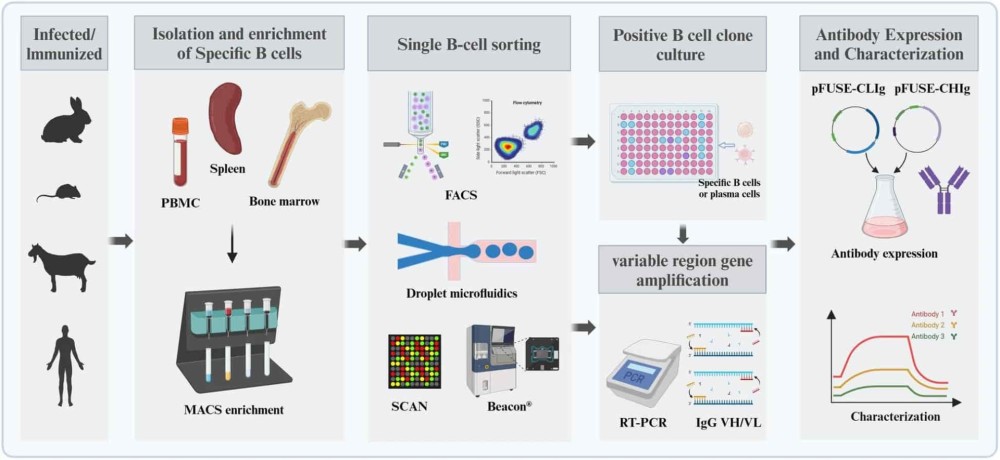
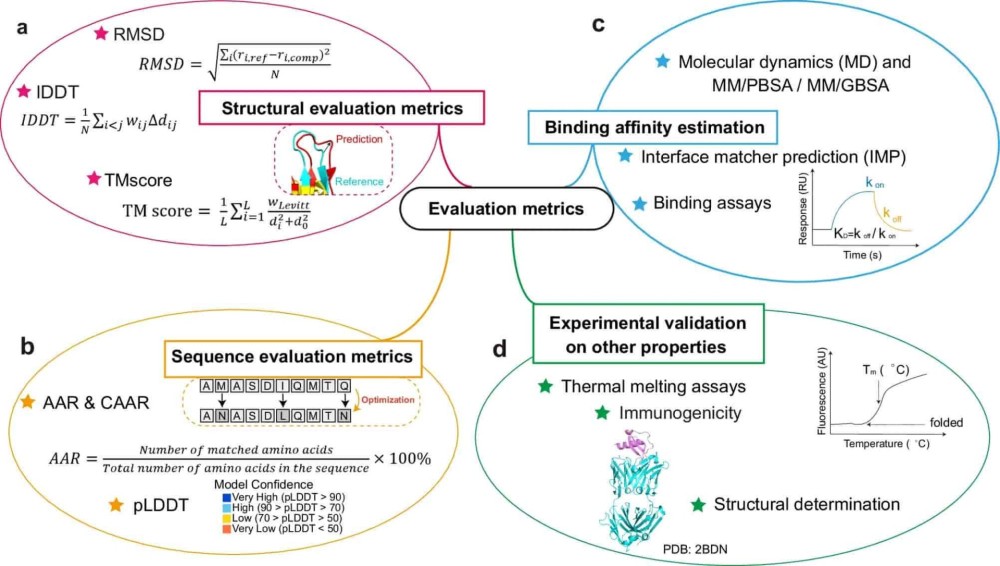


Antibody discovery programs can generate hundreds or thousands of candidate sequences, but each project requires different levels of experimental characterization.
RushData offers three packages: Basic, Standard and Premium, designed to support these different stages of candidate evaluation. Each package combines high-throughput expression with a set of analytical assays and structured data outputs. The appropriate package depends on the scientific question being asked and the amount of characterization required.
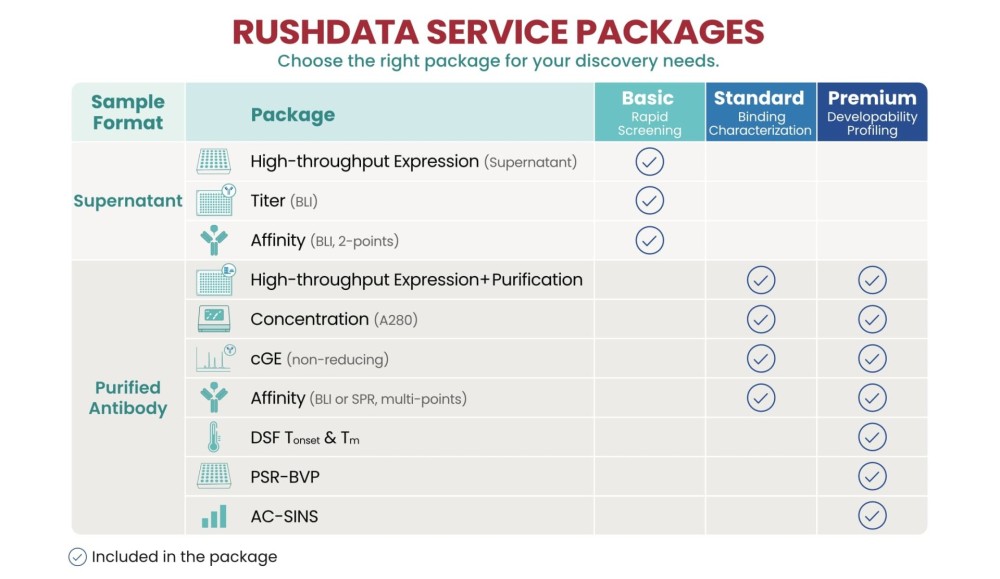
The Basic package is intended for programs that need to compare a large number of candidates quickly using antibody-containing cell culture supernatant.
A supernatant is the liquid collected from cultured cells after they have secreted the antibody. Because the antibody is evaluated without a separate purification step, supernatant-based screening can provide an efficient first look at expression and binding performance.
The Basic package includes:
High-throughput expression in supernatant
Titer measurement by biolayer interferometry
Two-point affinity assessment by biolayer interferometry
Titer refers to the amount of antibody produced in the cell culture. Affinity describes the strength of the interaction between an antibody and its target.
Biolayer interferometry, or BLI, is a label-free analytical method that measures molecular interactions in real time. BLI can be used for antibody quantitation and for evaluating binding affinity and kinetics. In the Basic package, Biointron uses BLI for titer measurement and a two-point affinity assessment.
Basic is suited to early-stage programs in which the primary objective is to:
Identify candidates with measurable expression
Confirm initial target binding
Compare a large sequence panel
Remove weakly expressing or poorly binding candidates before purification
Generate an initial experimental dataset for candidate ranking
Because the package uses supernatant and a two-point binding assessment, it is primarily a screening workflow rather than a complete analytical characterization package.
The Standard package is intended for programs that require purified antibodies and a more detailed dataset for comparing candidate quality and target binding.
It includes:
High-throughput expression and purification
Antibody concentration measurement by A280
Non-reducing capillary gel electrophoresis
Multi-point affinity analysis by BLI or surface plasmon resonance
The A280 method estimates protein concentration by measuring ultraviolet-light absorbance at 280 nanometers. This method is commonly used for purified protein samples because aromatic amino acids within proteins absorb light at this wavelength.
Non-reducing capillary gel electrophoresis, or cGE, separates protein species according to their movement through a gel-filled capillary. Under non-reducing conditions, the antibody’s disulfide bonds remain intact. The method can be used to assess intact antibody purity and detect lower-molecular-weight species such as fragments.
For binding characterization, the Standard package uses multi-point BLI or surface plasmon resonance. Surface plasmon resonance, or SPR, is a label-free technique that monitors molecular interactions at a sensor surface in real time and can provide information about binding affinity and kinetics.
Standard is suited to programs that need to:
Compare purified antibody candidates
Measure antibody concentration
Assess intact antibody purity
Obtain more detailed affinity data
Select candidates for functional testing or further optimization
Generate a consistent dataset across expression, purity and binding measurements
Standard provides a broader analytical view than supernatant-level screening while remaining focused on expression quality and target binding.
Strong expression and target binding do not, by themselves, establish that an antibody has favorable properties for continued development. Candidates can also differ in thermal stability, nonspecific binding and their tendency to interact with themselves.
These characteristics are part of antibody developability: the collection of molecular and biophysical properties that can influence whether an antibody can be produced, formulated and advanced successfully.
The Premium package includes all Standard assays, plus:
Differential scanning fluorimetry for onset and melting temperatures
PSR-BVP polyreactivity assessment
AC-SINS self-interaction analysis
Differential scanning fluorimetry, or DSF, monitors changes in protein fluorescence as temperature increases and the protein begins to unfold. The assay provides values including the onset temperature, or T_onset, and melting temperature, or T_m, which help compare the thermal stability of antibody candidates.
The PSR-BVP assay evaluates polyreactivity—the tendency of an antibody to interact with multiple unrelated biological materials rather than binding only to its intended target. RushData uses this assay as an early indicator of nonspecific-binding liability.
Affinity-capture self-interaction nanoparticle spectroscopy, or AC-SINS, evaluates an antibody’s tendency to interact with other molecules of the same antibody. The method was developed to identify self-association liabilities using relatively low antibody concentrations and has been adapted for high-throughput screening during early antibody discovery.
Premium is suited to programs that need to:
Rank leads using both binding and developability data
Identify candidates with lower thermal stability
Detect potential polyreactivity
Compare antibody self-interaction propensity
Generate multidimensional data for computational analysis
Reduce the number of higher-risk candidates entering later studies
The package is particularly relevant when several candidates have similar affinity but differ in the properties that may affect later development.
Package | Primary purpose | Sample format | Main readouts |
Basic | Rapid screening | Supernatant | Expression, BLI titer and two-point BLI affinity |
Standard | Binding characterization | Purified antibody | Concentration, non-reducing cGE and multi-point BLI or SPR affinity |
Premium | Developability profiling | Purified antibody | All Standard readouts plus DSF, PSR-BVP and AC-SINS |
The package choice can therefore be guided by a straightforward question:
Choose Basic when the immediate goal is rapid triage across a large candidate panel.
Choose Standard when purified antibodies, purity information and more detailed binding characterization are required.
Choose Premium when lead selection also depends on thermal stability, polyreactivity and self-interaction risk.
Not every candidate needs a full developability profile at the beginning of a program. A staged strategy can begin with rapid supernatant screening, followed by purified-antibody characterization for selected candidates and developability profiling for the most promising leads.
Alternatively, programs designed to generate comprehensive training data may apply a broader package to a larger candidate set. RushData supports structured, multidimensional datasets that can be compared by scientists or returned to computational antibody design and optimization workflows. The platform is designed to support thousands of candidates in parallel, with capacity for more than 3,000 molecules per batch. Exact turnaround depends on candidate count, package selection and the requested assays.
Selecting the appropriate RushData package is therefore not simply a choice between more or fewer assays. It is a decision about which experimental evidence is needed at the current stage of the program: rapid screening, purified binding characterization or broader developability-based lead prioritization.
Biointron announces limited-time RushData launch pricing for high-throughput ant……
August 2026 brought another mix of acquisitions, licensing agreements, strategic……
Antibody discovery often begins with a highly diverse population of B cells, onl……
As larger candidate panels move from computational design into the laboratory, a……