


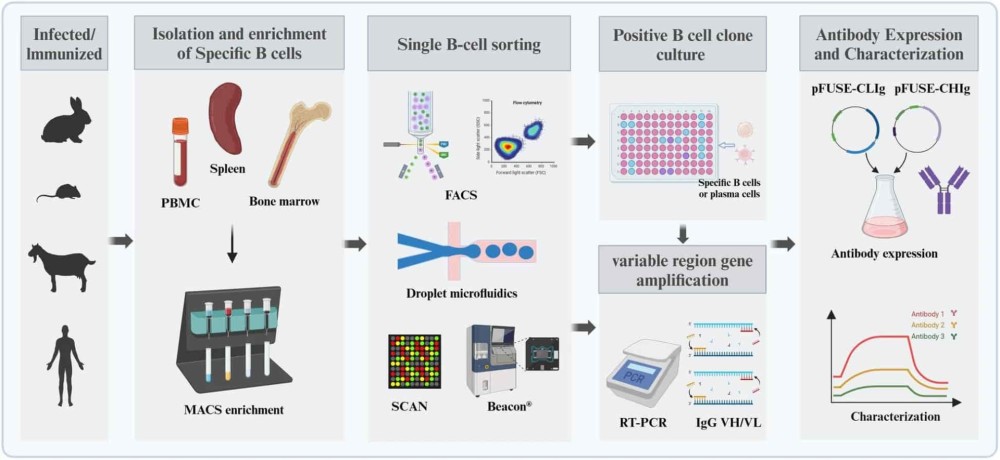


Recombinant antibody (rAb) production in mammalian cells is a critical technology for biologics development. Mammalian systems are preferred for their ability to perform human-like post-translational modifications (PTMs), particularly glycosylation, as well as their capacity for proper folding and assembly of complex, disulfide-rich proteins such as immunoglobulins.
Among mammalian hosts, HEK293 and CHO cells dominate. HEK293 cells offer high transfection efficiency and faster growth, while CHO cells provide higher genetic stability and are more widely used in manufacturing due to their regulatory acceptance and scalability.
Gene delivery for antibody expression follows two main strategies: transient and stable transfection. These systems differ in mechanism, timeline, cost, and scalability, and are typically used at different stages in the antibody development pipeline.
Transient expression involves introducing plasmid DNA, or less commonly, RNA, into mammalian host cells without integration into the host genome. The genetic material remains episomal and is diluted through cell division, resulting in a short production window.
The standard transient workflow includes:
Vector construction with codon-optimized heavy and light chain sequences.
Co-transfection into HEK293 or CHO cells in suspension culture, typically using polyethylenimine (PEI), a cost-effective transfection reagent.
Culturing under optimized conditions (chemically defined, serum-free media).
Harvest of supernatant after 5-7 days and purification using Protein A affinity chromatography.
Transient systems support various delivery techniques beyond PEI:
Lipid-based reagents (e.g., lipofectamine).
Electroporation.
Viral vectors (e.g., adenovirus, adeno-associated virus [AAV]).
Although these methods vary in efficiency and cost, they allow flexibility across different experimental setups.
Use of RNA: In specific research contexts, RNA-based transfection can be employed. This bypasses transcription and leads to protein expression within hours, though it is less commonly used in antibody workflows due to its instability and reduced scalability.
HEK293 cells offer higher transfection efficiency and human-like glycosylation patterns, which can be beneficial in specific research assays. CHO cells, while slightly slower-growing, are easier to culture at scale and are less susceptible to human pathogens. Both are compatible with PEI-based protocols and are amenable to serum-free conditions.
Large Scale Antibody Expression →
Stable expression involves the integration of the gene of interest into the host genome, enabling long-term protein production. This requires selection, clonal screening, and expansion of transfected cells to isolate high-expressing, stable clones.
Common systems include:
DHFR/MTX: In CHO-DG44 cells, methotrexate selects for gene-amplified clones containing the DHFR gene.
GS/MSX: In CHO or NS0 cells, selection is performed in glutamine-free media with methionine sulfoximine as a selection enhancer.
Transfection methods for stable integration include:
Chemical reagents (e.g., PEI, lipids).
Electroporation.
Lentiviral vectors (especially for hard-to-transfect cell lines).
Transposon systems (e.g., piggyBac) for efficient multi-gene integration.
Advantages
Stable, long-term expression: Enables consistent output over extended culture periods.
Low batch-to-batch variability: Critical for regulatory and clinical workflows.
High yield and scalability: Suitable for large-scale production in bioreactors.
Improved protein maturation: Longer production windows allow for complete folding, glycosylation, and assembly.
Considerations
Time- and resource-intensive: Stable cell line development may require 2–3 months.
Selection stress: Use of antibiotics or metabolic selection can impact cell health.
Genomic integration site effects: Random insertion may cause variable expression due to chromatin structure or gene silencing.
Robust clone screening and productivity validation are required to ensure uniformity across production batches.
CHO cells are the most widely used for stable expression due to their long history of regulatory approval, high productivity, and scalability. HEK293 cells are used for certain specialized applications where human-like glycosylation is critical, but they are less frequently used for commercial biomanufacturing.
Commercial License for CHOK1BN →

In modern antibody development pipelines, both systems are used complementarily:
Transient expression accelerates candidate screening, enabling early decision-making.
Stable cell lines ensure consistency, scalability, and regulatory compliance for lead molecules entering development.
A typical workflow may begin with rapid antibody generation in HEK293 or CHO cells via transient expression for binding and functional assays. Once a lead is selected, a stable CHO cell line is developed in parallel to ensure a seamless transition to GMP manufacturing.
Such dual-platform strategies reduce development timelines and ensure production-readiness at each stage.
Biointron offers fast, high-quality transient antibody expression in mammalian systems for rapid delivery of purified recombinant antibodies. This service is designed for:
Researchers requiring milligram- to gram-scale antibodies on short timelines: 100g in as fast as 2 weeks.
Rapid evaluation of monoclonal antibodies, bispecifics, antibody fragments, and Fc-fusion proteins.
Reliable, reproducible output using optimized HEK293 or CHO expression systems.
This service is part of Biointron’s antibody expression platform, delivering functional antibodies for preclinical R&D and assay development.
Large Scale Antibody Expression →
For clients advancing to GMP production, Biointron offers sublicensing of the CHOK1BN cell line. This is a separate offering:
Customers receive a master CHOK1BN cell line.
Clients can develop their own production cell line to express their therapeutic antibody.
This structure supports clients needing a regulatory-compliant cell line foundation for manufacturing activities under their own control.
Full antibody expression support across discovery, validation, and preclinical development.
Quick delivery of antibodies through transient expression.
Stable expression solutions for longer-term internal use.
Access to a regulatory-compliant CHOK1BN platform for clients scaling to GMP manufacturing.
Biointron offers both transient expression services for rapid antibody production and stable cell line generation for long-term research use. For customers preparing for GMP production, CHOK1BN sublicensing is available as a standalone licensing option. Whether you're screening candidates or scaling up, Biointron supports your antibody pipeline at every step. Learn more at www.biointron.com
Commercial License for CHOK1BN →
References:
Schütz, A., Bernhard, F., Berrow, N., Buyel, J. F., Ferreira-da-Silva, F., Haustraete, J., Van den Heuvel, J., Hoffmann, J., De Marco, A., Peleg, Y., Suppmann, S., Unger, T., Vanhoucke, M., Witt, S., & Remans, K. (2023). A concise guide to choosing suitable gene expression systems for recombinant protein production. STAR Protocols, 4(4), 102572. https://doi.org/10.1016/j.xpro.2023.102572
Biointron announces limited-time RushData launch pricing for high-throughput ant……
August 2026 brought another mix of acquisitions, licensing agreements, strategic……
Antibody discovery often begins with a highly diverse population of B cells, onl……
As larger candidate panels move from computational design into the laboratory, a……