




Enzyme-linked immunosorbent assay (ELISA) remains one of the most widely implemented detection platforms in analytical science, providing quantitative, sensitive, and specific recognition of molecular targets. Its adaptability across pharmaceutical development and diagnostics to food safety and environmental has made it a workhorse technology in laboratories and field settings.
VHH antibodies, also known as nanobodies, are single-domain antigen-binding fragments derived from heavy chain-only antibodies produced by Camelidae species. Their minimal structure, comprised solely of the VHH region, offers unique biochemical advantages over conventional antibodies, including phage display technology-derived selection strategies and construction from a phage display library or VHH library. These include high-affinity binding, exceptional thermal and chemical stability, small size (~15 kDa), and ease of recombinant production. As a result, demand for specialized VHH antibody service solutions has grown to support antibody discovery, engineering, and assay development across research and diagnostic applications.
In recent years, VHHs have attracted increasing interest as recognition elements in ELISA and other immunoassay formats, including applications for detecting contaminants and pathogens in complex matrices such as food, water, and environmental samples. Their compact single-domain structure and, in many cases, favorable thermal and chemical stability can support their use under a range of assay conditions. These properties make VHHs promising candidates for both laboratory-based and potentially field-deployable diagnostic and detection assays, although assay sensitivity and detection limits ultimately depend on factors such as affinity, assay design, background signal, and matrix effects.
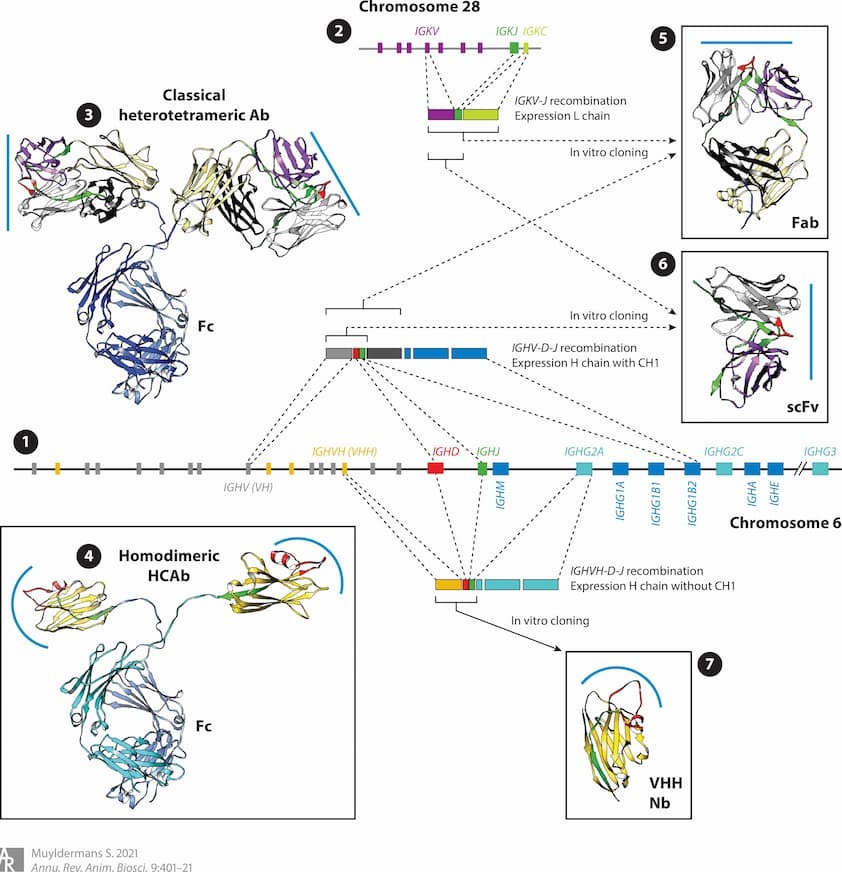
VHHs can exhibit high antigen-binding affinity, with reported affinities ranging from nanomolar to, in some cases, picomolar levels. Their single-domain structure and extended complementarity-determining region 3 (CDR3) can enable recognition of epitopes that may be difficult for conventional antibodies to access. These characteristics can support highly specific antigen recognition in ELISA and other immunoassay formats. However, assay specificity and performance ultimately depend on the individual VHH, target antigen, and assay design.
Many VHHs demonstrate favorable thermal and chemical stability compared with some conventional antibody fragments, making them attractive for immunoassays that involve challenging storage or assay conditions. However, stability is dependent on the individual VHH sequence and experimental conditions. Reported studies have demonstrated substantial retention of antigen-binding activity following exposure to elevated temperatures, variations in pH, or certain concentrations of organic solvents, although these properties should be experimentally validated for each VHH and application.
VHHs are generally soluble recombinant proteins, and many VHHs exhibit good resistance to aggregation due to their compact single-domain architecture and favorable surface properties. These characteristics can facilitate recombinant production and formulation for immunoassay applications. Nevertheless, solubility and aggregation behavior vary among individual VHH sequences and should be evaluated experimentally
VHHs have been incorporated into competitive ELISA and related immunoassay formats for the detection of low-molecular-weight compounds, including pesticides, mycotoxins, and pharmaceutical residues. Because small molecules often present limited epitopes for antibody recognition, competitive assay formats are commonly used for their detection. VHHs can provide high-affinity and selective recognition of these targets, potentially supporting sensitive detection when appropriately optimized for the target and assay format.
VHHs can be produced recombinantly using expression systems such as Escherichia coli and yeast, including Pichia pastoris, depending on the characteristics of the individual VHH and the requirements of the application. Their small size and single-domain architecture can simplify recombinant production compared with full-length antibodies, potentially reducing production costs and facilitating scalable manufacturing. Phage display is commonly used for VHH library screening and selection, but it is a discovery and selection technology rather than an expression system.
VHH-based reagents may also support decentralized assay development and testing in resource-limited settings because recombinant production and assay formats can be adapted for relatively simple workflows. VHH-based immunoassays have been investigated for applications including food safety and the detection of contaminants in products such as milk and other dairy matrices.
Recombinant VHHs can be immobilized onto ELISA plates using tags such as His6, biotin-streptavidin interactions, or site-directed coupling chemistries. Directional immobilization enhances orientation and antigen exposure, contributing to signal consistency and assay reproducibility.
VHHs can be directly fused to reporter enzymes like alkaline phosphatase, horseradish peroxidase, or nanoluciferase. These constructs maintain their antigen-binding capacity while enabling efficient signal generation in colorimetric or chemiluminescent readouts.
VHHs have been successfully applied in:
Competitive ELISA: Optimal for low molecular weight targets, using VHHs labeled with enzymes or fluorophores.
Sandwich ELISA: Application in protein biomarkers, pathogens, and environmental toxins. Multivalent or bivalent constructs can be used to enhance avidity and improve sensitivity.
Chemical Interference: Complex environmental matrices may contain interfering compounds that affect binding or signal.
Cross-Reactivity: In some cases, structural analogs of small molecules may lead to non-specific binding. CDR3 engineering and affinity maturation are required to improve selectivity.
Sensitivity Requirements: Regulatory limits for environmental contaminants are often in the parts-per-trillion range. Signal amplification or preconcentration steps are necessary to reach adequate sensitivity.
The small size of nanobodies can also limit immobilization efficiency when directly adsorbed onto surfaces. This can be mitigated by using 3D scaffolds or modified solid supports such as NHS-functionalized melamine-formaldehyde foams, which increase the available surface area and orientation flexibility.
The integration of nanobodies into LFA platforms enables rapid, on-site testing without cold chain logistics. Stability at ambient temperatures and tolerance to matrix variability make VHHs ideal for decentralized diagnostics.
Nanobody-based cELISAs can be deployed across species without major redesign. In a HEV-3 assay, a single VHH probe detected anti-HEV antibodies in humans, pigs, wild boars, deer, and mice, enabling unified surveillance of zoonotic transmission routes.
The use of VHH antibodies in ELISA platforms and related immunoassay formats in these examples has helped address challenges in environmental and food safety monitoring, including the need for stable, reproducible, and cost-effective recognition reagents. Their favorable stability, compact structure, and recombinant production can support the development of robust assays for detecting contaminants and other targets in complex matrices. However, detection limits, assay variability, and reproducibility depend on factors including VHH affinity and specificity, assay format, matrix effects, and overall assay design.
As interest grows in robust and decentralized testing approaches, VHHs offer a promising alternative to conventional antibody formats for certain ELISA applications. Access to reliable VHH discovery and production services can streamline the identification, engineering, and optimization of VHH binders for research and commercial applications. Specialized providers such as Biointron can support customized VHH discovery and optimization, helping researchers develop VHH-based reagents suited to their specific targets and assay requirements.
References:
Muyldermans, S. (2021). Applications of Nanobodies. Annual Review of Animal Biosciences, 9(1), 401–421. https://doi.org/10.1146/annurev-animal-021419-083831
Salvador, JP., Vilaplana, L. & Marco, MP. Nanobody: outstanding features for diagnostic and therapeutic applications. Anal Bioanal Chem 411, 1703–1713 (2019). https://doi.org/10.1007/s00216-019-01633-4
Bastos-Soares, E. A., Sousa, R. M. O., Gómez, A. F., Alfonso, J., Kayano, A. M., Zanchi, F. B., Funes-Huacca, M. E., Stábeli, R. G., Soares, A. M., Pereira, S. S., & Fernandes, C. F. C. (2020). Single domain antibodies in the development of immunosensors for diagnostics. International Journal of Biological Macromolecules, 165, 2244-2252. https://doi.org/10.1016/j.ijbiomac.2020.10.031
Arce, L. P., Pavan, M. F., Bok, M., Gutiérrez, S. E., Estein, S. M., Santos, A. T., Condorí, W. E., Uhart, M. M., Parreño, V., Guadalupe, M., & Ibañez, L. I. (2023). A multispecies competitive nanobody-based ELISA for the detection of antibodies against hepatitis E virus. Scientific Reports, 13(1), 15448. https://doi.org/10.1038/s41598-023-41955-z
He, Q., Pan, B., McCoy, M., Pan, J., Xu, Z., Morisseau, C., Sun, G., Li, D., & Hammock, B. D. (2024). Strategies for the Immobilization and Signal Amplification of a Double Nanobody Sandwich ELISA for Human Microsomal Epoxide Hydrolase. Analytical Chemistry, 96(49), 19605–19614. https://doi.org/10.1021/acs.analchem.4c04505
Zhao, J., Zhu, J., Wang, Y., Yang, M., Zhang, Q., Zhang, C., Nan, Y., Zhou, E., Sun, Y., & Zhao, Q. (2022). A simple nanobody-based competitive ELISA to detect antibodies against African swine fever virus. Virologica Sinica, 37(6), 922-933. https://doi.org/10.1016/j.virs.2022.09.004
Duan, H., Chen, X., Zhao, J., Zhu, J., Zhang, G., Fan, M., Zhang, B., Wang, X., Sun, Y., Liu, B., Zhou, M., & Zhao, Q. (2021). Development of a Nanobody-Based Competitive Enzyme-Linked Immunosorbent Assay for Efficiently and Specifically Detecting Antibodies against Genotype 2 Porcine Reproductive and Respiratory Syndrome Viruses. Journal of Clinical Microbiology, 59(12), e01580-21. https://doi.org/10.1128/JCM.01580-21
Biointron announces limited-time RushData launch pricing for high-throughput ant……
August 2026 brought another mix of acquisitions, licensing agreements, strategic……
Antibody discovery often begins with a highly diverse population of B cells, onl……
As larger candidate panels move from computational design into the laboratory, a……