





Artificial intelligence and machine learning are expanding the number of antibody sequences that can be designed, ranked, and optimized computationally. However, a predicted antibody sequence still must be expressed and tested before researchers can determine whether it produces a functional protein with suitable binding and developability characteristics.
High-throughput antibody production can help address this gap by converting designed sequences into experimentally measured data at a scale that better matches computational discovery.
The expression host also matters. Chinese hamster ovary, or CHO, cells are the predominant mammalian host used for the production of recombinant therapeutic proteins, including monoclonal antibodies. Using CHO during antibody screening can provide information about expression in a system that is relevant to later-stage development and manufacturing. When CHO expression data are linked with antibody sequences and analytical results, these measurements can also support the training, validation, and refinement of certain antibody-focused machine-learning models.
CHO cells have become an established industry platform for therapeutic antibody production because they support the expression, assembly, secretion, and post-translational modification of complex recombinant proteins. They are also compatible with suspension culture, chemically defined media, and scalable fed-batch manufacturing processes.
CHO expression does not guarantee that a candidate will have acceptable product quality or developability. Productivity and product quality are influenced by several factors, including the antibody sequence, cell line, culture medium, production process, and bioreactor conditions. However, CHO provides a relevant mammalian context for evaluating whether an antibody can be produced using a host commonly used during clinical and commercial development.
Other expression systems remain useful. HEK293 cells are widely used for transient research-scale expression, while yeast, bacterial, cell-free, and display-based systems can provide advantages for particular formats or screening objectives. The appropriate platform depends on the scientific question. For programs intended to progress toward CHO-based manufacturing, early CHO expression can reduce uncertainty associated with changing expression hosts later in development.
Antibody discovery initially focuses on identifying sequences with the required target specificity and biological activity. These candidates must then be assessed for properties that affect their suitability as therapeutic molecules.
An antibody sequence that appears favorable in silico may still show:
Low expression or secretion
Poor heavy- and light-chain assembly
Aggregation or fragmentation
Low purity
Reduced binding after expression
Poor thermal stability
High self-interaction or nonspecific binding
Other physicochemical characteristics associated with development risk
Only a subset of initial antibody hits typically has the combination of biological activity, solubility, stability, manufacturability, and other properties required for therapeutic development. Computational methods can help predict several of these characteristics, but experimental measurements remain necessary to evaluate model predictions and detect behaviors that are not captured adequately by current models.
Expression titer is therefore useful as an early screening measurement, but it should not be treated as a complete measure of developability. A high-expressing antibody may still have poor binding or unfavorable biophysical properties. Conversely, a low-expressing candidate with strong activity may be improved through sequence or process optimization. Expression data are most informative when evaluated together with binding, product-quality, and developability measurements.
The conditions used during screening influence the data generated from each antibody candidate. Host cell, culture format, media, expression time, purification status, and analytical method can all affect measured outcomes.
This principle has been demonstrated in CHO cell-line development. Wang and colleagues reported that traditional static-batch screening showed poor correlation with the suspension fed-batch conditions used later in manufacturing.1 The researchers developed an automated deep-well suspension fed-batch system that allowed more clones to be screened under conditions designed to better represent the later production process. Their system allowed one scientist to screen five times as many clones as manual fed-batch shake-flask or culture-tube workflows.
While this study evaluated stable CHO clones rather than transient expression of different antibody sequences, it supports how experimental results are generally more relevant when the screening environment is aligned with the process or application that the experiment is intended to inform.
For antibody sequence screening, this means that expression data should be interpreted within the context in which they were generated. A titer measured in one host or culture format is not necessarily interchangeable with a titer measured under different conditions.
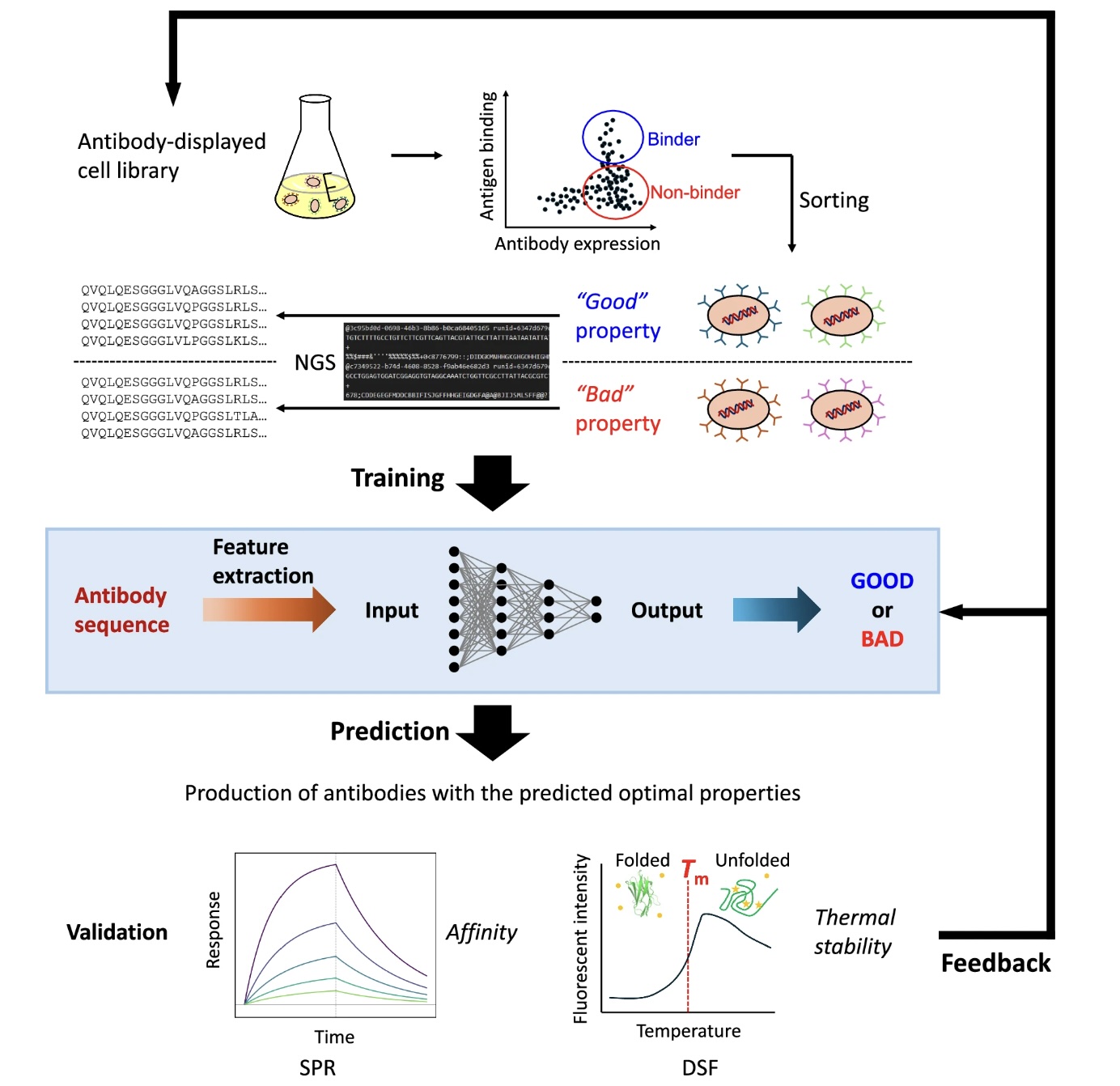
Machine-learning methods are increasingly applied to antibody structure prediction, affinity optimization, humanization, developability assessment, and sequence generation. These methods depend on datasets that connect antibody sequences and structures with experimentally measured properties.
Large antibody sequence databases are available, but sequence abundance does not provide all of the information required to predict therapeutic performance. Models intended to predict affinity, stability, expression, viscosity, aggregation, or manufacturability require corresponding experimental labels.
High-throughput experimentation is therefore important for two separate purposes:
Validating computational predictions: Designed or model-ranked sequences must be expressed and tested to determine whether predicted properties are observed experimentally.
Generating training data: Experimental measurements can be returned to computational teams and used to train, fine-tune, benchmark, or update predictive models.
Matsunaga and Tsumoto describe this combination of high-throughput experimentation and machine learning as an iterative process.2 Computational models identify promising sequences, experimental assays measure their properties, and the resulting data can inform subsequent design cycles. They also note that high-throughput experimentation is needed both to generate datasets for robust machine-learning models and to validate model predictions.
CHO expression data are not required for every antibody AI model. Many protein language models, antibody repertoire models, and structure-prediction systems are trained primarily on sequence or structural information.
CHO-derived data become especially relevant when a model is intended to predict properties such as:
Expression success in CHO
Relative antibody titer
Recoverable product yield
Product quality under defined CHO conditions
Relationships between sequence and expression
Associations among expression, binding, and developability
Candidate performance within a CHO-centered development workflow
For these applications, the expression system is part of the data-generating process. A model learns relationships from the measurements provided during training. If expression labels were generated in different hosts, media, formats, or assay workflows, some observed variation may reflect experimental conditions rather than antibody sequence alone.
Producing more antibodies does not automatically produce a useful machine-learning dataset. Experimental data must be organized so that measurements can be connected accurately to individual sequences and interpreted in the correct context.
Useful antibody datasets may include:
Heavy- and light-chain sequences
Construct and antibody-format information
Quantitative expression measurements
Binding affinity or kinetic measurements
Purity and product-quality results
Developability assay data
Experimental controls
Batch identifiers
Assay conditions
Units, detection limits, and data-processing methods
Results from both successful and unsuccessful candidates
Negative or low-performing results can be important. Excluding candidates that express poorly, fail to bind, or show unfavorable biophysical behavior may introduce bias and limit a model’s ability to distinguish successful sequences from unsuccessful ones.
Consistency is also important. Measurements generated using standardized expression and analytical workflows are generally easier to compare than results compiled from multiple laboratories, hosts, protocols, or assay formats.
Expression provides one experimental label. Combining it with additional measurements creates a more complete dataset for candidate ranking and model development.
For example, affinity measurements generated using bio-layer interferometry or surface plasmon resonance can be connected with expression results to distinguish among candidates that:
Express well and retain strong binding
Express well but bind weakly
Express poorly despite favorable predicted affinity
Show strong binding but unfavorable early developability characteristics
Additional measurements of thermal stability, aggregation, self-interaction, polyspecificity, or other physicochemical properties can identify further trade-offs. This is relevant because therapeutic antibody optimization usually involves multiple objectives rather than a single property. Current computational approaches are being developed to predict affinity and other characteristics, including stability, viscosity, aggregation, and manufacturability, but the accuracy and generalizability of these methods depend on the availability and quality of experimental data.
Multidimensional datasets can therefore help computational teams evaluate whether improvements in one property are associated with changes in another. They may also support models designed to rank candidates across several experimental endpoints.
A high-throughput antibody workflow can connect computational design with experimental evaluation through four recurring stages:
Design: Computational methods generate, modify, or rank antibody sequences.
Build: Selected sequences are produced using a defined expression system.
Test: Expression, binding, product quality, and relevant developability properties are measured.
Learn: Results are used to select candidates, assess model performance, or inform the next sequence-design cycle.
The value of this cycle depends partly on turnaround time. Long delays between computational design and experimental results limit the number of iterations that can be completed during a discovery program. High-throughput expression and parallel characterization can shorten this interval while allowing more candidates to be evaluated under consistent conditions.
Biointron developed RushData to support this experimental stage of AI-driven and high-throughput antibody discovery. The service combines one-day CHO expression with rapid affinity characterization and optional developability profiling, enabling large sequence panels to be evaluated in parallel. Results are organized as structured, sequence-linked datasets that can be used for candidate selection, model evaluation, or subsequent computational iterations.
The objective is not to replace computational antibody design. It is to provide the experimental measurements required to determine which computationally selected sequences produce functional antibodies and to return those results at a throughput compatible with iterative model development.
CHO is the predominant mammalian host used for therapeutic antibody production, making it a relevant platform for screening candidates intended to progress through CHO-based development and manufacturing. Early CHO expression can provide information about whether designed antibody sequences can be produced and evaluated in this context.
For machine-learning applications, the relevance of CHO data depends on the model’s objective. CHO-derived measurements are particularly useful for models intended to predict expression, product quality, or other experimentally measured properties in a CHO system. They are not required for all antibody AI models.
Combining standardized, high-throughput CHO expression with binding and developability measurements can address two related needs: physical validation of computationally designed antibodies and generation of structured experimental data for model training or refinement. This integration allows antibody discovery programs to connect sequence design with measured protein behavior through repeated design–build–test–learn cycles.
CHO cells are the predominant mammalian host used for therapeutic protein production. They support the expression, assembly, secretion, and post-translational processing of full-length antibodies and are compatible with scalable suspension culture. Screening in CHO can therefore provide expression data in a system relevant to many downstream antibody development and manufacturing workflows.
Machine-learning models require experimental data that connect antibody sequences with measured properties. Standardized CHO expression results can provide labels such as expression success, relative titer, product quality, binding, and selected developability measurements. These data can be used to train, validate, or refine models intended to predict antibody behavior in a CHO expression context. High-throughput experimentation also provides the physical validation needed to assess computationally designed candidates.
No. Expression level is only one part of antibody assessment. A high-expressing candidate may still have poor affinity, aggregation, low solubility, high viscosity, instability, nonspecific binding, or other development risks. Antibody candidates should therefore be evaluated using expression data together with binding, product-quality, and biophysical measurements.
Wang, B., Albanetti, T., Miro-Quesada, G., Flack, L., Li, L., Klover, J., Burson, K., Evans, K., Ivory, W., Bowen, M., Schoner, R., & Hawley-Nelson, P. (2018). High-throughput screening of antibody-expressing CHO clones using an automated shaken deep-well system. Biotechnology Progress, 34(6), 1460-1471. https://doi.org/10.1002/btpr.2721
Matsunaga, R., & Tsumoto, K. (2025). Accelerating antibody discovery and optimization with high-throughput experimentation and machine learning. Journal of Biomedical Science, 32(1), 46. https://doi.org/10.1186/s12929-025-01141-x
Kim, J., McFee, M., Fang, Q., Abdin, O., & Kim, P. M. (2023). Computational and artificial intelligence-based methods for antibody development. Trends in Pharmacological Sciences, 44(3), 175–189. https://doi.org/10.1016/j.tips.2022.12.005
Biointron’s Antibodies After Hours: From Algorithms to Antibodies was held at Th……
Discover how high-throughput wet-lab validation connects AI-designed antibody se……
Understand the hybridoma generation process for monoclonal antibody production, ……
Artificial intelligence (AI) is changing how therapeutic antibodies are discover……