





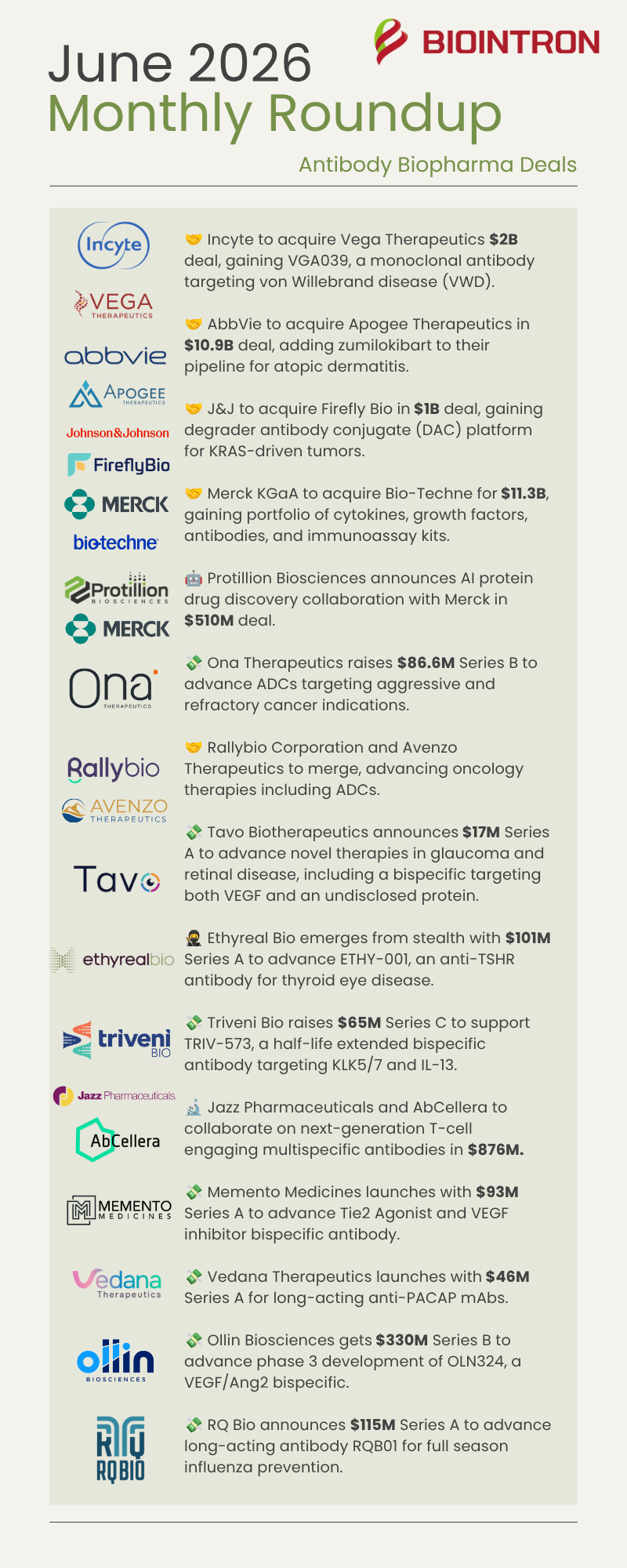
June 2026 brought a broad set of antibody-related transactions across mergers and acquisitions, research collaborations, licensing agreements, and private financings. The month included acquisitions of late-stage antibody developers, partnerships involving multispecific and AI-enabled discovery platforms, and financings supporting programs across oncology, immunology, ophthalmology, neurology, and infectious disease.
Four antibody-related acquisitions carried announced values ranging from $1 billion to $11.3 billion, with the transactions ranging from therapeutic antibody developers to life science research tools.
Multispecific antibodies appeared across several therapeutic areas, including oncology, autoimmune disease, inflammatory disorders, retinal disease, and migraine.
Several financings supported ophthalmology programs, including antibodies targeting VEGF/Ang2, Tie2/VEGF, TSHR, and other pathways involved in retinal or ocular disease.
AI-enabled discovery was represented through both platform-access agreements and asset-level licensing, including collaborations involving Protillion, Chai Discovery, TrueLab, and METiS TechBio.
AbbVie × Apogee Therapeutics – AbbVie agreed to acquire Apogee Therapeutics for an equity value of approximately $10.9 billion. The transaction adds Apogee’s immunology pipeline, led by zumilokibart, a half-life-extended IL-13-targeting monoclonal antibody being developed for atopic dermatitis and other inflammatory diseases.
Merck KGaA, Darmstadt, Germany × Bio-Techne – Merck KGaA agreed to acquire Bio-Techne for an enterprise value of approximately $11.3 billion. Unlike the therapeutic pipeline acquisitions in this roundup, this transaction primarily expands Merck KGaA’s life science tools business through Bio-Techne’s portfolio of cytokines, growth factors, antibodies, immunoassay kits, analytical technologies, and workflow solutions.
Incyte × Vega Therapeutics – Incyte agreed to acquire Vega Therapeutics, a subsidiary of Star Therapeutics, for $1.25 billion upfront and up to $750 million in additional sales-based payments. The transaction adds VGA039, a Protein S-targeting monoclonal antibody in Phase 3 development for von Willebrand disease.
Johnson & Johnson × Firefly Bio – Johnson & Johnson agreed to acquire Firefly Bio for $1 billion in cash. The acquisition adds Firefly’s Firelink degrader antibody conjugate platform, which is being applied to KRAS-driven tumors and combines antibody-based targeting with targeted protein degradation.
Rallybio × Avenzo Therapeutics – Rallybio and Avenzo Therapeutics entered a merger agreement under which the combined company will operate as Avenzo Therapeutics. A concurrent private placement is expected to provide $215 million in gross proceeds to support a clinical-stage oncology pipeline that includes targeted small molecules and ADCs.
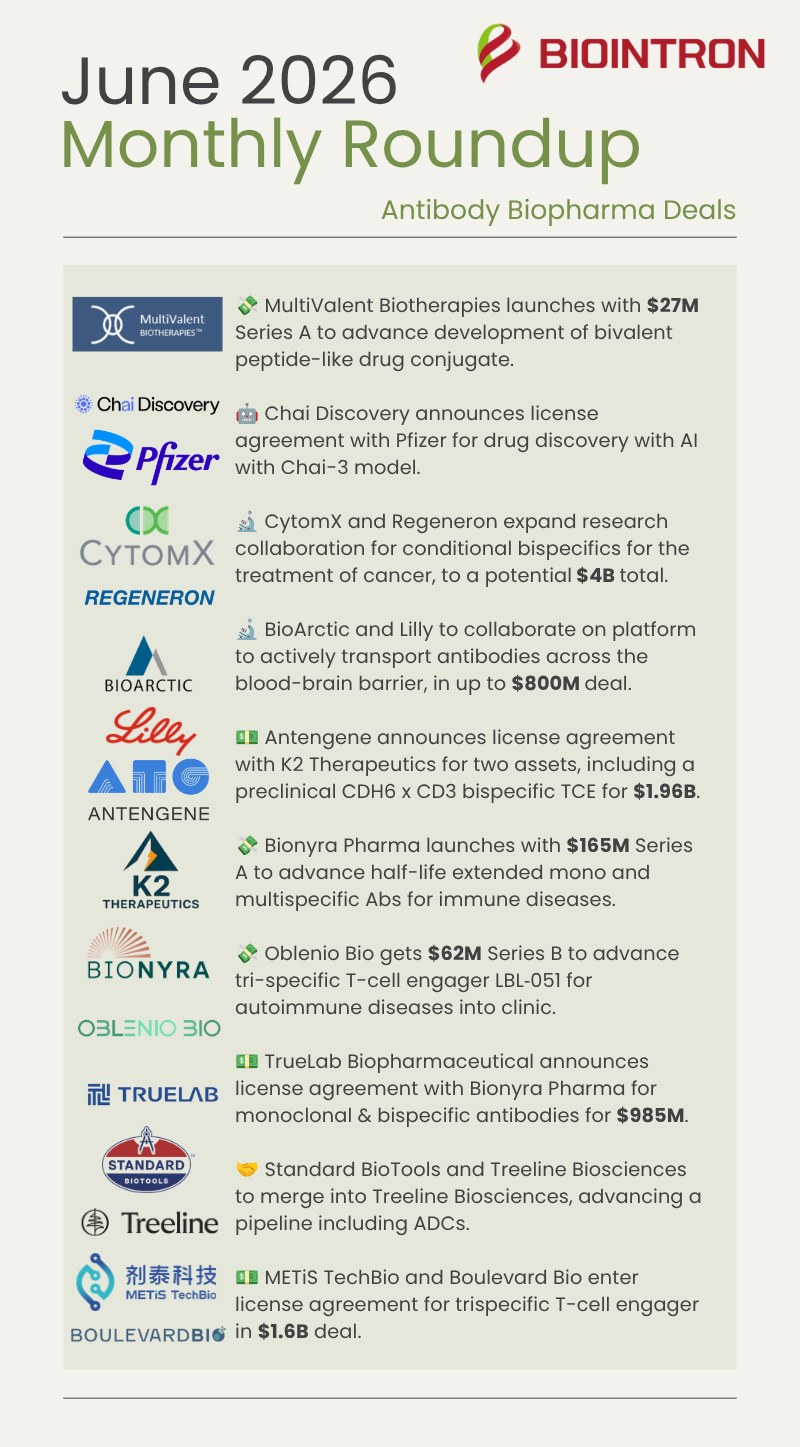
Standard BioTools × Treeline Biosciences – Standard BioTools and Treeline Biosciences agreed to combine in an all-stock transaction. The combined company is expected to operate as Treeline Biosciences, with more than $900 million in pro forma cash and a pipeline spanning small-molecule inhibitors, protein degraders, and targeted therapy ADCs.
CytomX Therapeutics × Regeneron – CytomX expanded its research collaboration with Regeneron for conditional bispecific cancer therapeutics. CytomX received a $37 million target-selection payment for two additional programs, while the total potential payments covered by the expanded collaboration could reach approximately $4 billion across the full set of programs.
Antengene × K2 Therapeutics – Antengene licensed global rights to ATG-106, a preclinical CDH6 × CD3 bispecific T-cell engager for solid tumors, to K2 Therapeutics. The parties also entered an option agreement covering a second undisclosed T-cell engager. Across both programs, Antengene could receive approximately $40 million in upfront and near-term consideration and up to $1.921 billion in future milestones.
METiS TechBio × Boulevard Bio – METiS TechBio granted Boulevard Bio exclusive global rights to MTS-128, a trispecific T-cell engager developed using METiS’s AI-enabled platform. METiS will receive $20 million upfront and is eligible for up to $1.6 billion in development, regulatory, and commercial milestones, plus royalties.
TrueLab Biopharmaceutical × Bionyra Pharma – Bionyra licensed worldwide rights outside Greater China to two TrueLab immunology assets: TL-001, a half-life-extended anti-TL1A monoclonal antibody, and TL-003, a TL1A × IL-23p19 bispecific antibody. TrueLab is eligible for up to $985 million in total.
Jazz Pharmaceuticals × AbCellera – Jazz and AbCellera entered a research, option, and license agreement to discover multispecific T-cell engagers for gastrointestinal cancers and other solid tumors. AbCellera will receive $56 million upfront and may receive up to $792 million in option fees and milestone payments, bringing the disclosed potential economics to up to $848 million.
BioArctic × Lilly – BioArctic and Lilly agreed to develop a potential neurodegenerative disease therapy combining an undisclosed Lilly candidate with BioArctic’s BrainTransporter technology, which is intended to facilitate transport across the blood-brain barrier. BioArctic will receive $30 million upfront and may receive up to $770 million in additional milestones.
Protillion Biosciences × Merck – Protillion entered a multi-target protein drug discovery collaboration with Merck. Protillion will receive up to $510 million in research, development, and commercial milestones for multiple therapies. The collaboration will use Protillion’s Prot-MaP platform to generate large quantitative protein datasets for AI-supported design and optimization.
Chai Discovery × Pfizer – Chai Discovery licensed its AI platform to Pfizer for use in drug discovery research. Pfizer scientists will receive access to Chai-3 and a customized model incorporating Pfizer’s proprietary data and workflows.
Ona Therapeutics – Ona raised an oversubscribed $86.6 million Series B to advance its first-in-class ADC pipeline. The proceeds will support clinical development of ONA-255 in breast cancer and advancement of ONA-389 toward first-in-human studies in colorectal cancer.
MultiValent Biotherapies – MultiValent launched with a $27.4 million first closing of its Series A financing. The funding will support a planned Phase 1b/2a trial of MVB-101, a PSMA × FRα-targeted, bivalent peptide-like drug conjugate carrying an MMAE payload for prostate cancer.
Bionyra Pharma – Bionyra launched with an oversubscribed $165 million Series A financing to advance a clinical- and IND-stage pipeline of half-life-extended monoclonal and multispecific antibodies for immune-mediated inflammatory diseases. Its pipeline includes BYN-002, an anti-TL1A monoclonal antibody, and BYN-003, a TL1A × IL-23p19 bispecific antibody.
Ethyreal Bio – Ethyreal emerged from stealth with $101 million raised across Series A and B financings. The company is advancing ETHY-001, a half-life-extended anti-TSHR monoclonal antibody designed to block autoantibody-mediated receptor activation in Graves’ disease and thyroid eye disease. A first-in-human study is expected to begin in the second half of 2026.
Triveni Bio – Triveni raised $65 million in Series C financing to expand clinical development of TRIV-573. The half-life-extended bispecific antibody inhibits KLK5/7 and IL-13 and is expected to enter a larger Phase 2 proof-of-concept study in atopic dermatitis.
Oblenio Bio – Oblenio closed a $62 million Series B financing to move LBL-051 into clinical development for autoimmune diseases. The trispecific T-cell engager targets BCMA, CD19, and CD3 and is designed to deplete both B cells and plasma cells.
Ollin Biosciences – Ollin raised an oversubscribed $330 million Series B to support global Phase 3 studies of OLN324, a VEGF × Ang2 bispecific antibody for diabetic macular edema and wet age-related macular degeneration. The financing will also support clinical advancement of OLN102, a TSHR × IGF-1R bispecific antibody for thyroid eye disease and Graves’ disease.
Memento Medicines – Memento launched with a $93 million Series A financing and licensed worldwide rights to MMT-205. The preclinical bispecific antibody is designed to activate Tie2 while inhibiting VEGF for retinal diseases, with clinical trials expected to begin in 2027.
Tavo Biotherapeutics – Tavo raised $17 million in Series A financing to advance treatments for glaucoma and retinal disease. Its pipeline includes TAV-002, a preclinical bispecific antibody targeting VEGF and an undisclosed protein involved in upstream retinal disease signaling.
Vedana Therapeutics – Vedana emerged from stealth with a $46 million Series A financing for next-generation migraine-prevention antibodies. Its lead program targets PACAP, while a second bispecific program targets both PACAP and CGRP.
RQ Bio – RQ Bio completed an oversubscribed $115 million Series A financing to advance RQB01, a long-acting antibody program intended to provide full-season influenza prevention through a single administration, particularly for high-risk and immunocompromised populations.
June’s announcements covered a wide range of transaction structures, development stages, and therapeutic areas. Large acquisitions included both clinical antibody assets and research-tool capabilities, while the collaboration activity included conventional antibody discovery, multispecific engineering, tissue-delivery technologies, and AI-supported platforms.
Multispecific antibodies were particularly visible in the month’s announcements, but their applications were not limited to oncology. Programs targeting inflammatory disease, autoimmune disorders, retinal disease, and migraine were also represented. At the same time, several financings supported long-acting or half-life-extended antibodies intended to reduce dosing frequency.
Biointron’s Antibodies After Hours: From Algorithms to Antibodies was held at Th……
Discover how high-throughput wet-lab validation connects AI-designed antibody se……
Understand the hybridoma generation process for monoclonal antibody production, ……
Artificial intelligence (AI) is changing how therapeutic antibodies are discover……