


Antibody drugs in ophthalmology represent a significant advancement in treating various eye diseases. These biologics target specific proteins involved in pathological processes, such as vascular endothelial growth factor (VEGF), which plays a key role in conditions like age-related macular degeneration (AMD) and diabetic retinopathy. By inhibiting VEGF, drugs like ranibizumab (Lucentis) and bevacizumab (Avastin) reduce abnormal blood vessel growth and leakage, thereby stabilizing and often improving vision. Recent developments have seen the emergence of longer-acting agents like faricimab (Vabysmo) and port delivery systems, which aim to reduce the frequency of injections required. This targeted approach not only enhances efficacy but also minimizes systemic side effects, offering a precise and effective means to manage complex retinal disorders.
Recently, exciting news from the biotech deal space involved a $3 billion USD bid from Merck to acquire EyeBio, in order to diversify their pipeline and add a focus on ophthalmology. Eyebio is a clinical-stage company that develops next-generation therapies to protect, restore and improve vision in patients with sight-threatening eye diseases. Their lead candidate is the tetravalent trispecific antibody Restoret, an agonist of the Wnt signalling pathway and potential treatment of diabetic macular edema (DME) and neovascular age-related macular degeneration (NVAMD).
Meanwhile, a research article published this week by University of Texas Medical Branch assessed a topical solution for retinal delivery of bevacizumab and ranibizumab eye drops. Using a novel anti-aggregation formula (AAF) in rabbits, they demonstrated it to be a potential adjunct to intravitreal injections for the treament of age-related macular degeneration (AMD), a blinding retinal disease. Bevacizumab is a humanized IgG monoclonal antibody that binds to VEGF, and alone, is typically used for cancer treatment. Ranibizumab is a humanized mAb Fab fragment which also targets VEGF-A and used as a blood vessel growth inhibitor.
In the clinical trial space, yesterday Oculis announced positive topline results of a Phase 2b relief trial with licaminlimab (OCS-02), an anti-TNFα eye drop candidate developed with single chain antibody fragment (scFv) technology. The drug is designed to treat ocular inflammatory diseases like Dry Eye Disease (DED). TNF-α inhibition has anti-inflammatory and anti-necrotic effects in inflammatory disorders. Besides licaminlimab, faricimab also holds promise for eye diseases like neovascular age-related macular degeneration and diabetic macular edema. A paper published this week by University of Freiburg reviewed the novel anti-angiopoietin-2 (Ang-2) and anti-VEGF-A bispecific antibody, which demonstrated non-inferior vision gains and improved anatomical outcomes versus aflibercept in patients with DME or nAMD in the phase 3 clinical trial program. Therefore, dual Ang-2/VEGF-A pathway inhibition with faricimab has the potential to provide longer-term improvements in vision over targeting just the VEGF pathway alone in monotherapy.

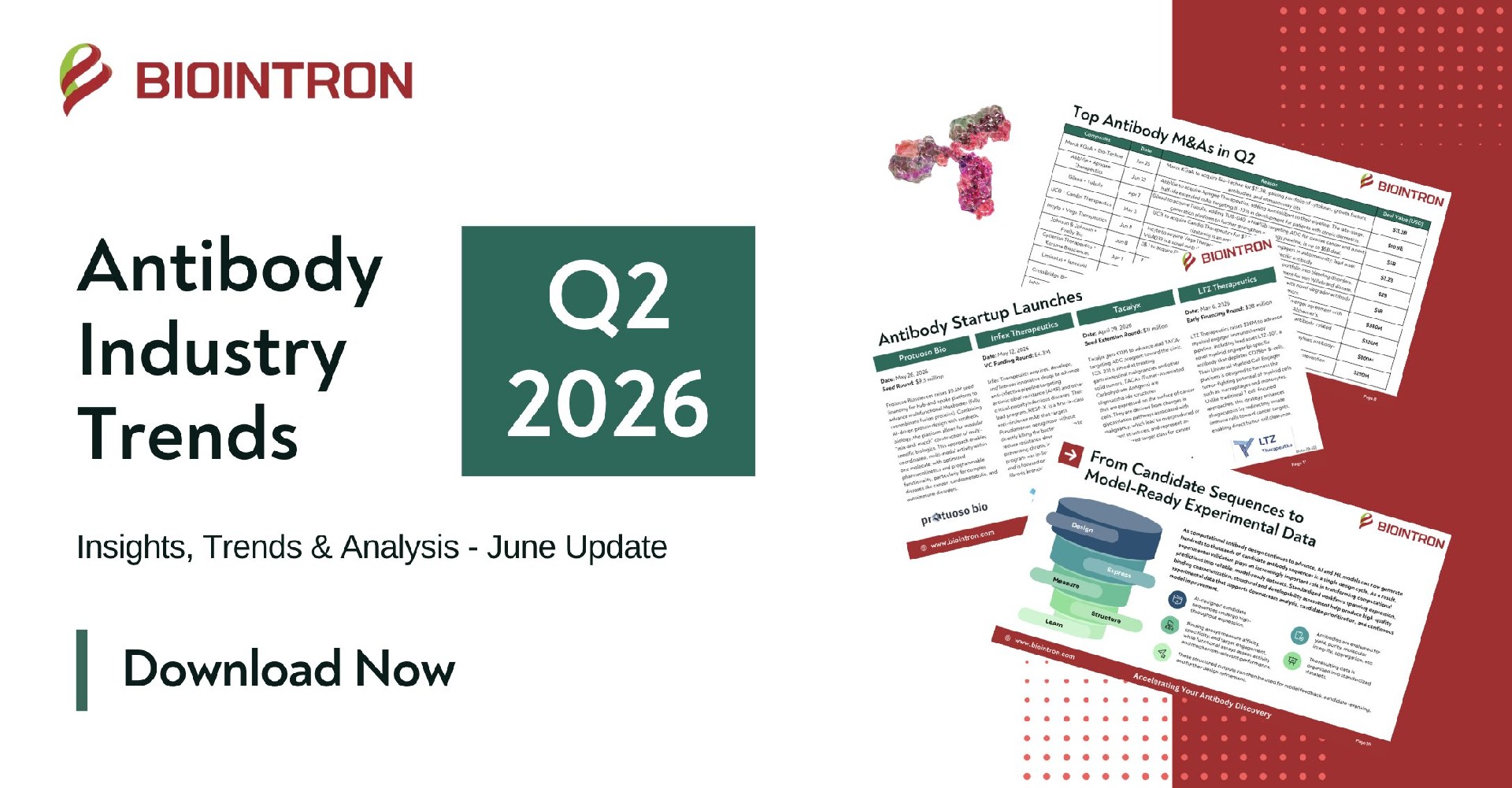
Biointron’s Q2 2026 Antibody Industry Trends report aims to explore the events a……
Artificial intelligence (AI) can be used throughout the drug development process……
Peptides and antibodies have different strengths as therapeutic molecules. Pepti……
Therapeutic antibodies are often used to block receptors or neutralize soluble m……