




Hybridoma technology, developed by Köhler and Milstein in 1975, introduced a method for the generation of monoclonal antibodies (mAbs) through the fusion of antigen-specific B lymphocytes with immortal myeloma cells. This approach enabled the long-term culture of hybrid cells (termed hybridomas) that produce highly specific antibodies targeting a single epitope.
Hybridoma-based workflows typically begin with the immunization of mice or other small laboratory animals with a target antigen, followed by spleen extraction, B lymphocyte isolation, and fusion with myeloma cells using polyethylene glycol (PEG) or electrofusion techniques. Post-fusion, cells are cultured in selective hypoxanthine-aminopterin-thymidine (HAT) medium to isolate viable hybrids. These hybridomas are screened, cloned, and expanded to obtain stable lines secreting monoclonal antibodies.
This technique remains a widely adopted and foundational platform in antibody discovery due to its ability to generate reproducible, antigen-specific antibodies in large quantities.
Hybridoma-derived monoclonal antibodies have been extensively used in diagnostics. They are employed to detect a wide range of targets, including microbial surface proteins, toxins, hormones, and drugs. Diagnostic assays such as ELISA, flow cytometry, and lateral flow tests depend on the specificity and reproducibility of mAbs.
Examples of diagnostic applications include:
Pregnancy detection via identification of human chorionic gonadotropin (hCG)
Viral detection (e.g., herpesvirus, malaria)
Serological typing of ABO blood groups
Pathogen strain differentiation, including Neisseria gonorrhoeae
Hybridoma technology has served as the basis for the discovery of numerous therapeutic antibodies. Early clinical antibodies such as muromonab-CD3 (OKT3), a murine mAb targeting CD3 on T cells, were derived directly from mouse hybridomas. Despite immunogenicity issues, these antibodies demonstrated proof-of-concept for targeted immunotherapy.
Subsequent developments allowed for the generation of chimeric and humanized antibodies using hybridoma-derived variable regions grafted onto human immunoglobulin frameworks. Examples include rituximab, a CD20-targeting antibody for B-cell malignancies, and daclizumab, used in transplant rejection and multiple sclerosis.
Currently, over 90% of therapeutic monoclonal antibodies approved by regulatory agencies originated from hybridoma-based discovery, either in their native or engineered forms.
Monoclonal antibodies from hybridoma lines are clonally derived and exhibit uniform specificity and affinity. This allows for consistent performance across assays and enables detailed epitope mapping and structure-function studies. Once a hybridoma is stabilized, long-term production and batch-to-batch consistency can be maintained through cryopreservation and cell banking.
High Specificity: Hybridomas generate antibodies specific to a single epitope, reducing background in analytical assays.
In Vivo Affinity Maturation: B cell maturation occurs naturally in the animal, yielding antibodies with high binding affinities.
Native Heavy-Light Chain Pairing: VH and VL domains retain native pairing, preserving authentic antigen-binding characteristics.
Scalability and Reproducibility: Once cloned, hybridoma lines provide a stable and unlimited source of monoclonal antibodies.
Cryopreservation: Hybridomas can be stored long-term and revived without loss of function or specificity.
No Requirement for Purified Antigen: Crude or complex immunogens can be used during animal immunization.
PEG-mediated fusion is associated with low efficiency and cytotoxicity. Only 1-2% of total cells may result in viable hybridomas, and the majority of B cells perish post-fusion. Alternative fusion methods, such as electrofusion or viral fusogens, offer limited improvements and require additional technical resources.
Hybridoma cell lines are subject to genetic drift, leading to potential loss of antibody expression or alterations in specificity. Long-term cultures are also vulnerable to microbial contamination, particularly in in vitro production systems.
Generating a hybridoma takes several months, from immunization to clone selection and expansion. The process requires animal facilities, cell culture expertise, and repeated screening. The low throughput of traditional hybridoma workflows limits their suitability for urgent or large-scale discovery efforts.
Hybridomas are typically generated in mice or rats, producing antibodies with non-human frameworks. When used in humans, these antibodies can elicit immune responses such as the human anti-mouse antibody (HAMA) effect. Although humanization strategies exist, they require additional molecular engineering and validation steps.
Several alternative and modified platforms have been developed for hybridoma technology:
BCT employs pulsed electric fields (PEF) to enhance the efficiency of B cell fusion with myeloma cells. This method preselects antigen-specific B cells using biotinylated antigen and streptavidin complexes. Fusion is then performed via electrofusion, aligning cells in an electric field to promote membrane fusion.
Reported benefits include:
5-10× higher fusion efficiency than PEG
Ability to generate multiple mAbs from a single mouse (multitargeting)
Reduced animal use
However, BCT requires specialized equipment and technical expertise, and fusion yields decrease when cell sizes are mismatched.
SST targets conformational epitopes by using DNA immunization to express antigens in their native form in vivo. B cells recognizing these conformations are fused with myeloma cells using electrofusion. Screening is performed against cell-surface-expressed native antigens.
SST enables generation of mAbs against complex membrane proteins or conformationally sensitive targets, which are often difficult to achieve with conventional protein immunization. The method is more labor-intensive but achieves higher specificity for native structures.
Phage display libraries bypass the need for animals by displaying antibody fragments (scFv, Fab) on filamentous bacteriophages. Antigen-specific clones are selected by iterative biopanning.
Advantages:
Animal-free antibody generation
Access to non-immunogenic or toxic targets
CDR region engineering for enhanced specificity and affinity
Limitations:
Restricted to fragment formats (full-length IgG requires reformatting)
Loss of native VH-VL pairing
Libraries are limited by transformation efficiency (~10¹¹ variants)
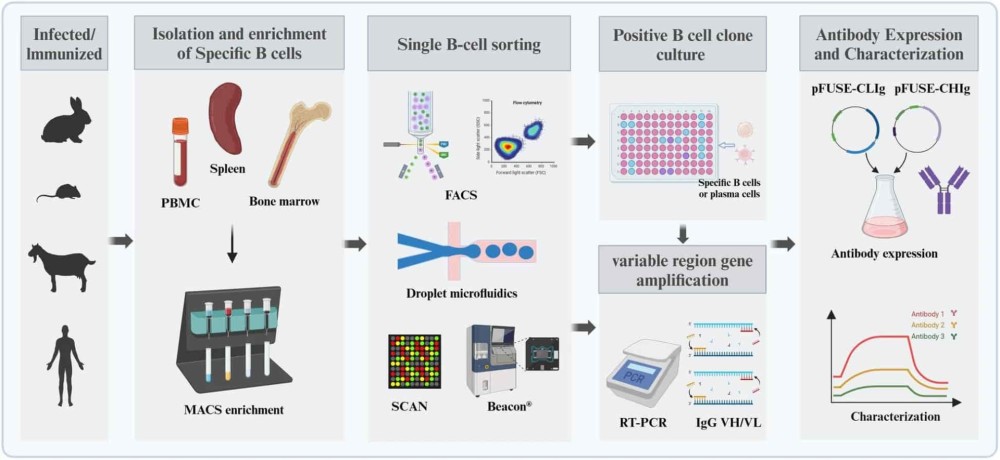
Single B cell platforms isolate individual antigen-specific B lymphocytes, often from immunized or infected human donors. The VH and VL genes are amplified from single cells and expressed recombinantly.
Benefits:
Preserves native chain pairing
Rapid mAb discovery from clinical samples
Applicable to human or rare species
No need for antigen purification or fusion steps
Challenges include:
High cost of single-cell sorting and sequencing infrastructure
Limited availability of species-specific B cell markers
Despite its advantages, hybridoma technology lacks an inherent mechanism for sequence preservation. Over time, hybridoma clones may undergo genetic drift or suffer from contamination, leading to loss of function or altered antibody characteristics. Sequencing the variable regions of the heavy (VH) and light (VL) chains provides a permanent record of the antibody identity and enables recombinant production.
Applications of hybridoma sequencing include:
Ensuring identity and reproducibility
Recombinant reformatting for humanization or Fc engineering
Compliance with regulatory and IP requirements
Transition to scalable, contaminant-free expression platforms
Hybridoma sequencing is an essential step in securing the long-term utility of monoclonal antibodies, particularly for clinical, diagnostic, or commercial applications.
For organizations relying on hybridoma-derived antibodies, securing the sequence information of the variable heavy (VH) and light (VL) chains is critical for ensuring long-term reproducibility, intellectual property protection, and transition to recombinant antibody production. Sequencing the antibody genes enables researchers to recover monoclonal antibodies even if the original cell line is lost or compromised, and provides a foundation for further engineering, such as isotype switching, humanization, or affinity maturation.
Biointron offers high-accuracy full-length VH and VL hybridoma sequencing with guaranteed sequence fidelity and rapid turnaround. Using 5′ Rapid Amplification of cDNA Ends (5′ RACE), Biointron clones and sequences the complete coding regions from hybridoma lysates or extracted RNA, preserving the native antibody structure. The standard input consists of two vials of hybridoma lysate (∼1×10⁶ cells each), but RNA extraction can be performed if cells are non-viable.
Fast Delivery: Full-length VH and VL sequences are delivered within one week of sample receipt.
100% Sequence Accuracy: Each sequence is verified across at least five independent clones.
Comprehensive Outputs: Deliverables include a final sequence report with CDR annotations, raw sequencing data, and plasmids containing the antibody coding regions.
Flexible Inputs: Sequencing can be performed from viable hybridoma cells or isolated RNA. Guidance is available for sample preparation and shipping.
Downstream Compatibility: Sequenced antibodies are expression-ready and can proceed directly to recombinant production and purification using Biointron’s platforms.
Optional recombinant antibody expression with delivery of purified antibody in as little as two weeks. Final products are quality-verified, with >95% purity (SDS-PAGE), low endotoxin levels (<1 EU/mg), and optional size-exclusion HPLC analysis.
Biointron’s hybridoma sequencing platform combines speed, accuracy, and compatibility with antibody discovery pipelines. For academics and biotech firms developing antibody-based therapeutics, diagnostics, or research tools, sequence retrieval from hybridomas ensures that valuable antibody assets remain accessible and modifiable for future use.
References:
Mitra, S., & Tomar, P. C. (2021). Hybridoma technology; advancements, clinical significance, and future aspects. Journal of Genetic Engineering and Biotechnology, 19(1), 159. https://doi.org/10.1186/s43141-021-00264-6
Moraes, J. Z., Hamaguchi, B., Braggion, C., Speciale, E. R., Cesar, F. B. V., Soares, G. D. F. D. S., Osaki, J. H., Pereira, T. M., & Aguiar, R. B. (2021). Hybridoma technology: Is it still useful? Current Research in Immunology, 2, 32-40. https://doi.org/10.1016/j.crimmu.2021.03.002
Biointron announces limited-time RushData launch pricing for high-throughput ant……
August 2026 brought another mix of acquisitions, licensing agreements, strategic……
Antibody discovery often begins with a highly diverse population of B cells, onl……
As larger candidate panels move from computational design into the laboratory, a……