




VHH libraries are collections of single-domain antibodies (also called nanobodies or VHHs) derived from the heavy-chain-only antibodies naturally present in camelids. These libraries are key sources for identifying antigen-specific VHHs with applications in therapeutic antibody discovery, diagnostics, and molecular biology. This makes VHH library construction a foundational step in nanobody engineering and binder discovery.
The term "VHH" refers to the variable domain of heavy-chain antibodies (HCAbs) found in species such as Camelus dromedarius, Camelus bactrianus, Lama glama, and Vicugna pacos. VHHs are monomeric, stable, and easily expressed in microbial systems, and they can be engineered for high-affinity binding, rendering them valuable tools in both research and clinical settings. Unlike monoclonal antibodies that contain both heavy chains and light chains and light chain components, camelid VHHs are derived from a heavy chain antibody format and retain binding activity in a compact single-domain structure. These molecules are also widely referred to as VHH antibody formats or VHH single domain antibody systems, with their simple structure and functional versatility.
Three major categories of VHH libraries are used for nanobody generation: immune, naïve, and synthetic libraries. While all are capable of yielding functional binders, their utility and performance vary significantly depending on the application and antigen class. These formats represent different strategies for library construction, from immune repertoires to synthetic and combinatorial libraries.
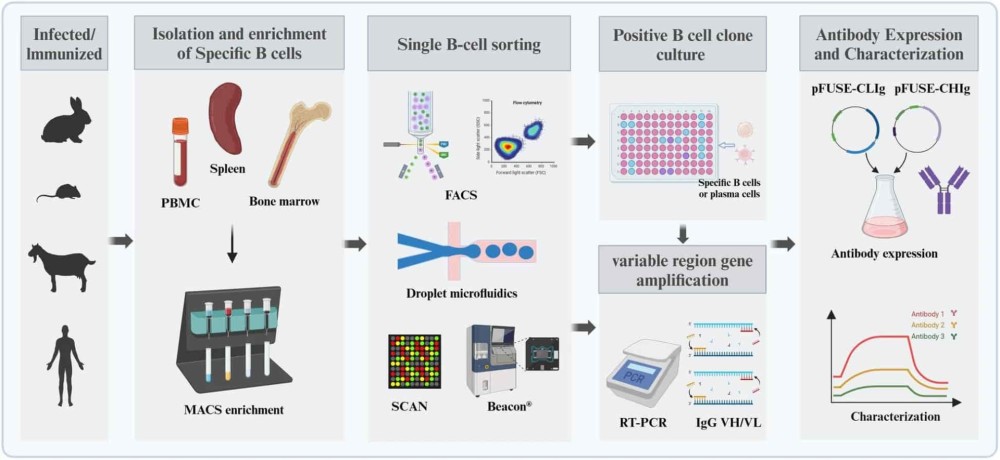
Immune libraries are derived from the peripheral blood or lymphoid tissue of immunized camelids. Following a targeted immunization protocol, which typically involves four to eight antigen administrations over two months, B cells expressing HCAbs are isolated through B-cell sorting. From these, mRNA is extracted, and VHH sequences are amplified for VHH library construction. In most workflows, the starting material is a blood sample collected after antigen exposure in the animal's immune system.
Immune libraries have several advantages:
They contain affinity-matured VHHs generated in vivo.
Target-specific binders occur at high frequency, even in relatively small libraries (10⁶–10⁸ clones).
They provide robust performance in downstream screening, particularly with well-folded protein antigens such as the epidermal growth factor receptor and other clinically relevant targets involving the extracellular domain.
Notably, the in vivo maturation of the immune response ensures that high-affinity clones are enriched prior to screening, simplifying the subsequent selection and characterization phases. This improves the selection of binders during downstream phage display screening and other enrichment workflows.
Naïve libraries avoid animal immunization by harvesting B cells from non-immunized camelids. These libraries require larger input material, often more than 10 liters of pooled blood, to achieve sufficient diversity (≥10⁹ clones). Synthetic libraries, by contrast, are built entirely in vitro using engineered scaffolds with randomized complementarity-determining regions (CDRs), especially CDR3. These synthetic repertoires expand the diversity of VHH domains, enabling the generation of affinity proteins against challenging targets.
While these formats enable binder discovery against non-immunogenic or toxic antigens, they often require more extensive screening and optimization to identify candidates with desirable affinity and stability profiles.
Once a VHH library is constructed, screening for high-affinity binders is typically performed using phage display, a robust and scalable method for enrichment. A phage display library enables repeated enrichment cycles and remains central to antibody phage display library workflows. The process involves the following steps:
Antigen Immobilization: Target antigens are adsorbed to solid supports such as polystyrene wells or magnetic beads. In some workflows, streptavidin-coated magnetic beads are used for solution-based capture.
Library Incubation: The VHH-displaying phage pool is incubated with the immobilized antigen.
Washing: Non-specific or weakly bound phage particles are removed. Washing is often performed with phosphate-buffered saline to maintain antigen stability.
Elution and Amplification: Bound phages are eluted, typically using a pH shift, and amplified in E. coli. This step sometimes involves M13 phage display rescue using an appropriate phage vector.
Iterative Rounds: 2-4 rounds of selection with increasing stringency refine the pool toward high-affinity binders.
The efficacy of biopanning is particularly high for immune-derived libraries, where the starting pool already contains enriched, affinity-matured clones. For fragile or poorly immunogenic antigens, solution-based panning with biotinylated antigens and magnetic bead capture may be used to maintain conformational integrity.
Related: What Is Phage Display?
VHHs have shown clinical utility in inflammatory diseases, oncology, and infectious diseases. Immune libraries are particularly well-suited for these applications due to their high-affinity clones. For example, caplacizumab, a bivalent VHH construct, is approved for treating thrombotic thrombocytopenic purpura. These therapeutic applications also support downstream engineering approaches such as Fc fusion for half-life extension and effector modulation.
VHHs function as capture and detection agents in ELISAs, lateral flow assays, and electrochemical sensors. Their solubility and stability enable use under harsh chemical and environmental conditions, which can impair conventional antibodies.
When expressed intracellularly, VHHs can be used as intrabodies to modulate or trace specific protein functions. Their small VHH domains allow efficient intracellular targeting and functional studies. They are also useful in super-resolution microscopy and real-time protein tracking in live cells.
Radiolabeled VHHs are promising agents for PET/SPECT imaging due to their small size and rapid tissue penetration. Their fast renal clearance enables high contrast in imaging applications.
The construction of an immune VHH library involves multiple precise steps, optimized for high fidelity and diversity.
Healthy adult camelids are immunized with the target antigen, which should be in a native and properly folded form. Soluble recombinant proteins are preferred; in some cases, DNA vaccination is also effective. After immunization, 50–100 mL of peripheral blood is collected for lymphocyte isolation.
mRNA Extraction: Total RNA is extracted from lymphocytes, followed by cDNA synthesis.
Nested PCR: A two-step PCR approach is used:
First PCR amplifies both classical VH-CH1 and HCAb-derived VHH-CH2 fragments.
Smaller VHH amplicons (~600–650 bp) are size-selected.
Second PCR introduces restriction sites for cloning into display vectors.
Using primers targeting conserved framework regions allows amplification of all functional VHH sequences while avoiding classical VH contamination.
The purified VHH sequences are ligated into a phagemid vector (e.g., pMECS-GG) and transformed into E. coli. Libraries of 10⁷–10⁸ clones are typical. Quality control steps include insert verification by colony PCR and Sanger sequencing. This method ensures a high percentage (>70%) of clones containing full-length VHH inserts.
Phage display remains the most widely used system for VHH library screening. Its advantages include:
High library diversity
Scalable for industrial pipelines
Compatibility with various selection strategies (panning on plates, beads, cells)
Phagemid vectors ensure monovalent display of VHHs on M13 filamentous phages, reducing avidity effects and improving selection stringency.
Yeast display enables quantitative analysis of binding via FACS, which allows direct sorting of high-affinity clones. It is particularly useful for applications requiring epitope binning or specificity profiling.
Alternative platforms like ribosome display or CIS display offer fully in vitro approaches but are technically demanding and less commonly used for immune libraries.
| Display Method | Library Size | Advantages | Limitations |
|---|---|---|---|
Phage Display | 10⁸–10⁹ | Robust, high throughput | Requires helper phage rescue |
Yeast Display | 10⁶–10⁸ | Quantitative, FACS-compatible | Lower throughput, slower cell growth |
Ribosome/MRNA Display | >10¹² | Cell-free, very high diversity | Complex protocol, limited adoption |
The antigen-binding specificity of VHHs is largely governed by the conformational variability of the CDR3 loop. Structural studies have categorized CDR3 loops into:
Upright: Protrudes from the scaffold, suited for deep pocket binding.
Half-Roll: Partially curved loop interacting with flat surfaces.
Roll: Folded back toward the framework, ideal for recessed epitopes.
This conformational plasticity is a critical advantage of VHHs over conventional antibody fragments.
The conformation of the CDR3 loop is influenced by the adjacent CDR2 region, particularly its length and sequence. This structural interdependency informs scaffold design for synthetic efforts and guides engineering for improved stability or specificity.
Understanding these relationships supports rational design and helps optimize biophysical characteristics for therapeutic development or industrial use.
Immune-derived VHH libraries remain the preferred platform for generating high-affinity, antigen-specific single-domain antibodies. Their natural in vivo maturation provides superior enrichment of functional binders, reducing the burden of downstream optimization. When combined with phage display, these libraries enable efficient identification of VHHs with robust developability profiles suitable for therapeutic, diagnostic, and research applications.
Muyldermans, S. (2021). A guide to: Generation and design of nanobodies. The FEBS Journal, 288(7), 2084-2102. https://doi.org/10.1111/febs.15515
Muyldermans S. (2013). Nanobodies: natural single-domain antibodies. Annual review of biochemistry, 82, 775–797. https://doi.org/10.1146/annurev-biochem-063011-092449
Murakami, T., Kumachi, S., Matsunaga, Y., Sato, M., Wakabayashi-Nakao, K., Masaki, H., Yonehara, R., Motohashi, M., Nemoto, N., & Tsuchiya, M. (2022). Construction of a Humanized Artificial VHH Library Reproducing Structural Features of Camelid VHHs for Therapeutics. Antibodies, 11(1). https://doi.org/10.3390/antib11010010
Biointron announces limited-time RushData launch pricing for high-throughput ant……
August 2026 brought another mix of acquisitions, licensing agreements, strategic……
Antibody discovery often begins with a highly diverse population of B cells, onl……
As larger candidate panels move from computational design into the laboratory, a……