


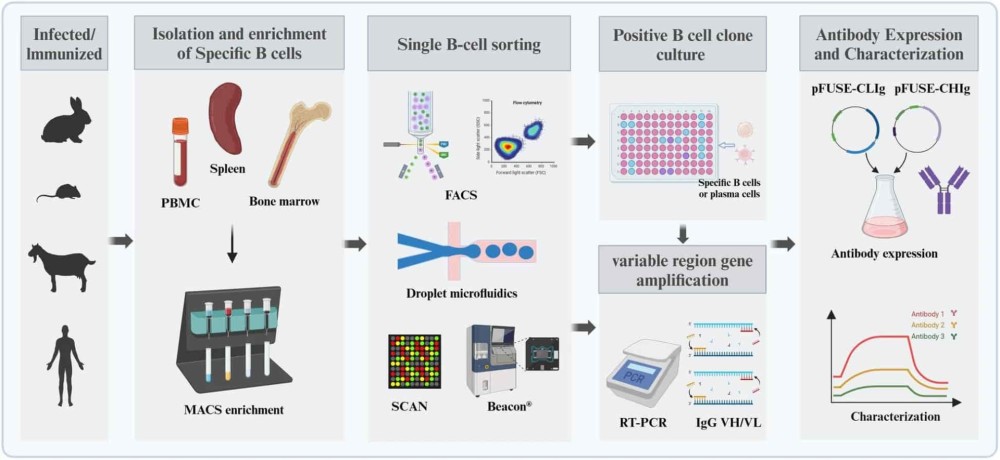


Biointron’s AbDrop™ platform revolutionizes antibody discovery by combining high-throughput screening with advanced microfluidic technology, enabling the identification of diverse and high-affinity antibodies. This platform streamlines the antibody drug discovery process, from initial screening to the identification of promising antibody leads. This process starts by isolating plasma B cells from immunized animals, encapsulating them in microdroplets to preserve natural heavy and light chain pairing, a critical factor for developing functional therapeutic antibodies. Using Next-Generation Sequencing (NGS), AbDrop™ rapidly identifies antibodies with superior specificity and affinity, ensuring targeted and potent therapeutic candidates. This approach delivers a broad range of fully human antibodies, accelerating the discovery of next-generation therapeutics.
The platform supports modern single B cell antibody discovery workflows by enabling analysis of natural antibody repertoires, generating high-quality antibody sequences, and creating diverse antibody libraries for downstream development.
Microfluidics for High-Throughput Antibody Discovery
At the heart of AbDrop™’s ability to discover diverse and high-affinity antibodies is its microfluidic single B cell screening. Unlike traditional hybridoma technology techniques, which limit the number of antibodies screened, microfluidics allows millions of B cells to be analyzed simultaneously. This ensures a rich pool of antibodies is screened, increasing the likelihood of finding rare, high-affinity candidates. By maintaining the natural pairing of heavy and light chains within each droplet, AbDrop™ preserves the full diversity of the immune response, which is essential for identifying therapeutically relevant antibodies.
Unlike approaches that depend on in vitro selection or phage display technology, AbDrop™ directly screens antibody-secreting cells from immunized animals. This provides a physiologically relevant approach to antibody discovery because candidate antibodies originate from an immune response generated through single B cell immunization workflows.
The platform facilitates single B cell isolation and enables the recovery of antigen-specific B cells and antigen-specific single B cells with desirable binding characteristics. Its proprietary microfluidic chip supports high-throughput experimentation and efficient data acquisition throughout antibody screening. Flow cytometry may also be used to characterize and enrich relevant B cell populations before microdroplet encapsulation.
NGS-Powered Antibody Discovery
AbDrop™’s integration of Next-Generation Sequencing further enhances the platform’s precision. After B cell screening, NGS is used to sequence the variable regions of the antibody genes, allowing rapid identification of candidates with high specificity for their target antigens. This strategy enables researchers to prioritize high-quality antibody leads for downstream validation while supporting affinity maturation and sequence optimization during therapeutic development. This precise genetic mapping enables researchers to quickly assess which antibodies are most likely to succeed in therapeutic applications, drastically reducing the time spent in the discovery phase.
Comprehensive analysis of antibody sequence data enables researchers to evaluate antibody–antigen interactions and identify promising antibody-coding sequences. The resulting antibody sequences can be used to support recombinant antibody development and antibody engineering efforts.
Rapid Antibody Validation in the Antibody Discovery Workflow
Following sequencing, AbDrop™ moves quickly to validate antibody activity and purify selected candidates. Within just one month, high-affinity antibodies are screened, expressed, and purified, ready for further testing. This rapid turnaround is a significant advantage for researchers, who can move promising candidates into preclinical testing without the delays commonly associated with traditional methods.
Rapid target validation and quality control processes help identify candidates suitable for drug discovery programs. Candidate antibodies may subsequently undergo in vivo efficacy studies and be characterized using surface plasmon resonance (SPR) to confirm binding kinetics and functional performance before advancing into later-stage development. These workflows support the advancement of clinical candidate selection and antibody therapeutics development.
The fully human nature of the antibodies generated by AbDrop™ further enhances their therapeutic antibody discovery potential. By using HUGO-Ab™ mice, which are genetically engineered to produce fully human antibodies, the platform eliminates the need for complex humanization processes. This not only speeds up the discovery process but also minimizes the risk of immunogenicity, ensuring that the antibodies are safer and more effective when used in patients.
These transgenic mouse models enable animal immunization campaigns designed to generate fully human antibodies for therapeutic applications. The resulting recombinant molecules can be further optimized through antibody engineering and molecular engineering strategies.
Compared with alternative display technologies such as phage display and yeast display, AbDrop™ preserves natural heavy and light chain pairing while accelerating antibody discovery. This capability supports the development of monoclonal antibodies, recombinant antibody candidates, and antibody-drug conjugates for cancer therapy and other therapeutic areas.
Learn more about our High-throughput Fully Human Antibody Discovery Platform here.
Biointron announces limited-time RushData launch pricing for high-throughput ant……
August 2026 brought another mix of acquisitions, licensing agreements, strategic……
Antibody discovery often begins with a highly diverse population of B cells, onl……
As larger candidate panels move from computational design into the laboratory, a……