


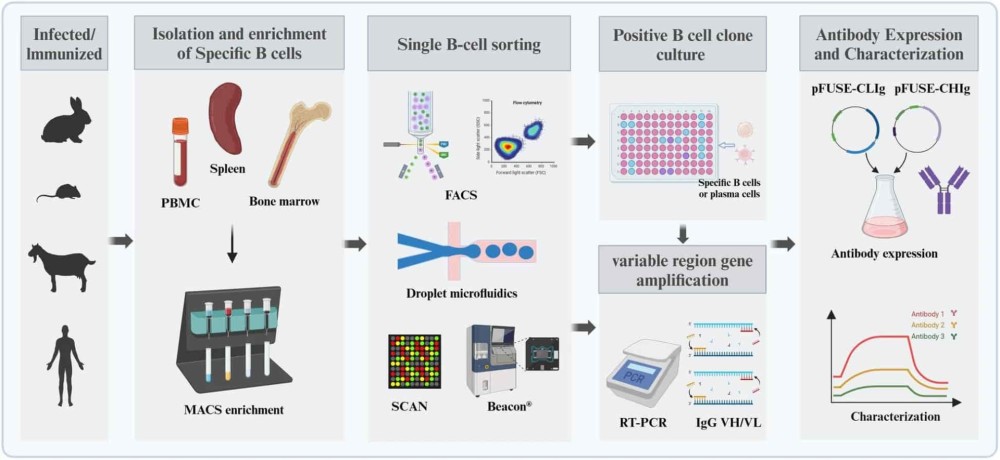



Lateral flow assays (LFAs) are widely used point-of-care diagnostic tools that enable rapid detection of molecular antigens in diverse settings, including decentralized and home environments. While methods such as PCR or ELISA offer higher analytical sensitivity, LFAs excel in terms of simplicity, cost-efficiency, speed, and operational independence from laboratory infrastructure. These features positioned LFAs as frontline tools during the SARS-CoV-2 pandemic, facilitating early detection and containment even under challenging public health conditions. The widespread use of the lateral flow test format during the pandemic further demonstrated the value of rapid diagnostics in decentralized settings.
Typical antibody-based LFAs (especially those using gold nanoparticle (AuNP) detection) offer visual, equipment-free readouts. These lateral flow immunoassays have become widely adopted for rapid screening and antigen testing across healthcare, veterinary, and research applications. However, producing disease- or target-specific antibodies in mammalian cell systems remains time- and resource-intensive. To address this, LFAs incorporating single-domain antibodies (nanobodies or VHHs) have emerged. VHHs are derived from camelid heavy-chain only antibodies and retain full antigen-binding capability as ~15 kDa domains. They are stable under thermal and chemical stress, and bind with equal or superior affinity compared to full-size antibodies.
In antibody diagnostics for therapeutic and research applications, including drug screening, pharmacokinetics, and product quality control, these features offer clear advantages. Biointron’s VHH Antibody Discovery platform provides customized nanobody generation tailored to these use cases, enabling rapid development of reliable diagnostic reagents.
Nanobodies possess several attributes that make them especially effective in LFA configurations for research and therapeutic diagnostics:
Small Molecular Size (~15 kDa): Facilitates rapid flow through nitrocellulose membranes and high density packing at test lines within a lateral flow test strip.
High Stability: Nanobodies are heat and pH resistant, extending the shelf-life of LFAs and ensuring performance under variable storage or transport conditions. Their robustness also supports long-term storage studies and stability test programs required during assay development and validation.
Epitope Access: Due to their small structure and diverse paratope repertoire, nanobodies can recognize cryptic or conformational epitopes often inaccessible to conventional IgGs.
No Fc Region: The absence of an Fc domain eliminates Fc-mediated interactions with host antibodies, reducing false positives and improving assay specificity.
Modifiability: VHHs are compatible with site-directed labeling and can be engineered into multivalent or tagged constructs for detection flexibility.
These attributes are particularly relevant in the development of diagnostic assays for biotherapeutic monitoring, drug batch release, or detection of contaminants during pharmaceutical manufacturing.
When integrated into LFA systems, nanobodies offer several advantages over conventional antibodies:
Extended Storage Life: Thermostability enables room-temperature storage, reducing cold chain dependence, which is valuable for field-deployable pharmaceutical QA tools.
Rapid Kinetics: Small size and high on-rates result in faster test line development and lower turnaround time.
Improved Specificity: Reduced non-specific binding and interference due to the absence of Fc domains enhances diagnostic confidence in complex matrices such as serum, saliva, or production buffers.
Scalable Production: Microbial expression systems allow cost-effective manufacturing and reproducible quality, which are critical for regulated diagnostic environments.
In therapeutic research, where diagnostic reagents are used to monitor pharmacodynamic markers or immunogenic responses, these attributes ensure consistent performance and ease of supply.
Nanobodies can be conjugated to gold nanoparticles, colored latex beads, or fluorescent tags to function as detection reagents in LFAs. Gold nanoparticles and colloidal gold remain among the most widely used labels due to their strong visual signal and ease of integration into rapid diagnostic platforms. Proper conjugation chemistry is required to preserve binding activity. For instance, in a study targeting SARS-CoV-2, nanobodies conjugated to gold nanoparticles retained full function and enabled signal-enhanced detection with improved sensitivity and specificity compared to monoclonal antibodies.
Nanobodies may serve as immobilized capture agents on test lines or as conjugated detection elements within the conjugate release pad. Their orientation flexibility and binding specificity make them suitable for both roles. In a nanobody-based Zika virus LFA, two high-affinity nanobodies were used in a sandwich configuration to detect NS1 antigen, achieving high sensitivity and no cross-reactivity with Dengue NS1.
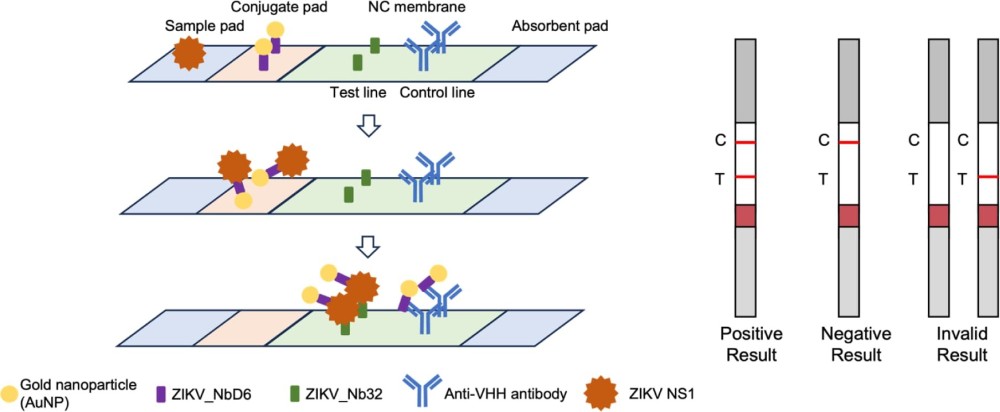
Due to their small size and modularity, VHHs are ideal for multiplexed LFA formats. Distinct nanobodies can be labeled with different tags or localized to separate test lines. Such designs are applicable to therapeutic research involving multi-analyte panels, such as cytokines, antigens, or antibody isotypes. Advanced characterization tools such as biolayer interferometry can be used during development to evaluate binding kinetics and optimize multiplex assay performance.
Related: Structure and Characteristics of VHH Domains
Nanobody-based LFAs have been developed for use in therapeutic monitoring, clinical diagnosis, livestock surveillance, and product quality control:
Zika Virus Detection (ACS Synth Biol. 2025): A nanobody-based LFA using two non-competing anti-NS1 nanobodies achieved a detection limit of 1 ng/mL in urine and 25 ng/mL in buffer. The assay capitalized on avidity effects from multimeric NS1 capture and showed no cross-reactivity with Dengue NS1, confirming its diagnostic specificity.
SARS-CoV-2 Saliva-Based Detection (Sci Rep. 2023): This work highlights the growing role of nanobody-enabled lateral flow immunoassays for rapid infectious disease detection. In a comparative study using 320 human saliva samples and complementary serum samples evaluated during validation studies. Nanobody-based LFAs targeting the S1 antigen achieved 97.14% sensitivity and 98.57% specificity for Ct ≤30 samples—outperforming monoclonal antibody-based tests. The nanobody LFAs also demonstrated a fourfold improvement in limit of detection.
Trypanosoma congolense Infection in Livestock (Sci Rep. 2018): A nanobody pair targeting pyruvate kinase was used in a LFA validated in plasma from infected mice and cattle. This assay provided proof of concept for using nanobody-based LFAs in veterinary diagnostics and test-of-cure monitoring.
Human Norovirus (mSphere 2016): A nanobody-based immunochromatographic assay (Nano-IC) using a biotinylated nanobody conjugated to gold particles detected four norovirus genotypes with 80% sensitivity and 86% specificity in clinical specimens. The assay delivered results in ~5 minutes and showed greater genotype coverage than traditional antibody-based systems.
Therapeutic Monitoring and Drug QA: LFAs targeting recombinant human interferon α2b have been developed using nanobodies for detection of counterfeit or substandard pharmaceuticals. These assays serve as quality control tools in biopharmaceutical production pipelines.
Related: VHH Antibodies Binding Affinity: Mechanisms, Measurement, and Applications
Nanobody expression in E. coli offers a scalable and cost-efficient route for generating diagnostic-grade antibodies. Expression strategies can be optimized to enhance yield and binding activity. In the Zika LFA study, periplasmic expression of Strep-tagged nanobodies provided the highest sensitivity. Further improvements in yield and folding conditions, including evaluation of disulfide bond requirements, are areas of ongoing development.
Biointron’s VHH Antibody Discovery platform supports nanobody development from immunization through expression and purification, with downstream screening to identify binders suitable for lateral flow integration. Characterization methods including mass photometry can provide additional insight into nanobody quality, molecular interactions, and assay suitability.
Batch-to-batch consistency, functional stability, and compatibility with conjugation methods are critical performance parameters for VHHs used in diagnostic assays related to therapeutic research and regulatory compliance.
While VHHs offer multiple benefits, several technical challenges remain:
Post-Conjugation Binding Retention: Labeling procedures can impair antigen-binding affinity; careful selection of coupling chemistry and linker strategies is necessary to maintain activity.
Membrane Flow Dynamics: The small size of nanobodies can alter flow behavior in porous media, necessitating optimization of membrane selection and buffer composition.
Non-Specific Binding in Complex Samples: Blocking agents and buffer systems must be tuned to prevent background interference, particularly in serum, saliva, or cell culture supernatants used in therapeutic monitoring.
Recent studies highlight continued innovation in VHH-LFA platforms:
Avidity-Based Signal Amplification: In the ZIKV LFA, capture of multimeric NS1 proteins via densely immobilized nanobodies improved sensitivity by three orders of magnitude, offering a design principle applicable to multimeric therapeutic proteins or complexes.
Signal Enhancement via Dual Conjugates: Such developments may enhance future serological tests designed to detect antibodies or biomarkers associated with diverse infectious diseases and viral proteins. The SARS-CoV-2 LFA employed dual gold conjugation, ACE2 for capture and nanobody for detection, achieving superior analytical sensitivity. This approach may be translated to biopharmaceuticals where target structure permits dual binding.
Cross-Genotype Pathogen Detection: The Nano-IC assay for norovirus successfully detected multiple genotypes, including newly emergent strains, supporting the adaptability of nanobody-based LFAs to antigenically variable therapeutic targets or vaccine antigens.
Nanobody-based LFAs combine stability, specificity, and manufacturability, offering a compelling alternative to traditional antibody-based diagnostic tools in therapeutic and research contexts. With rapid development timelines, high yield expression, and modular assay design, VHHs enable high-performance diagnostics for biotherapeutic monitoring, infectious disease surveillance, and pharmaceutical quality control. Continued innovation in nanobody engineering, assay chemistry, and detection technologies will further expand the capabilities of VHH-enabled diagnostics. Biointron's experienced support team helps researchers advance custom nanobody projects from discovery through assay development and deployment.
The continued integration of VHHs into LFA systems, supported by services like Biointron’s VHH Antibody Discovery platform, will accelerate the development of next-generation diagnostic assays that meet stringent performance and regulatory standards across the biotechnology industry.
References:
Peng, Y., Alqatari, A., Kiessling, F., Renn, D., Grünberg, R., Arold, S. T., & Rueping, M. (2025). Nanobody-Based Lateral Flow Assay for Rapid Zika Virus Detection. ACS synthetic biology, 14(3), 890–900. https://doi.org/10.1021/acssynbio.4c00819
Jin, B. K., Odongo, S., Radwanska, M., & Magez, S. (2023). NANOBODIES®: A Review of Diagnostic and Therapeutic Applications. International journal of molecular sciences, 24(6), 5994. https://doi.org/10.3390/ijms24065994
Pinto Torres, J.E., Goossens, J., Ding, J. et al. Development of a Nanobody-based lateral flow assay to detect active Trypanosoma congolense infections. Sci Rep 8, 9019 (2018). https://doi.org/10.1038/s41598-018-26732-7
Maher, S., Kamel, M., Demerdash, Z., El Baz, H., Sayyouh, O., Saad, A., Ali, N., Salah, F., & Atta, S. (2023). Gold conjugated nanobodies in a signal-enhanced lateral flow test strip for rapid detection of SARS-CoV-2 S1 antigen in saliva samples. Scientific reports, 13(1), 10643. https://doi.org/10.1038/s41598-023-37347-y
Doerflinger, S. Y., Tabatabai, J., Schnitzler, P., Farah, C., Rameil, S., Sander, P., Koromyslova, A., & Hansman, G. S. (2016). Development of a Nanobody-Based Lateral Flow Immunoassay for Detection of Human Norovirus. mSphere, 1(5), e00219-16. https://doi.org/10.1128/mSphere.00219-16
Biointron announces limited-time RushData launch pricing for high-throughput ant……
August 2026 brought another mix of acquisitions, licensing agreements, strategic……
Antibody discovery often begins with a highly diverse population of B cells, onl……
As larger candidate panels move from computational design into the laboratory, a……