


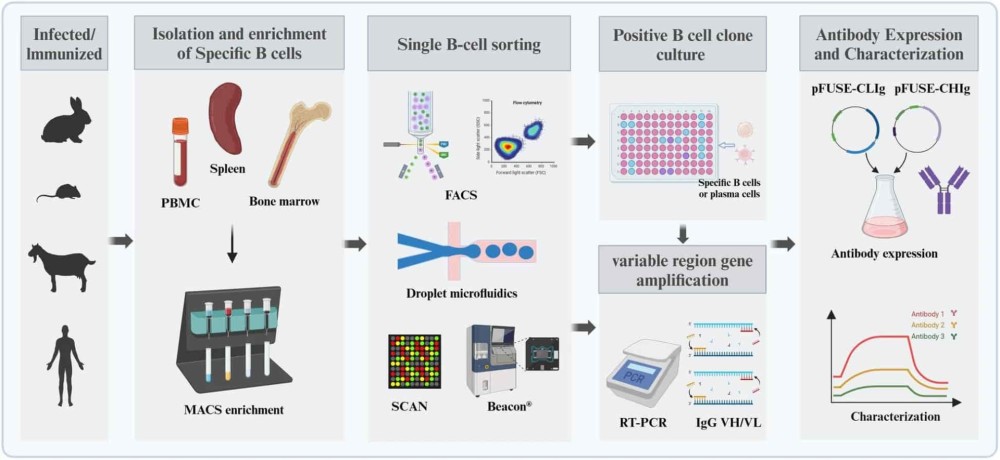


Antibody discovery has traditionally relied on selecting clones based on target binding. However, for therapeutic applications and broader drug discovery efforts, the desired monoclonal antibodies must also drive a functional response, such as receptor activation, T cell stimulation, or signaling modulation. Identifying these antibodies early in therapeutic antibody discovery can significantly reduce downstream risk and accelerate lead optimization in biomedical research.
Microfluidic screening of single antibody-secreting cells (ASCs) makes it possible to directly screen for function, not just binding, at high throughput and with native IgG secretion. This is a key capability of Biointron’s Single B platform, which integrates droplet-based microfluidics to identify functionally active antibodies at the single-cell level, without the need for recombinant protein production or display libraries.
Using a microfluidics-based droplet system built on a specialized microfluidic chip, individual ASCs are encapsulated alongside relevant assay components through controlled microfluidic compartmentalization platforms. For function-first screening, this means co-encapsulating:
An ASC (e.g., hybridoma cells generated via hybridoma technology or plasma cell),
A reporter cell that provides a measurable response upon functional engagement (e.g., GFP expression) serving as defined target cells, and
Any necessary co-stimulatory reagents or labeling components.
Each droplet serves as an isolated reaction chamber, enabling detection of secreted antibodies that induce a specific cellular effect on cell-surface receptors.
To illustrate, one screening campaign by Gaa et al. (2021) using this high-throughput droplet microfluidics approach focused on identifying CD3-specific agonist antibodies capable of activating T cells and modulating immune responses.1 OKT3 hybridomas (known to produce anti-CD3 antibodies) were spiked at 0.55% into a background of irrelevant EGFR-specific hybridomas. These cells were co-encapsulated with Jurkat-GFP reporter cells, which fluoresce upon TCR signaling activation, enabling evaluation of antigen-binding affinity in a functional context.
After incubation, droplets were sorted based on GFP signal intensity. The results demonstrated strong enrichment: from an initial frequency of 0.55%, OKT3 clones were recovered in 68% of droplets analyzed, with 88% purity among antibody-positive wells. This reflects a greater than 100-fold enrichment for functionally active clones in a single round of screening.
This is full-length IgG screening based on activity, not just antigen recognition or antibody-antigen binding kinetics.
Several parameters were optimized to ensure successful functional screening within advanced microfluidic platforms:
ASC-to-reporter ratio: Maintaining one antibody-producing cell per droplet, while ensuring at least one reporter cell, was critical. Excess reporter cells reduced assay performance due to nutrient depletion and background activation.
Incubation conditions: An 8-hour incubation allowed sufficient time for antibody secretion and downstream signaling, while preserving viability and enabling accurate measurement of single-cell protein secretion.
Detection and gating: GFP signal was measured using peak fluorescence (“max mode”) supported by a robust gating strategy to discriminate between true activation and background noise.
Cell labeling: Antibody-secreting cells were pre-stained with fluorescent markers and analyzed under a fluorescence microscope to distinguish droplets that contained viable ASCs, improving sort specificity.
Droplet dispensing: Positive droplets were dispensed into individual wells for downstream PCR-based antibody gene recovery, single-cell sequencing, and expression, supporting rapid production of recombinant antibodies through downstream recombinant antibody workflows.
All steps in this workflow are integrated into Biointron’s Single B platform, allowing for complete recovery of functional, natively paired antibodies from single cells across diverse antibody screening formats, starting from hybridomas, immunized mice, or human donors.
AbDrop™: Microfluidic-Based Single B Cell Screening Platform →
Binding-based assays are effective for screening antibodies against soluble, well-characterized antigens. However, they fall short in several cases within modern antibody engineering workflows:
Membrane proteins often require conformational presentation not captured in recombinant formats.
Functional epitopes may not be accessible in binding assays that measure only fragment antigen-binding interactions or rely on single-chain fragment variable (scFv) formats.
Bispecific or agonistic antibodies require co-engagement of receptors or cell types to exert activity on target cells.
With droplet microfluidics, antibodies can be screened for effects such as:
T cell activation (e.g., CD3 or CD28 engagement)
Receptor internalization (e.g., for ADC applications) targeting circulating tumor cells)
Agonist or antagonist activity on signaling pathways, linked to autoimmune disorders or oncology, induction of gene expression in reporter systems
Induction of gene expression in reporter systems
The Single B platform is compatible with antibody-secreting cells from diverse sources. In high-throughput campaigns, both human plasma blasts and murine plasma cells were screened successfully using droplet microfluidics:
From human blood samples collected after tetanus vaccination, over 5 million CD38+ plasma blasts were isolated. Screening yielded 44 unique, high-affinity anti-TT antibodies, all confirmed in secondary validation assays.
From wild-type mice immunized with a cancer-related antigen, CD138+ plasma cells were enriched from bone marrow, lymph nodes, and spleen. The screen identified 30 unique antibodies with confirmed specificity.
These results demonstrate that the platform accommodates both fresh and cryopreserved samples. Cells stored in liquid nitrogen for up to 10 months remained functional, with no loss in antibody secretion or viability, supporting flexible logistics for discovery campaigns.
AbDrop™: Microfluidic-Based Single B Cell Screening Platform →
Another advantage of microfluidic droplet screening is the ability to bypass recombinant protein production entirely. In cases where the target is a complex membrane protein or exists only in cellular context, functional or cell-based assays can be used.
In a proof-of-concept, hybridomas secreting anti-EGFR antibodies were co-encapsulated with EGFR-positive A431 cells. Fluorescent labeling of ASCs and detection antibodies allowed sorting based on cellular binding within droplets, without requiring purified EGFR protein.1
The enrichment was significant: starting from a 0.3% frequency, EGFR-specific clones were recovered at 32% purity. This demonstrates that direct cell-based selection can be efficiently implemented, making the platform suitable for targets that are otherwise difficult to address.
Biointron's platform can screen millions of cells within one week, and by bypassing conventional hybridoma steps, an entire single B cell discovery project takes ~3 months.
The system supports either:
Single-well droplet dispensing, for individual clone tracking and downstream sequencing, or
Bulk export, for pooled analyses and large-scale screening.
This throughput is particularly valuable for early-stage antibody campaigns where diversity and speed are critical.
Screening antibodies based on their functional activity, rather than just binding, is essential for developing next-generation therapeutics, especially in immuno-oncology and cell signaling pathways. Microfluidic droplet systems now make this possible at high throughput, using native full-length IgGs secreted by individual antibody-producing cells.
Biointron’s Single B platform integrates this microfluidic approach to deliver function-first antibody discovery services. By encapsulating antibody-secreting cells with reporter systems, co-stimulatory components, or target cells, we enable precise selection of antibodies based on biological effect. Combined with downstream gene recovery, sequencing, and expression, this provides a powerful workflow for identifying differentiated antibody leads early in discovery.
AbDrop™: Microfluidic-Based Single B Cell Screening Platform →
Gaa, R., Menang-Ndi, E., Pratapa, S., Nguyen, C., Kumar, S., & Doerner, A. (2021). Versatile and rapid microfluidics-assisted antibody discovery. mAbs, 13(1). https://doi.org/10.1080/19420862.2021.1978130
Biointron announces limited-time RushData launch pricing for high-throughput ant……
August 2026 brought another mix of acquisitions, licensing agreements, strategic……
Antibody discovery often begins with a highly diverse population of B cells, onl……
As larger candidate panels move from computational design into the laboratory, a……