




Chimeric antigen receptor (CAR)-T cell therapy is a revolutionary cancer treatment in which engineered CARs redirect lymphocytes, typically T cells, to recognize and destroy cells expressing a specific target antigen. While not as commonly used as immune checkpoint inhibitors, they are now widely available and have demonstrated the same ability to eradicate advanced leukemias and lymphomas and cause sustained remission for several years.1,2
The specificity and binding affinity of the CAR to the target antigen are critical for the therapy’s success and are primarily determined by the scFv (single-chain variable fragment) derived from monoclonal antibodies. This integration of antibody discovery into CAR-T cell design is pivotal in enhancing the precision of cancer immunotherapy.
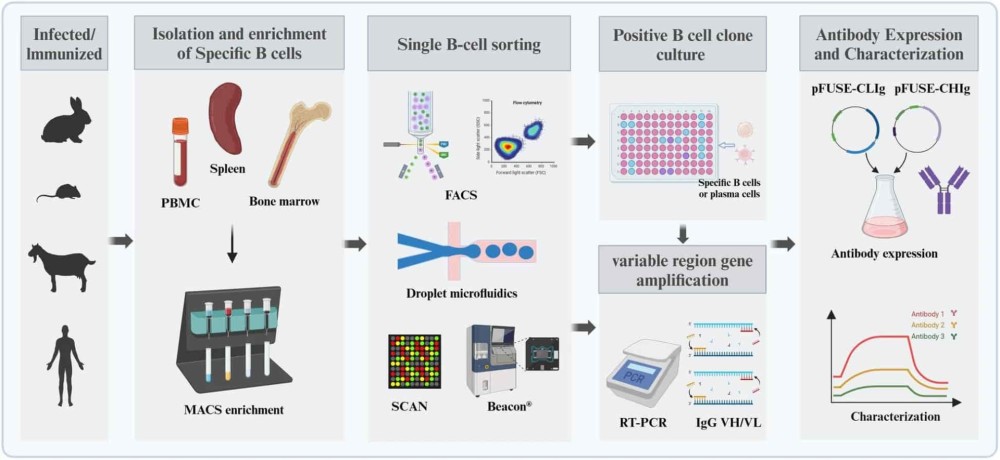
Scientists use antibody discovery techniques, such as phage display, hybridoma technology, or single B-cell cloning, to isolate and characterize potent antibodies that can recognize and bind to specific epitopes on target cells. These antibodies form the basis of the CAR's antigen recognition domain, defining the therapy's targeting mechanism and directly influencing its therapeutic efficacy. Human antibody discovery service platforms play a vital role in advancing these techniques, enabling the rapid identification of high-affinity antibodies for therapeutic applications.
The specificity of CAR-T cells is necessary since off-target effects can lead to severe toxicities, such as cytokine release syndrome (CRS) or neurotoxicity. CRS can be life-threatening but may be treated with the anti-IL-6 receptor antagonist tocilizumab.3 Advanced antibody engineering techniques are utilized to modify and optimize antibodies’ affinity and specificity towards target antigens. For example, affinity maturation and humanization of scFv fragments are critical steps to reduce immunogenicity and improve the safety profile of CAR-T cell therapies.
Affinity maturation and humanization are routinely employed to optimize antibody fragments used in CAR constructs. These strategies reduce the immunogenic potential of non-human sequences while preserving or enhancing antigen binding affinity. By minimizing the likelihood of anti-drug immune responses, they contribute to improved safety, sustained CAR-T cell persistence, and enhanced therapeutic efficacy.
To improve antigen specificity, researchers fine-tune single-chain variable fragments (scFvs) to ensure that CARs selectively recognize their intended targets. This engineering reduces off-target interactions that can lead to severe toxicities, such as on-target/off-tumor effects or cytokine release. Additional optimization of the extracellular antigen-binding domain further refines target recognition, improving both the safety profile and antitumor potency of CAR-T cell therapies.
Dual-targeting CAR constructs are designed to recognize two distinct tumor-associated antigens, thereby mitigating the risk of tumor immune escape through antigen downregulation or loss. By incorporating two separate single-chain variable fragments (scFvs) within the CAR architecture, these approaches enable more comprehensive tumor recognition, enhancing the durability and depth of antitumor responses. Dual-targeting strategies are particularly advantageous in heterogeneous malignancies, where reliance on a single antigen can lead to therapeutic failure as tumors evolve and shed specific surface markers. Preclinical and clinical studies have shown that dual-targeting CAR-T cells can improve response rates, prolong remission, and reduce the likelihood of relapse compared to monospecific CARs.
Unlike conventional autologous CAR-T therapies, which rely on patient-derived T cells and individualized manufacturing, allogeneic (“off-the-shelf”) CAR-T cells are generated from healthy donor T cells and engineered for broad clinical applicability. This platform enables on-demand treatment, significantly shortening vein-to-vein time and allowing for rapid intervention in aggressive disease settings. Furthermore, scalable manufacturing of allogeneic products has the potential to lower production costs and increase accessibility. Recent advances in gene-editing technologies, such as CRISPR/Cas9, TALENs, and base editing, are being employed to eliminate endogenous T-cell receptor expression and other immunogenic elements, thereby minimizing the risk of graft-versus-host disease (GVHD) and host immune rejection. These innovations are driving the development of safer and more effective allogeneic CAR-T cell therapies.4
CAR-T cells face significant barriers within the immunosuppressive tumor microenvironment (TME), particularly in solid tumors. Tumor and stromal cells secrete immunosuppressive cytokines (e.g., TGF-β, IL-10) and express immune checkpoint molecules (e.g., PD-L1) that inhibit T-cell activation and persistence. In addition, the dense extracellular matrix (ECM) and abnormal vasculature characteristic of many solid tumors restrict CAR-T cell trafficking and infiltration, thereby limiting therapeutic efficacy.
To enhance CAR-T cell performance in these hostile environments, several strategies are under investigation, including:
Combination with immune checkpoint inhibitors to counteract inhibitory signaling and restore T-cell effector function.
Engineering CAR-T cells to secrete pro-inflammatory cytokines (e.g., IL-12, IL-18) to improve expansion, persistence, and local immune activation.
Arming CAR-T cells with ECM-degrading enzymes (e.g., heparanase) to facilitate tumor penetration and improve spatial distribution within the tumor mass.
The identification of novel and tumor-specific antigens remains essential for expanding CAR-T therapy to a broader range of malignancies while minimizing on-target/off-tumor toxicities. Advances in genomic, transcriptomic, and proteomic profiling are enabling the discovery of new, more selective targets for next-generation CAR designs. Current research directions include:
Neoantigen discovery through integrated sequencing approaches to identify unique tumor-derived epitopes.
Multi-targeted CAR architectures, such as tandem CARs or dual CARs, to address tumor antigen heterogeneity and evolution.
Synthetic receptor systems (e.g., SynNotch circuits) that allow CAR-T cells to respond to dynamic or combinatorial antigen cues, increasing precision and adaptability.
These innovations aim to generate more resilient and adaptable CAR-T therapies capable of achieving durable responses in both hematologic malignancies and solid tumors.
Antibody discovery remains a cornerstone of CAR-T cell therapy innovation. As the field advances, continued refinement of antibody engineering will be critical for enhancing therapeutic potency, minimizing off-target toxicities, and expanding the clinical reach of CAR-T therapies beyond hematologic malignancies. Future efforts are expected to focus on the development of novel antigen-targeting strategies, improving CAR-T cell persistence and functionality within solid tumors, and incorporating multi-specific CAR architectures to achieve greater precision. Collectively, these advancements will drive the evolution of next-generation, personalized cellular immunotherapies with improved safety, efficacy, and applicability across diverse cancer types.
References:
Sterner, R. C., & Sterner, R. M. (2021). CAR-T cell therapy: Current limitations and potential strategies. Blood Cancer Journal, 11(4), 1-11. https://doi.org/10.1038/s41408-021-00459-7
Melenhorst, J. J., Chen, G. M., Wang, M., Porter, D. L., Chen, C., Collins, M. A., Gao, P., Bandyopadhyay, S., Sun, H., Zhao, Z., Lundh, S., Nobles, C. L., Maji, S., Frey, N. V., Gill, S. I., Loren, A. W., Tian, L., Kulikovskaya, I., Gupta, M., . . . June, C. H. (2022). Decade-long leukaemia remissions with persistence of CD4+ CAR T cells. Nature, 602(7897), 503-509. https://doi.org/10.1038/s41586-021-04390-6
Frey, N. and Porter, D. (2018) ‘Cytokine release syndrome with chimeric antigen receptor T cell therapy’, Biology of Blood and Marrow Transplantation, 25(4). doi:10.1016/j.bbmt.2018.12.756.
Huang, R., Li, X., He, Y. et al. (2020). Recent advances in CAR-T cell engineering. J Hematol Oncol 13, 86. https://doi.org/10.1186/s13045-020-00910-5
Biointron announces limited-time RushData launch pricing for high-throughput ant……
August 2026 brought another mix of acquisitions, licensing agreements, strategic……
Antibody discovery often begins with a highly diverse population of B cells, onl……
As larger candidate panels move from computational design into the laboratory, a……