




VHH antibodies, also known as single-domain antibodies or nanobodies, are derived from the heavy-chain-only antibodies found in camelids. With a molecular weight of approximately 15 kDa, VHHs are significantly smaller than conventional antibodies.
VHH domains are filtered efficiently by the glomerulus due to their molecular weight falling well below the renal threshold (~60 kDa), leading to a half-life often measured in hours or even minutes in small animal models. This requires frequent administration to maintain therapeutic concentrations, reducing patient compliance and increasing treatment costs. For biotherapeutics intended to act over extended periods, such as in chronic inflammatory or oncologic indications, half-life extension is a crucial engineering goal.
Several approved and investigational VHH therapeutics integrate half-life extension modules to overcome this limitation. For instance, ozoralizumab, a trivalent anti-TNFα VHH therapeutic approved in Japan for rheumatoid arthritis, incorporates a domain that binds human serum albumin (HSA) to achieve a half-life of approximately 18 days. Similarly, envafolimab, a PD-L1 blocking VHH-Fc fusion administered subcutaneously, demonstrates a steady-state half-life of 23 days.
Learn how Biointron’s VHH Antibody Discovery Service can assist in VHH discovery for therapeutic and diagnostic applications.
Half-life extension techniques exploit either molecular size increase or interactions with endogenous recycling systems, particularly those mediated by the neonatal Fc receptor (FcRn).
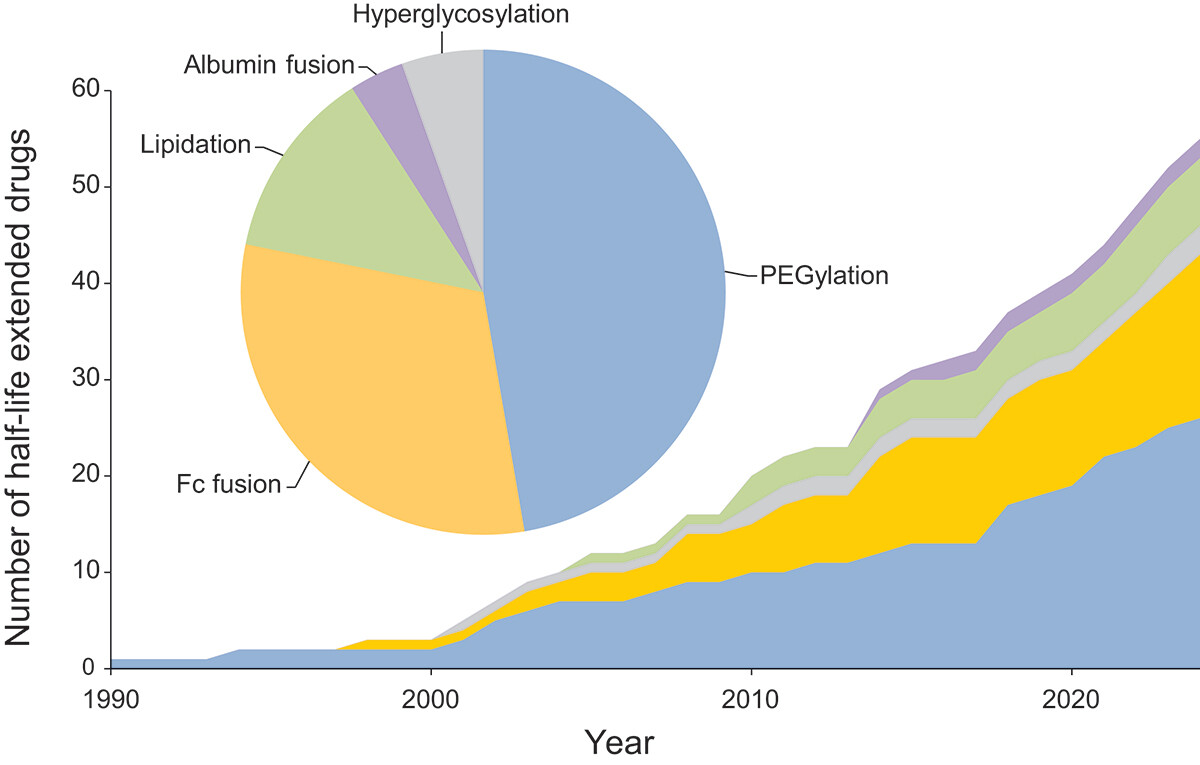
Size-dependent clearance: Increasing the hydrodynamic radius of the VHH above the renal filtration threshold slows glomerular elimination. This can be achieved through PEGylation, polypeptide fusions (e.g., XTEN, PAS), or protein fusions (e.g., Fc domains, albumin).
FcRn engagement: Both albumin and IgG exploit FcRn-mediated recycling to avoid lysosomal degradation, extending their half-lives in serum. Engineering VHHs to bind FcRn either directly (via Fc fusion) or indirectly (via albumin binding) enables reuse of this natural mechanism.
Albumin is an abundant serum protein with a natural half-life of ~19 days, owing to FcRn recycling. Two main formats are used:
Anti-albumin VHHs: As seen in ozoralizumab, one VHH domain targets albumin, while the others engage the therapeutic target (e.g., TNFα).
Albumin-binding domains (ABDs): Non-immunoglobulin scaffolds engineered for high-affinity albumin binding.
Fusing a VHH to an albumin-binding domain (another VHH) has resulted in detectable serum levels for 10+ days in mice and up to 35 days in monkeys. For example, Anti-rabies glycoprotein VHH fused to albumin-binding VHH increased systemic exposure ~100-fold and prolonged survival in challenged mice. Albumin’s accumulation in tumors and inflamed tissues can help direct VHHs to disease-relevant sites.
A recent study developed half-life extended nanobody-based bispecific killer cell engagers (HLE-nano-BiKEs) targeting CD38 on multiple myeloma cells and CD16 on NK cells. These trivalent constructs included an albumin-specific nanobody fused at the C-terminus, enabling extended systemic circulation. The nanobody format conferred high solubility, ease of reformatting, and a small molecular size (~45 kDa), with superior in vitro cytotoxicity against CD38+ cells compared to daratumumab. Importantly, binding to albumin did not impair the NK cell-engaging function, supporting albumin-binding domains as a robust and modular half-life extension strategy in multivalent VHH therapeutics for oncology applications.
Recent findings:
Li et al. (2024) engineered an anti-HSA VHH fused to a 5T4-targeting sdADC (n501–αHSA–MMAE). This construct exhibited a 10-fold increase in serum half-life in wild-type mice and improved tumor accumulation, enhancing antitumor efficacy in ovarian and pancreatic xenograft models. Notably, albumin-binding fusion mitigated off-target liver and kidney accumulation without impairing target binding.
Fc fusion involves genetically attaching the Fc domain of human IgG to a VHH molecule. The Fc portion binds FcRn in acidic endosomes, leading to recycling back to the plasma membrane and release at physiological pH.
Fc fusion not only increases size but also restores FcRn engagement, extending half-life beyond what size alone would predict. For example, VHHs fused to IgG1 or IgG2 Fc regions targeting MERS-CoV retained detectable serum levels 10 days post-injection, while monovalent counterparts were undetectable by that time. In addition, Fc fusion introduces bivalency (avidity) and Fc-mediated effector functions like ADCC or CDC, which is relevant when designing therapeutics with immune engagement in mind.
Example: Envafolimab, a PD-L1-targeting VHH-Fc fusion, shows subcutaneous bioavailability and a first-dose half-life of 14 days.
Considerations: While Fc fusions offer robust half-life extension, they increase the overall molecular weight and may confer effector functions (e.g., ADCC, CDC), which must be evaluated depending on the therapeutic context.
PEGylation involves covalent attachment of polyethylene glycol (PEG) to increase the molecule’s hydrodynamic size. By increasing molecular size and protease resistance, it improves half-life and neutralizing capacity (e.g., FMDV-neutralizing VHHs in guinea pigs).
Mechanism: Reduces renal filtration and shields against proteolysis and immunogenicity.
Approved examples: Multiple FDA-approved PEGylated biologics use this strategy, including peginterferon and pegvisomant.
Limitations:
Risk of immunogenicity from anti-PEG antibodies.
Cytoplasmic vacuolation observed in preclinical studies.
Heterogeneity in conjugation chemistry and batch variability.
Binder and Skerra (2025) note increasing concern about PEG accumulation in tissues and anaphylactic reactions tied to anti-PEG antibodies, especially in the post-COVID-19 vaccine context. Consequently, PEG alternatives are in active development. >50 kDa PEG chains may lead to accumulation in tissues, reducing accessibility to the target. PEG is not biodegradable, and PEGylated proteins taken up by cells may cause vacuolation. This has driven interest in alternatives such as recombinant PEG mimetics or biodegradable polymers.
These are biodegradable, genetically encoded, unstructured polypeptides that mimic the effects of PEGylation without requiring chemical modification.
XTEN: Composed of natural amino acids (Glu, Pro, Ser, Thr, Ala, Gly). Approved in combination products (e.g., Altuviiio).
PASylation: Based on Pro, Ala, and Ser repeats. Extends half-life by increasing size and hydration.
Advantages:
Full recombinant production with no chemical conjugation.
Low immunogenicity.
Biodegradable and less likely to accumulate in tissues.
| Strategy | Advantages | Key Considerations |
|---|---|---|
| Fc Fusion | Strong FcRn recycling, robust PK enhancement | Potential immune effector functions, larger size |
| Albumin Binding | High serum persistence, low immunogenicity | Albumin variability across species must be considered |
| PEGylation | Well-characterized, tunable PK | Safety risks, non-biodegradable, anti-PEG antibody responses |
| XTEN / PASylation | Biodegradable, recombinant, low toxicity | Large constructs, less clinical experience |
A less conventional yet promising approach to prolong the systemic half-life of VHH-based therapeutics is red blood cell (RBC) hitchhiking. This strategy involves genetically fusing a single-domain antibody (sdAb) to a domain that binds RBC surface antigens, such as the band 3 protein (b3p), which is abundantly expressed (~1 million copies per cell) on human erythrocytes.
Recent work has demonstrated the feasibility of this method using anti-b3p sdAbs derived from a phage display library. Bispecific fusion constructs targeting both TNF-α and RBCs exhibited markedly extended half-lives. In murine models, the circulation half-life increased from 1.3 hours (non-RBC-binding control) to 75 hours for the RBC-binding fusion protein. This enhancement was attributed to the long lifespan of RBCs (~120 days in humans) and their limited extravascular trafficking.
An emerging strategy to prolong the circulatory half-life of VHHs involves modifying their surface charge. Negatively charged proteins have been shown to remain in circulation longer than their neutral counterparts, likely due to electrostatic repulsion from the negatively charged glomerular basement membrane, thereby reducing renal clearance. To leverage this, VHHs can be conjugated with negatively charged, biodegradable polymers such as polysialic acid chains (polysialylation) or hydroxyethyl starch (HESylation), as well as the beta carboxy-terminal peptide (CTP) derived from human chorionic gonadotropin (hCG). Unlike PEG, these polymers are naturally metabolized by the body, offering a potentially safer and more biocompatible alternative for extending the half-life of biotherapeutics.
Several half-life extension strategies have already been translated into therapeutic VHH formats targeting inflammatory and infectious diseases. These real-world examples illustrate both the clinical promise and the developmental challenges associated with optimizing VHH pharmacokinetics.
One of the most advanced VHH-based therapeutics in development is ALX-0171, a trivalent VHH targeting the fusion (F) protein of respiratory syncytial virus (RSV). By leveraging multivalency, this construct enhances both binding avidity and neutralizing potency. In preclinical models, ALX-0171 outperformed palivizumab, the currently approved monoclonal antibody for RSV prophylaxis, and is currently being evaluated in a Phase IIb clinical trial for the treatment of RSV infection in infants.
In the inflammatory disease space, half-life extension via albumin binding has shown both successes and setbacks. Vobarilizumab, an anti-interleukin-6 receptor (IL-6R) VHH fused to an albumin-binding domain, was investigated for rheumatoid arthritis and systemic lupus erythematosus. Although the drug demonstrated a favorable pharmacokinetic and safety profile, it failed to meet efficacy endpoints in pivotal trials and was ultimately discontinued.
In contrast, the anti-tumor necrosis factor alpha (TNFα) VHH ozoralizumab (marketed as Nanozora®) has successfully advanced to market. This trivalent construct includes an albumin-binding VHH for extended circulation time and is administered subcutaneously. In 2022, ozoralizumab received regulatory approval in Japan for the treatment of rheumatoid arthritis inadequately controlled by conventional therapies. It exhibits a half-life of approximately 18 days, demonstrating the clinical feasibility of albumin-based half-life extension strategies.
The clinical translation of VHH-based therapeutics increasingly depends on integrated half-life extension strategies. PEGylation, Fc fusion, albumin binding, and recombinant polypeptide fusions each offer distinct advantages and trade-offs. Successful therapeutic development demands a case-specific selection of extension method based on the target, indication, and delivery route.
Fc fusion, albumin-binding, PEGylation, and multimerization can work independently or synergistically. The choice of extension method must balance half-life gain with potential drawbacks such as loss of activity, increased immunogenicity, or impaired tissue penetration.
Emerging data from molecules such as ozoralizumab, envafolimab, and investigational agents like sonelokimab and vobarilizumab demonstrate that VHH therapeutics can match or exceed full-length antibody pharmacokinetics when optimally engineered.
What is the VHH half-life extension mechanism?
It refers to bioengineering strategies that prolong the circulation time of single-domain antibodies by increasing molecular size or engaging FcRn-mediated recycling.
Why do VHH antibodies need half-life extension?
Unmodified VHHs are rapidly cleared by the kidneys due to their small size, resulting in short systemic half-lives and necessitating frequent dosing.
How does Fc fusion extend VHH antibody half-life?
The Fc domain engages the neonatal Fc receptor (FcRn), which recycles the protein back into circulation, avoiding degradation.
What are the benefits of using albumin-binding VHH constructs?
Albumin has a natural 19-day half-life and circulates extensively. Binding albumin enables the VHH to “hitchhike” on this long-lived protein.
Is PEGylation still commonly used for VHH antibodies?
Yes, although PEGylation faces concerns around immunogenicity, tissue accumulation, and manufacturing heterogeneity.
What are the safety considerations when modifying VHH antibodies?
Potential issues include immunogenicity, altered biodistribution, loss of activity, or undesirable immune effects from effector domains.
References:
Binder, U., & Skerra, A. (2024). Strategies for extending the half-life of biotherapeutics: successes and complications. Expert Opinion on Biological Therapy, 25(1), 93–118. https://doi.org/10.1080/14712598.2024.2436094
Li, Q., Kong, Y., Zhong, Y., Huang, A., Ying, T., & Wu, Y. (2024). Half-life extension of single-domain antibody–drug conjugates by albumin binding moiety enhances antitumor efficacy. MedComm, 5(5), e557. https://doi.org/10.1002/mco2.557
Jovčevska, I., & Serge Muyldermans. (2019). The Therapeutic Potential of Nanobodies. BioDrugs, 34(1), 11–26. https://doi.org/10.1007/s40259-019-00392-z
Nguyen, T. D., Bordeau, B. M., Zhang, Y., Mattle, A. G., & Balthasar, J. P. (2022). Half-Life Extension and Biodistribution Modulation of Biotherapeutics via Red Blood Cell Hitch-Hiking with Novel Anti-Band 3 Single-Domain Antibodies. International Journal of Molecular Sciences, 24(1), 475. https://doi.org/10.3390/ijms24010475
Vlieger, D. D., Ballegeer, M., Rossey, I., Schepens, B., Saelens, X., Vlieger, D. D., Ballegeer, M., Rossey, I., Schepens, B., & Saelens, X. (2018). Single-Domain Antibodies and Their Formatting to Combat Viral Infections. Antibodies, 8(1). https://doi.org/10.3390/antib8010001
Evers, A., Guarnera, E., Pekar, L., & Zielonka, S. (2025). From discovery to the clinic: structural insights, engineering options, clinical, and 'next wave' applications of camelid-derived single-domain antibodies. mAbs, 17(1), 2583210. https://doi.org/10.1080/19420862.2025.2583210
Biointron announces limited-time RushData launch pricing for high-throughput ant……
August 2026 brought another mix of acquisitions, licensing agreements, strategic……
Antibody discovery often begins with a highly diverse population of B cells, onl……
As larger candidate panels move from computational design into the laboratory, a……