




Since the first recombinant protein therapeutic, human insulin, was approved in 1982, more than 250 protein-based drugs have entered the global market. Monoclonal antibodies (mAbs), in particular, are a rapidly growing class of biologics, representing nearly half of all therapeutic proteins approved by the U.S. Food and Drug Administration (FDA) in recent years. These molecules have proven effective across oncology, autoimmune diseases, and infectious disease, largely due to their ability to bind flat protein surfaces with high specificity, unlike small molecules, which typically bind deep pockets.
Despite their success, therapeutic antibodies remain susceptible to unwanted immune responses that can compromise safety and efficacy. The formation of anti-drug antibodies (ADAs) can result in altered pharmacokinetics, neutralization of activity, or even life-threatening reactions. Reducing immunogenicity, specifically the development of T cell-dependent ADA responses, remains an important goal in antibody engineering.
Two leading approaches for minimizing immunogenicity in therapeutic antibodies are humanization and the development of fully human antibodies.
Humanization involves the grafting of murine antibody complementarity-determining regions (CDRs) onto human immunoglobulin frameworks. This method reduces the amount of foreign (i.e., non-human) sequence in the antibody, thereby lowering the risk of T cell recognition and ADA formation. The initial step in antibody engineering was the generation of chimeric antibodies, where murine variable regions were fused to human constant domains. Humanization goes further by replacing murine framework sequences while retaining antigen-specific CDRs.
The effectiveness of humanization in lowering immunogenicity is well documented. In vivo, approximately 40% of chimeric antibodies induce marked ADA responses, whereas only 9% of humanized antibodies do. In vitro T cell proliferation assays have shown that CD4+ T cell responses to framework-derived peptides are nearly eliminated after humanization. These findings support the conclusion that tolerance to human framework sequences is intact, and that removing murine frameworks significantly reduces immunogenic potential.
Humanized antibodies continue to dominate clinical pipelines due to their strong efficacy-to-immunogenicity balance. The process is also faster and more cost-effective than fully human antibody generation, making it attractive for many biotech developers.
Related: Antibody Humanization
Fully human antibodies are produced using two main platforms:
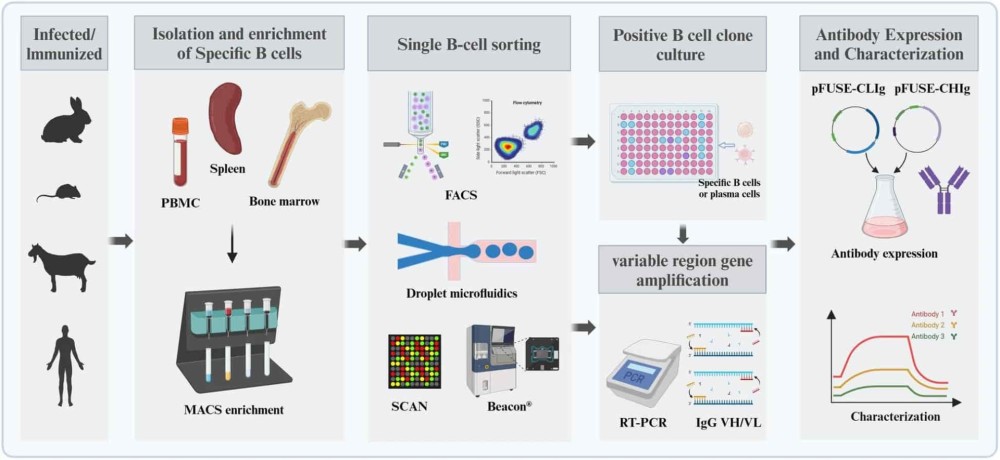
Phage display libraries expressing human V region repertoires
Transgenic mice engineered with human immunoglobulin loci (e.g., HUGO-Ab™ mice)
Antibodies developed using these methods, such as adalimumab (Humira) and panitumumab (Vectibix), contain no non-human sequences and are designed to minimize immunogenicity through native human germline frameworks. These fully human antibodies are generally associated with low immunogenic risk, particularly when combined with careful sequence selection and formulation strategies.
However, clinical experience shows that immunogenicity can still occur, largely due to the inherent variability of CDR regions, which are shaped by somatic recombination and affinity maturation. As such, both fully human and humanized antibodies benefit from epitope analysis and design optimization during early-stage development.
Related: Fully Human Antibody Discovery
Immunogenicity to therapeutic antibodies is primarily driven by T cell-dependent pathways. Peptides from the antibody variable regions are presented by MHC class II molecules and recognized by CD4+ T helper cells, which then activate B cells to produce ADAs. These CD4+ T cell epitopes are crucial targets for deimmunization.
In a detailed study of eight humanized antibodies, CD4+ T cell responses were observed exclusively in peptides containing CDR sequences. None of the framework-derived peptides elicited a statistically significant T cell response across 793 donors. This result has been corroborated in multiple studies, including analysis of the chimeric antibody cetuximab, where humanization eliminated T cell responses to framework-derived peptides.
Even in fully human antibodies, the generation of unique CDR sequences during affinity maturation introduces amino acid patterns that may function as immunogenic epitopes, especially when presented by widely expressed HLA class II alleles. Therefore, CDR regions remain the primary source of immunogenicity in both humanized and fully human antibodies.
While T cell epitopes are central to ADA formation, B cell epitopes, which are the conformational surfaces recognized by anti-drug antibodies, also contribute. Predicting B cell epitopes remains challenging due to their discontinuous and structure-dependent nature. Computational models for B cell epitope prediction offer only marginal accuracy, slightly better than random. Experimental methods such as antibody-antigen co-crystallography or anti-serum screening provide more definitive data but are not scalable in early discovery.
A recent computational analysis of CDR structural features (e.g., hydrophobicity, cavity volume of the CDR-H3 loop) has identified parameters correlated with immunogenicity. Using these features, a Support Vector Machine (SVM) model called PITHA (Predict Immunogenicity for Therapeutic Antibodies) was developed to estimate the immunogenic potential of humanized and fully human antibodies. This kind of tool is especially useful during lead optimization, when structural data is available. However, most deimmunization strategies still focus on T cell epitope removal, given the limited predictive power for B cell epitopes.
The choice between humanized and fully human antibodies should be made in the context of clinical indication, regulatory risk, manufacturing capability, and project timelines. Notable considerations:
Humanized antibodies are faster and more economical to develop, particularly when starting from high-affinity murine antibodies.
Fully human antibodies from transgenic platforms offer robust in vivo affinity maturation.
Computational and in vitro epitope prediction tools are useful for lead selection but must be validated with functional assays and eventually, clinical trial outcomes.
Biointron offers a comprehensive and accelerated antibody humanization platform designed to reduce immunogenicity risk while preserving high-affinity binding and functional activity.
Key features of Biointron’s humanization service include:
Guaranteed Affinity: Retention of parental affinity within 3-fold of original binding; ≤5 back mutations for VH/VL and ≤7 for VHH
Rapid Turnaround: Humanized antibodies delivered within 3–4 weeks
Optimized Functionality: Affinity confirmation via Biacore; optional validation by FACS flow cytometry
Experience & Expertise: Over 10 years of success in humanized antibody design
Our services are ideal for biotech teams seeking a fast, scientifically grounded path to de-risking antibody immunogenicity before IND-enabling studies. Biointron combines rigorous design, experimental validation, and industry-standard deliverables for seamless integration into preclinical development pipelines.
Contact us to learn how Biointron can help humanize your antibody candidate efficiently and reliably.
References:
Harding, F. A., Stickler, M. M., Razo, J., & DuBridge, R. B. (2010). The immunogenicity of humanized and fully human antibodies: Residual immunogenicity resides in the CDR regions. MAbs, 2(3), 256. https://doi.org/10.4161/mabs.2.3.11641
Biointron announces limited-time RushData launch pricing for high-throughput ant……
August 2026 brought another mix of acquisitions, licensing agreements, strategic……
Antibody discovery often begins with a highly diverse population of B cells, onl……
As larger candidate panels move from computational design into the laboratory, a……