




Fully human antibodies offer distinct advantages in antibody drug development. They trigger minimal immune response (immunogenicity of engineered antibodies) in patients, leading to improved safety and tolerance compared to traditional antibody therapies. This approach also focuses on identifying high-affinity and highly specific antibodies, ensuring they effectively target the desired molecules with strong therapeutic efficacy. These advancements also support emerging formats such as bispecific antibodies, antibody fragments, and next-generation constructs developed through modern antibody engineering.
Monoclonal antibodies (mAbs) are laboratory-made molecules engineered to serve as substitute antibodies that can restore, enhance, or mimic the immune system's attack on harmful cells. mAbs are uniform and bind specifically to a single epitope on an antigen, including regions classified as B-cell epitopes. Depending on their source and structure, mAbs can be categorized into several types:
Murine (Mouse) monoclonal antibodies: Derived entirely from mouse cells, these antibodies can trigger immune responses when used in humans.
Chimeric monoclonal antibodies: These are partially humanized antibodies, with portions of the mouse antibody replaced by human sequences.
Humanized monoclonal antibodies: Mostly human, with only a small part derived from mouse sequences.
Fully human monoclonal antibodies: These are entirely derived from human genetic material, eliminating the non-human components that can lead to immune reactions.

Fully human antibodies, as their name implies, are fully human in origin, either produced through technologies like Phage Display Technology or generated using transgenic animals that have been genetically modified using gene deletion to produce human antibodies. Unlike murine or partially humanized antibodies, fully human antibodies are less likely to be identified as foreign by the human immune system, thus minimizing the likelihood of an adverse immune response. Structural features such as the antigen-binding cavity volume further contribute to improved biological performance and stability.
One of the most significant advantages of fully human antibodies is their reduced risk of immunogenicity. Unlike murine or partially humanized antibodies, fully human antibodies are less likely to be identified as foreign by the human immune system, thus minimizing the likelihood of an adverse immune response. Genetic approaches such as gene deletion in murine loci or engineered tolerance further help ensure stability across repeated dosing. This is particularly important for chronic treatments where repeated administration is required.
Fully human antibodies tend to have higher binding affinity and specificity to their target antigens, which enhances their therapeutic efficacy. By closely mimicking natural immune B cell mechanisms driven by B-cell development, they can more effectively neutralize or destroy target cells or pathogens while reducing off-target effects. Therapeutic performance may also depend on optimized antigen-binding architecture, including the cavity volume that influences molecular fit. This precise targeting is crucial in conditions such as cancer, autoimmune diseases, and chronic inflammatory disorders.
Fully human antibodies can be tailored for a wide range of therapeutic applications, from oncology and immunology to infectious diseases and rare genetic disorders. Their versatility makes them ideal candidates for developing personalized therapies that can be optimized for individual patients’ needs.
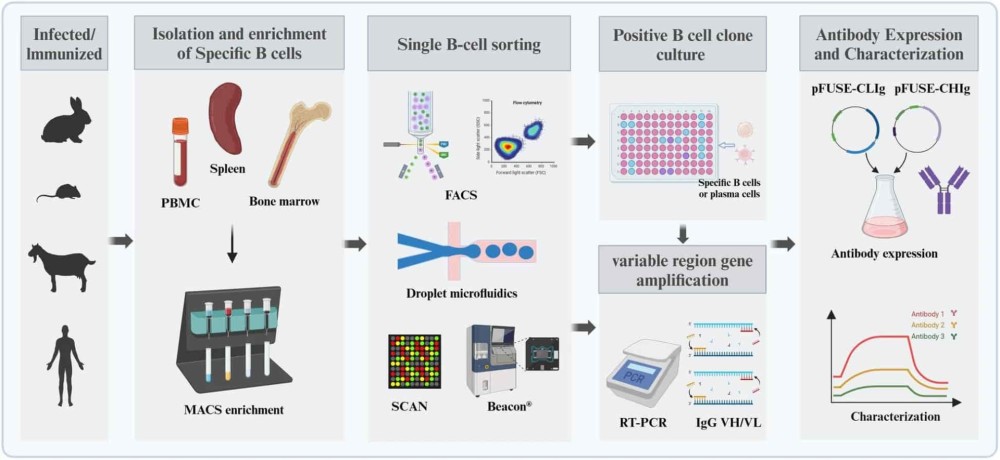
Human monoclonal antibodies, including fully human monoclonal antibodies, can be generated using two primary technologies: phage display and transgenic mice. While phage display technology is a powerful method for generating human antibodies in vitro, using transgenic mice offers distinct advantages, particularly for single-cell B-cell screening strategies and therapeutic applications.
Transgenic mice are engineered to carry human immunoglobulin genes, often using genomic replacement or gene deletion strategies to remove murine antibody components. This enables them to produce fully human antibodies through a natural immune response. These antibodies undergo in vivo selection and maturation processes, which means they benefit from the animal's natural immune mechanisms. This results in antibodies that are more likely to be effective in humans, as they have already undergone a form of preselection and refinement within a living organism.
At the core of Cyagen's HUGO-Ab™ mice is their TurboKnockout® gene editing technology. This next-generation technology enhances the development of transgenic mouse models by addressing the limitations of traditional genetic modification techniques.
Precision and Stability: TurboKnockout® retains the precision and stability of embryonic stem (ES) cell targeting, a traditional method known for its accuracy. However, it overcomes the inefficiencies, long timelines, and potential off-target effects that are often associated with CRISPR technology. This makes TurboKnockout® particularly effective for creating complex genetic modifications, such as the knock-in or knockout of large gene segments.
Reduced Breeding Cycle: TurboKnockout® significantly shortens the breeding cycle by bypassing the "chimeric" stage and employing a unique self-deleting Neo cassette. This innovation reduces the time required to produce fully human antibodies to as little as four months, accelerating the development process and reducing costs.
Large Fragment Gene Editing: TurboKnockout® allows for the precise editing of large gene fragments, enabling the creation of sophisticated humanized mouse models that are crucial for generating fully human antibodies. This capability is particularly important for developing whole-genome humanized mice, which are essential for the production of diverse and robust antibody repertoires.
Our High-throughput Fully Human Antibody Discovery Platform integrates HUGO-Ab™ mice with Biointron’s AbDrop™ microdroplet-based single B cell screening. This powerful combination accelerates the discovery and development of fully human antibodies, reducing the time from target identification to therapeutic candidate to just three months.
The future of medicine is increasingly oriented toward the development of therapies that are not only highly effective but also tailored to individual patient needs. Fully human antibodies are central to this shift toward personalized medicine. Their reduced immunogenicity and enhanced efficacy make them ideal candidates for treating a wide range of diseases, from cancer to autoimmune disorders and beyond.
As the demand for fully human antibodies continues to grow, Biointron and Cyagen’s innovative platform will be instrumental in the development of high-throughput therapeutic antibodies. Companies looking to stay ahead in the competitive field of drug development should consider partnering with us to harness the full potential of fully human antibodies. Learn more about the service here.
Biointron announces limited-time RushData launch pricing for high-throughput ant……
August 2026 brought another mix of acquisitions, licensing agreements, strategic……
Antibody discovery often begins with a highly diverse population of B cells, onl……
As larger candidate panels move from computational design into the laboratory, a……