


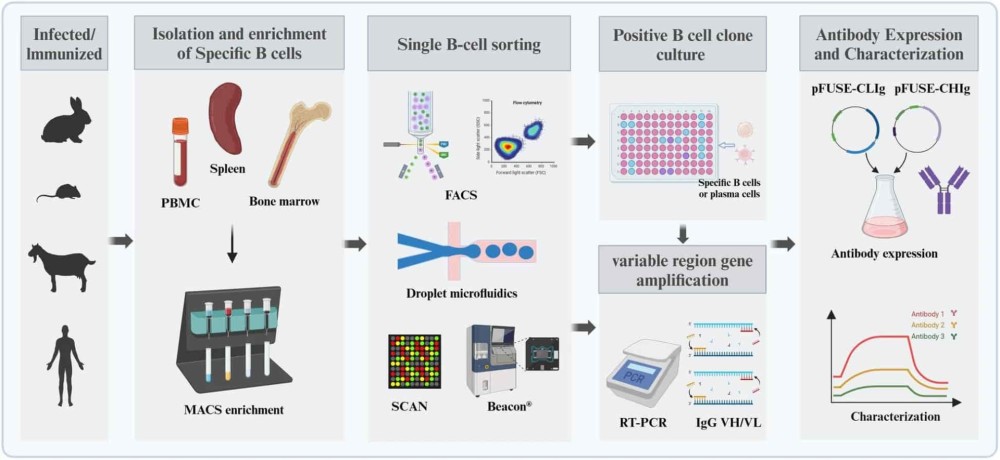


Monoclonal antibodies (mAbs) are useful therapeutic antibodies for targeted treatments in oncology, autoimmune diseases, and infectious diseases. Among the key distinctions in therapeutic monoclonal antibodies (mAbs) are those labeled "fully human" and "humanized." Both rely heavily on animal models (primarily mice), and they differ in sequence origin, immunogenicity profiles, and engineering workflows. The choice affects efficacy, safety, and time-to-candidate, with anti-drug antibodies (ADAs) and Fc engineering as major levers in modern antibody therapy and cancer treatment.
Fully human mAbs are antibodies whose variable and constant regions align with human germline sequences. They are commonly generated in transgenic mice carrying human immunoglobulin loci and then selected using high-throughput single-B cell methods. Clinically, they aim to lower immunogenicity while maintaining developability. Each antibody’s heavy chain pairs with a light chain to create a specific paratope, supporting durable antibody therapy.
Humanized mAbs start from mouse antibodies. Developers transplant mouse complementarity-determining regions (CDRs) onto human framework regions (CDR grafting). Targeted back-mutations may be introduced to restore paratope geometry and affinity. Humanized antibodies typically reduce, but do not eliminate, immunogenicity relative to chimeric antibodies. Production commonly involves CHO cells and suitable expression vectors for stable expression.
Fully human mAbs are derived from transgenic mice that carry human immunoglobulin genes. The process begins by immunizing these transgenic mice with the target antigen, which might be a protein related to a disease pathway. After the mice's immune system produces antibodies against the antigen, the genetic sequences responsible for the antibodies are isolated and engineered for therapeutic use as therapeutic antibodies. The Chinese hamster ovary (CHO) cells are then used to produce large quantities of these antibodies.
Transgenic mice offer a unique advantage by providing a humanized immune system context. This allows antibodies to undergo natural immune diversification and selection, akin to that in the human body, resulting in highly efficacious antibodies suitable for therapeutic use due to their high affinity and low immunogenicity. Discovery may be complemented by phage display and curated antibody libraries, and alternative antibody fragments such as VHH antibodies can be profiled for specific applications.
On the other hand, humanized mAbs start with a wild-type mouse, which carries its natural mouse immunoglobulin genes. These mice are immunized similarly, but the resulting antibodies are not immediately suitable for human use because they are fully mouse-derived. To create a humanized mAb, the complementarity determining regions (CDRs)—the parts of the antibody that bind to the target—are transplanted onto a human antibody scaffold. The resulting hybrid antibody contains human framework regions but retains mouse-derived regions responsible for antigen binding. Depending on program needs, developers may generate Fab fragments as part of characterization, alongside other antibody fragments for mechanism studies.
Related: What is Antibody Humanization?
One of the critical concerns with both fully human and humanized mAbs is the potential for patients to develop Anti-Drug Antibodies (ADAs). ADAs can neutralize the therapeutic monoclonal antibodies, reducing their efficacy or causing adverse reactions. Factors like the overall sequence of the antibody, glycosylation patterns, and patient-specific immune responses all play a role in eliciting ADAs. ADA monitoring spans indications such as rheumatoid arthritis, systemic lupus, and other inflammatory disease states, and is also relevant in immunology settings like transplant rejection and broader cardiometabolic contexts, including cardiovascular disease.
While much of the focus in mAb development has historically been on antigen-binding affinity, other molecular traits are now receiving attention. Modern molecular engineering allows for optimization beyond just the binding strength of the antibody. For example, developers can improve the stability of monoclonal antibodies, extending their shelf life and making them more resilient to the manufacturing process. Similarly, efforts are made to reduce immunogenicity by fine-tuning the antibody's interaction with the immune system, often targeting regions outside of the CDRs, such as the constant (Fc) region.
The Fc region, responsible for mediating interactions with immune cells and other components of the immune system, can also be engineered for improved therapeutic outcomes. Altering glycosylation patterns in this region, for instance, can enhance the antibody’s half-life or modulate its effector functions, such as antibody-dependent cellular cytotoxicity (ADCC). These functional improvements are vital in creating monoclonal antibodies that not only bind effectively but also exhibit optimal therapeutic activity with minimal side effects.
Choosing between fully human and humanized approaches depends on available assets, risk tolerance, speed requirements, IP constraints, and developability goals. Across indications, iterative antibody evolution and data-driven antibody optimization shape final candidate selection. Use this checklist to align scientific and operational priorities.
Source assets: If you already have well-characterized mouse binders, antibody humanization can shorten optimization while preserving epitope-paratope geometry. For novel targets or when you want human germline diversity from the start, fully human discovery in transgenic models paired with single-B screening is efficient.
Risk posture: Fully human sequences often lower, but do not eliminate, immunogenicity risk. Both routes still require liability screening (e.g., in silico T-cell epitope mapping, MHC-II binding risk, glycan/PTM assessment). Humanized programs should also review framework back-mutations and consider deimmunization where needed.
Timeline & scale: High-throughput single-B and NGS workflows can compress the discovery cycle for fully human leads. Humanized routes are faster when legacy mouse antibodies and assay packages already exist. Factor in downstream CMC impacts (expression, stability, yield) when comparing schedules.
IP & freedom to operate: Evaluate constraints around transgenic strains, human germline usage, framework families, Fc variants (e.g., LS/YTE/LALA), and glyco-engineering claims. Run Freedom to Operate (FTO) early to avoid late-stage redesigns.
Developability: Prioritize early triage for aggregation propensity, viscosity risk, charge variants/isoelectric point, chemical liabilities (e.g., deamidation, oxidation), and glycan profile. Choose the route that minimizes re-engineering to meet stability and manufacturability targets.
Related: Afucosylated Antibodies: Mechanism of Action and Therapeutic Applications
Our High-throughput Fully Human Antibody Discovery Platform integrates Cyagen’s HUGO-Ab™ mice with Biointron’s AbDrop™ microdroplet-based single B cell screening. This powerful combination accelerates the discovery and development of fully human antibodies, reducing the time from target identification to therapeutic antibody candidate to just three months. Learn more about the service here.
References:
Lotus Mallbris, Davies, J., Glasebrook, A., Tang, Y., Wolfgang Glaesner, & Nickoloff, B. J. (2016). Molecular Insights into Fully Human and Humanized Monoclonal Antibodies: What are the Differences and Should Dermatologists Care? The Journal of Clinical and Aesthetic Dermatology, 9(7), 13. https://pmc.ncbi.nlm.nih.gov/articles/PMC5022998/
Biointron announces limited-time RushData launch pricing for high-throughput ant……
August 2026 brought another mix of acquisitions, licensing agreements, strategic……
Antibody discovery often begins with a highly diverse population of B cells, onl……
As larger candidate panels move from computational design into the laboratory, a……