



Over the past four decades, antibody discovery platforms have transformed biotherapeutics. Hybridoma technology, developed in 1975, pioneered the production of monoclonal antibodies, while more recent advances in single B cell screening have expanded access to rare, high-affinity clones. The COVID-19 pandemic accelerated the adoption of high-throughput screening methods, reinvigorating global efforts to enhance antibody discovery pipelines for infectious disease and beyond.
Hybridoma technology remains one of the earliest and most widely adopted approaches. By fusing B cells with immortalized myeloma cells, hybridomas produce stable antibody-secreting clones. This approach preserves the natural heavy and light chain pairing and has been instrumental in generating dozens of FDA-approved therapeutic antibodies, including Muromonab-CD3 in 1986. Its reliability and proven track record make hybridomas attractive for certain applications, though inefficiencies in fusion limit throughput. Typically, only one viable antibody-secreting hybridoma is generated per 100,000 fused cells, constraining discovery potential.
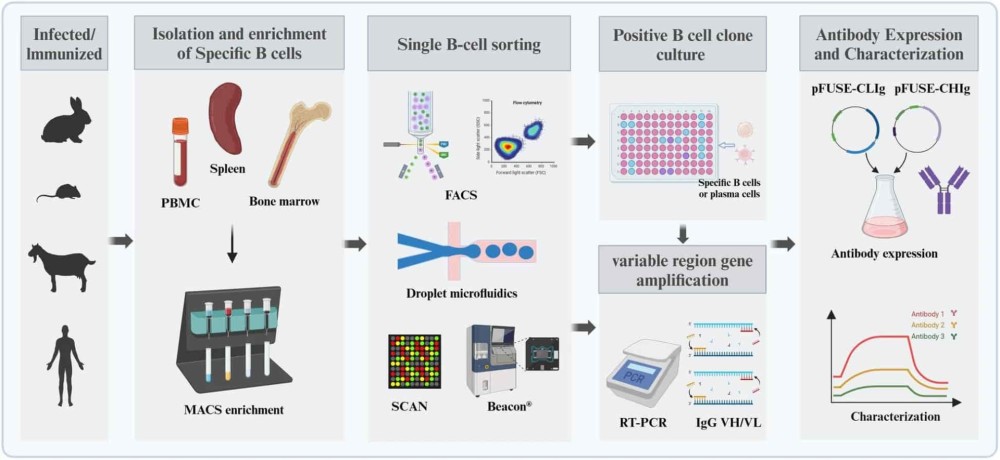
Single B cell screening emerged as a higher-efficiency alternative. Using fluorescence-activated cell sorting (FACS), antigen-specific B cells are isolated and subjected to reverse transcription–polymerase chain reaction (RT–PCR) for paired VH and VL gene amplification. Cloned and expressed antibodies undergo downstream screening to evaluate binding, neutralization, and developability. This workflow bypasses the bottlenecks of cellular fusion, accelerates timelines, and maintains native heavy/light chain fidelity. Importantly, it allows access to human donor repertoires, enabling the identification of therapeutic antibodies against HIV, respiratory syncytial virus (RSV), and other pathogens.
In parallel with cell-based approaches, surface display methods such as phage and yeast display have contributed to therapeutic antibody pipelines. These methods enable the conversion of immune repertoires into large libraries, supporting iterative rounds of selection based on affinity and specificity. Phage display was central to the discovery of adalimumab (Humira), a top-selling therapeutic antibody.
While surface display methods are scalable and compatible with both antigen-experienced and naïve repertoires, they lack the physiological context of B cell–derived antibodies. Affinity-matured clones generated in vivo may be missed when working exclusively with synthetic repertoires. As such, display technologies serve as valuable complements rather than replacements for single B cell–based discovery.
Recent innovations have significantly improved the efficiency, throughput, and resolution of single B cell screening. Several technologies are transforming discovery workflows:
LIBRA-seq (Linking B Cell Receptor to Antigen Specificity through Sequencing)
LIBRA-seq integrates DNA barcoding and next-generation sequencing to directly link antibody sequences to antigen specificity. By exposing B cells to barcoded antigens and processing them through droplet microfluidics, investigators can match VH/VL gene sequences to antigen-binding profiles. LIBRA-seq has identified broadly neutralizing antibodies against HIV, SARS-CoV-2, and hepatitis C virus. Moreover, it supports epitope-specific profiling, enabling targeted antibody selection. Limitations remain in predicting affinity, but LIBRA-seq provides a powerful framework for high-throughput antigen mapping.
TRAPnSeq
This barcoding-based approach captures secreted antibodies from antibody-secreting cells, enabling the sequencing of IgEs and IgGs. Unlike LIBRA-seq, TRAPnSeq accommodates cells beyond memory B cells, making it particularly relevant for profiling antibodies in allergy research.
Beacon platform (NanoPen technology)
The Beacon platform employs optofluidics to guide individual plasma cells into nanoliter-scale chambers for culture and functional interrogation. This allows simultaneous assessment of secretion, antigen binding, ligand blocking, and specificity across tens of thousands of B cells. In COVID-19 research, Beacon identified antibodies that blocked ACE2 binding to SARS-CoV-2, reducing discovery timelines from weeks to days. The platform has also been adapted for the discovery of VHH antibodies, cross-reactive binders, and anti-idiotypic antibodies.
Other nanowell and micromanipulation-based systems
Complementary approaches miniaturize screening further, enabling the direct visualization and isolation of antigen-specific cells. Together, these emergent platforms expand the resolution and speed of B cell screening workflows.
Related: Single B Cell Screening
The COVID-19 pandemic highlighted the need for accelerated antibody discovery pipelines. Single B cell screening was central to the rapid development of therapeutic antibodies, including:
Bebtelovimab and bamlanivimab. Identified from convalescent donors, these antibodies target the SARS-CoV-2 spike protein and block ACE2 receptor binding. Bebtelovimab, in particular, maintained potency against multiple variants of concern.
Sotrovimab (S309). Derived from SARS-CoV memory B cells collected years before the pandemic, sotrovimab demonstrated cross-neutralizing activity against both SARS-CoV and SARS-CoV-2.
These case studies demonstrate how single B cell screening enables the recovery of rare clones with broad reactivity and therapeutic potential. The same approaches are now being applied to HIV, Zika, and RSV, broadening the scope of antibody-based interventions.
One of the primary advantages of single B cell screening is access to low-frequency B cell populations. Rare clones often exhibit unique epitope recognition or enhanced neutralization potency but are typically masked in bulk population analyses. By isolating individual cells, researchers can recover antibodies that would otherwise remain undetected.
Immune responses often bias toward immunodominant epitopes, which may not confer optimal therapeutic properties. Careful antigen design and adjuvant strategies mitigate this limitation, enabling the discovery of antibodies with broader functional coverage. This enhanced diversity contributes to richer antibody libraries, providing a stronger foundation for therapeutic development.
Traditional antibody discovery workflows focus primarily on affinity and specificity. However, therapeutic relevance often depends on functional activity, such as receptor agonism, ligand blocking, or signaling inhibition. Integrating functional assays into early discovery is a growing priority.
Platforms such as CytoMine, a microfluidic tool, enable the functional screening of antibody-secreting cells prior to sequencing. Biointron's AbDrop service uses microfluidics for single B cell screening.

Next-generation sequencing (NGS) datasets generated from single B cell screening offer opportunities for computational integration. Bioinformatics enables repertoire analysis, while machine learning models predict antibody binding, stability, and developability.
LIBRA-seq datasets are particularly valuable for training algorithms that connect antibody sequence with antigen specificity. Such predictive models hold potential for expediting antibody discovery, humanization, and optimization. As computational and experimental platforms converge, workflows will become increasingly efficient and predictive.
Despite significant progress, challenges remain in scaling emergent single B cell technologies. High equipment costs and specialized expertise slow adoption across the biotech industry. Moreover, different platforms often identify distinct sets of antibody leads, underscoring the need for multimodal approaches.
Future directions include:
Incorporating broader functional screening capabilities.
Expanding epitope diversity through antigen design.
Enhancing predictive computational models for antibody optimization.
Combining single-cell technologies with synthetic biology for accelerated engineering.
The ultimate objective is to reduce the timeline from immunization to therapeutic candidate selection, enabling rapid responses to future infectious disease outbreaks.
To meet the demand for faster and more comprehensive antibody discovery, Biointron has developed AbDrop™, a microfluidic-based single B cell screening platform. AbDrop™ combines high-throughput screening, broad antibody diversity, and rapid timelines to support biotechnology and pharmaceutical partners in therapeutic discovery.
High-Throughput: AbDrop™ screens up to two million plasma B cells within a single day. Using picoliter-scale droplet encapsulation, the platform detects antibody secretion within hours while preserving cell viability. This enables single-round screening at unprecedented scale and sensitivity.
High Diversity: The platform supports a wide range of species, including wild-type mice, humanized mice (HUGO-Ab™), rats, and rabbits. It is validated across diverse target classes, such as cytokines, viral proteins, and transmembrane proteins, making it suitable for both standard and challenging projects.
Short Timelines: With AbDrop™, naturally paired heavy and light chain sequences can be obtained within one week. Comprehensive antigen–antibody validation is achieved within three months, significantly accelerating the transition from discovery to preclinical development.
Integrated Workflow: AbDrop™ streamlines the entire discovery pipeline—from immunization and plasma cell enrichment to single-cell sequencing, high-throughput expression, and functional validation. Assays such as ELISA, SPR, and FACS provide comprehensive characterization of binding and activity.
By combining throughput, diversity, and speed, Biointron’s AbDrop™ offers a robust platform for antibody discovery in therapeutic, vaccine, and diagnostic applications. For biotech and pharmaceutical organizations, AbDrop™ represents an efficient and scalable solution to accelerate the identification of therapeutic-quality antibodies.
References:
Schardt, J. S., Sivaneri, N. S., & Tessier, P. M. (2024). Monoclonal Antibody Generation Using Single B Cell Screening for Treating Infectious Diseases. BioDrugs, 38(4), 477–486. https://doi.org/10.1007/s40259-024-00667-0
Biointron announces limited-time RushData launch pricing for high-throughput ant……
August 2026 brought another mix of acquisitions, licensing agreements, strategic……
Antibody discovery often begins with a highly diverse population of B cells, onl……
As larger candidate panels move from computational design into the laboratory, a……